
Acquiring early modern books for KB, national library of the Netherlands
by Marieke van Delft, former curator of the KB, national library of the Netherlands
Share this article
On 16 March 2021, my long career in the library field ended. From 1978 I was an employee of the KB, national library of the Netherlands, the last sixteen years as a curator of Early Printed Editions at the Department of Collections. As a curator one has many tasks, one of which is the acquisition of new objects to expand the collections for which you are responsible, which in my case was the collection of books printed before 1800. Of course, one does not start from scratch. The collections of the KB have grown since its founding in 1798 and as a general rule one is expected to build upon on this, bearing in mind that the collection focus can shift because of the acquisition of large collections with a special theme or developments over time.
In the KB-collection of early modern books some themes can be seen. The KB hosts the largest collection of incunabula in The Netherlands (ca. 2,250 items) and my predecessors were very active in the field of incunabula research. Early 16th-century books were into focus as well. During my curatorship I managed to acquire some rare or even unique incunabula. The most important of these was the acquisition of Le recueil des histoires de Troyes (Haarlem: Jacob Bellaert, 1485-1486), which was written in 1464 by Raoul Le Fèvre, who was the chapelain of Philip te Good, Duke of Burgundy, until his death in 1467. The work is very important in the history of The Netherlands because it was printed at a time when queries about the legitimacy of the power of the Burgundians caused unrest in society. Another element that gives the item its importance is the design of the book. Jacob Bellaert had beautiful woodcuts made for this work and another text of Le Fèvre, the Histoire de Jason. Both works are known to have been published in French and Dutch but none of the editions were in a Dutch public collection. That made this acquisition extra important.
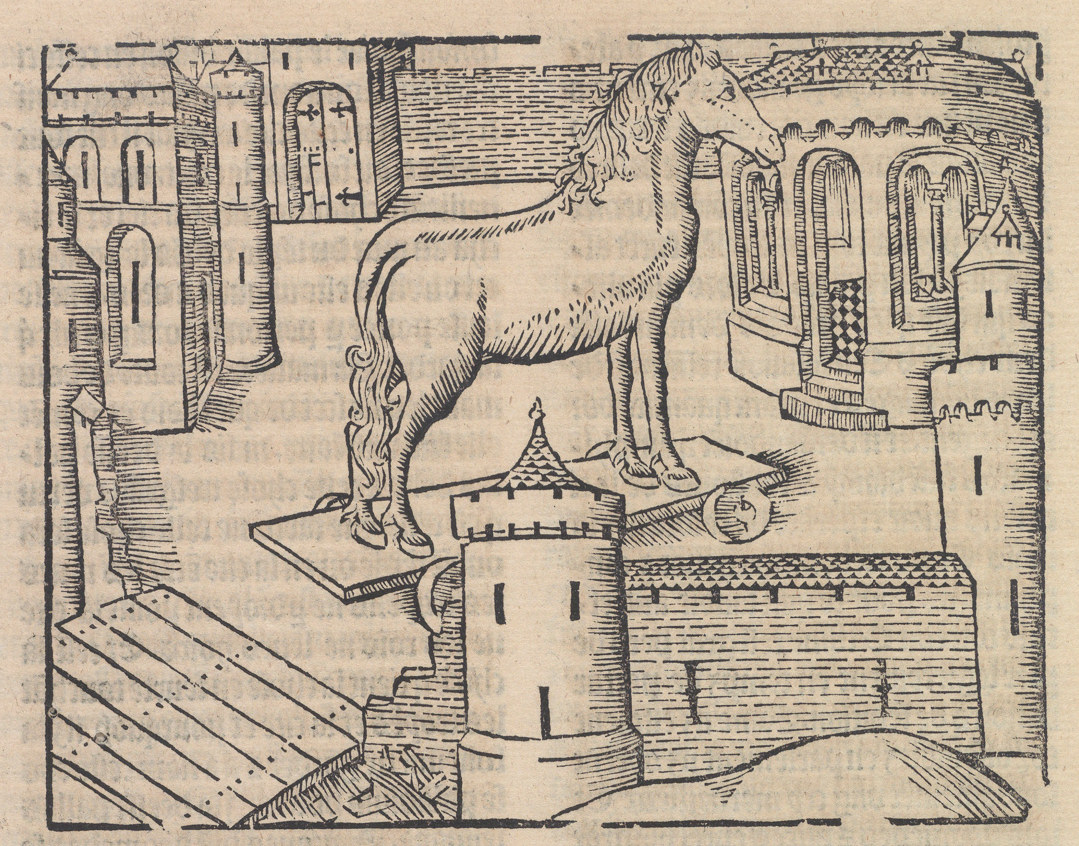
The Trojan horse in Le recueil des histoires de Troyes (Haarlem: Jacob Bellaert, 1485-1486, fol. 183v.
Digital copy
Another important purchase happened towards the end of my career, in corona times. In December 2020, I was able to acquire a unique Indulgence Calendar [Deventer, Jacobus de Breda, ca. 1516], with the woodcut Medici coat of arms of Pope Leo X. This is, as it were, a travel guide to Rome indicating the days throughout the year when indulgences of various kinds could be ‘earned’ when visiting the Holy City, either at the seven ‘station churches’ in Rome or at churches elsewhere. This broadside was on sale at the Dutch antiquarian Menno Hertzberger and seen there by M.E. Kronenberg in 1942 when she compiled her bibliography of early sixteenth century books of the Low Countries. It then was acquired by the directors of the publishing firm of Tjeenk Willink and after his death in 1994 on the market again. Both my predecessor Gerard van Thienen and I considered to buy it before but hesitated because of the price – but now I did. It is a key document in the history of the Reformation because it was printed around 1516, the year before Martin Luther started his crusade against indulgences in Wittenberg.
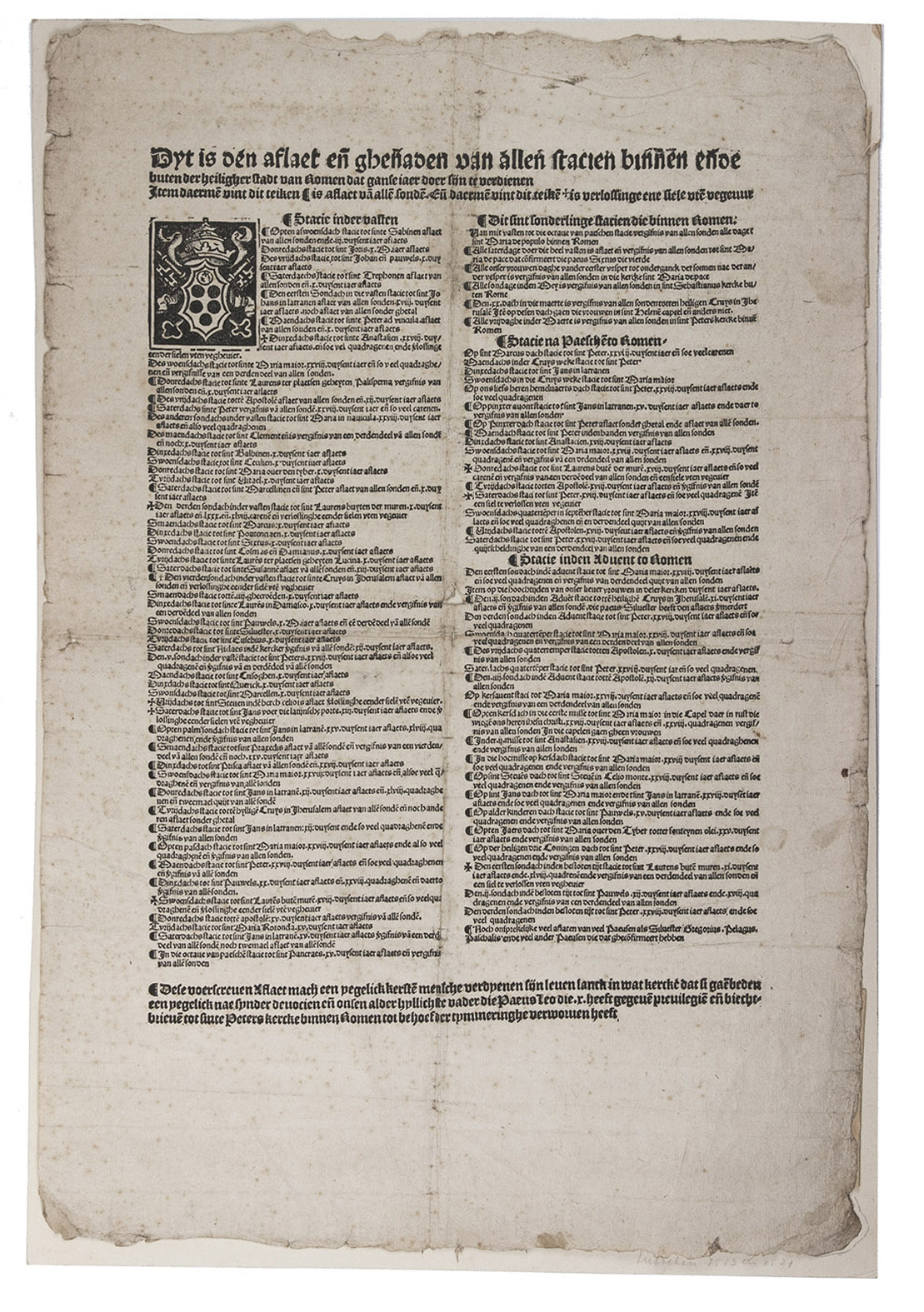
[INDULGENCE CALENDAR – LEO X]. Dyt is den aflaet en[de] ghenaden van allen stacien binnen ende buten der heiligher stadt van Romen dat ganse jaer doer sijn te verdienen. [Deventer, Jacobus de Breda, ca. 1516]. Broadside (small 1mo) (42.5 x 29.5 cm)
Besides these two very early books, other items can make a difference. That is the case with a 2010 acquisition– a beautiful town atlas produced in 1698 by the Amsterdam cartographer and seller of prints, Frederick de Wit, the Theatrum ichnographicum omnium urbium et præcipuorum oppidorum Belgicarum XVII Provinciarum peraccurate delineatarum. The atlas had been in private hands for many years but the family wanted to safeguard it and offered it to the KB to make sure that it would be kept in perfect conditions. Our contact started with an email that included images of beautifully colored maps, but the view of the real thing surpassed this by far. The book holds 112 leaves with maps and 12 leaves with city views, depicting a total of 151 cities from the Low Countries (today’s Belgium and The Netherlands) and even some from Northern France. All maps are colored by hand and as is the case with maps in books – all colors are still very intense because light does not enter closed books!
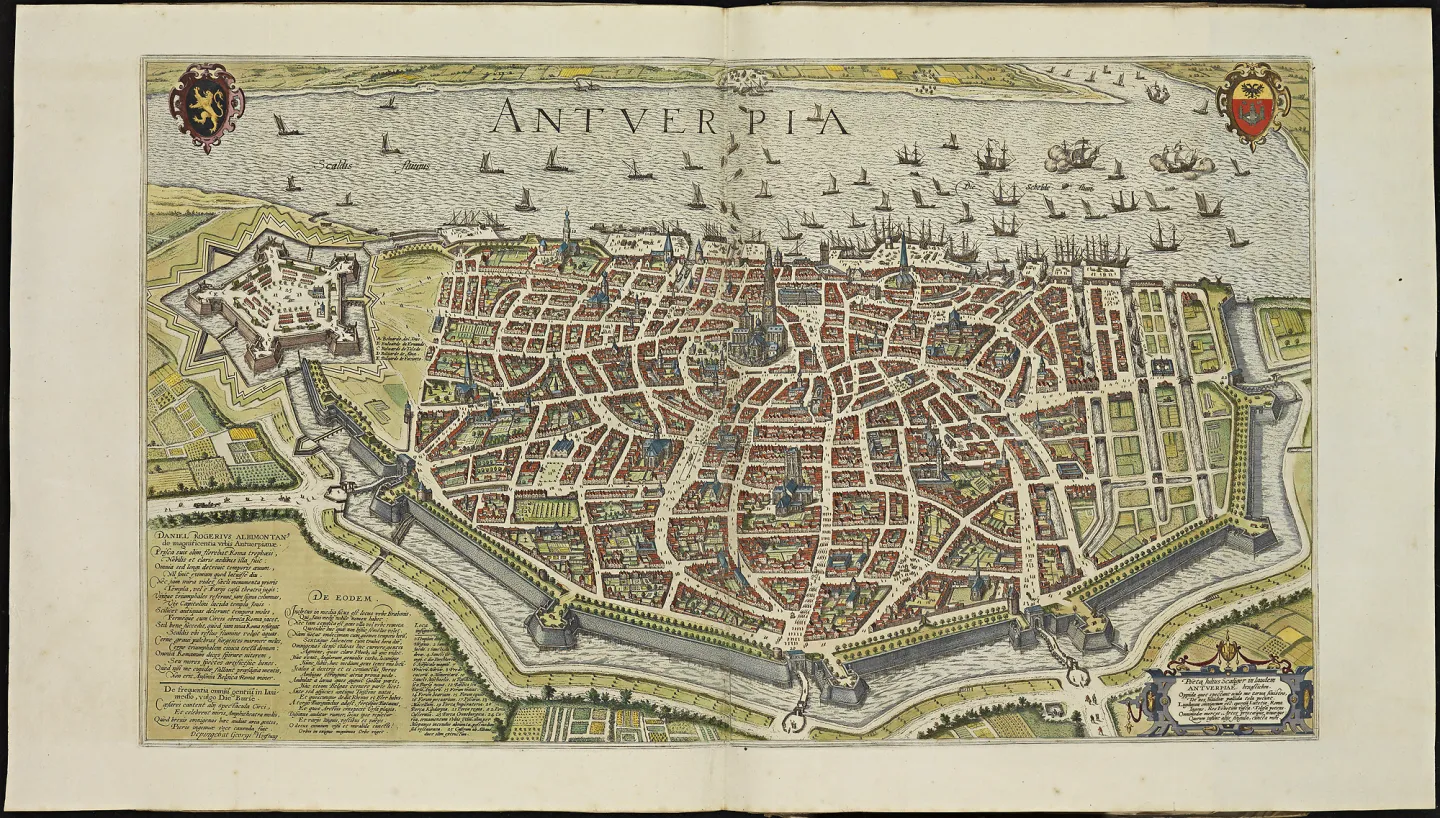
Antwerp in the Theatrum ichnographicum omnium urbium et præcipuorum oppidorum Belgicarum XVII Provinciarum peraccurate delineatarum (Amsterdam: Frederick de Wit, ca. 1698), p. 071. This is the largest map in the book, the only one printed on two leaves
Digital copy
If one talks about Dutch map production in the seventeenth century, the name of Joan Blaeu always pops up. But De Wit and other map makers have also contributed very much to the history of Dutch cartography. De Wit was a keen business man and continued the work of Blaeu and Blaeu’s major competitor Johannes Janssonius, not in the least because he was able to buy the map’s copperplates of both predecessors. He expanded and adjusted these and used them for his own books such as this town atlas.

The acquisition of this book did not only enrich the KB collection, but was also the starting point of a very successful collaboration with the Flemish publishing firm Lannoo in producing facsimiles of books from the collection of the KB. Together we published a facsimile of the De Wit atlas (you might like to view this video in Dutch), but after that also of the book Nederlandsche vogelen of Nozeman & Sepp, an eighteenth-century book on birds in The Netherlands (video in Dutch) and the book on the butterflies and plants in Surinam by Maria Sybilla Merian that originally was published in 1705 (video in Dutch and English and another video / Facsimile of Maria Sibylla Merian. Metamorphosis insectorum Surinamensium. Tielt/The Hague: Lannoo/KB, 2016. Texts in Dutch and English; in 2017 a German version was published).
After these examples, one can wonder: is buying very expensive, rare and important books the main task of a curator? No, it is not. Obviously, a curator has many more tasks such as participating in projects – in my case the STCN, WILC, Bibliopolis and CERL (MEI and the CERL PDA), presenting the collection via articles, books, lectures, blogs, podcasts and educating young professionals through teaching and internships, and working with colleagues to see to it that the collections are well preserved.
Still, collection forming has to play a role, particularly since the KB as the national library of The Netherlands tries to make sure that the national heritage of The Netherlands is preserved, in the KB or elsewhere, preferably in a public collection in The Netherlands, so that Dutch researchers or researchers from abroad can reach the research the books without too much effort. Additionally, we should note in all honesty that acquisitions are not always as glamorous and remarkable as the ones highlighted above.
To investigate whether a book is in a Dutch public collection, The Netherlands has a magnificent tool that is still expanded daily, the Short-Title Catalogue Netherlands (STCN), the Dutch pre-1800 bibliography. The utopian purpose of this bibliography is that at some point, all books that were ever printed in The Netherlands will be included, whether they are present in The Netherlands or in major collections abroad such as the British Library. We all know that this will be impossible: not all books have survived and the ones that did, are not all available in public collections. When looking for books to acquire for the KB, I always tried to lay my hands on material that was not yet included in STCN – or only present in collections outside The Netherlands. And my second aim was to acquire rare books. So, I also checked international catalogues such as CERL’s Heritage of the Printed Book (HPB) database and other catalogues to see whether a book is rare or not and then tried to acquire rare or unique titles.
In total, I was able to acquire some 2,500 to 3,000 early modern books since I started as a curator, some by antiquarian purchases or at an auction, others as gifts. Even while I made sure to add to the collections that have traditionally been KB focus areas such as almanacs, occasional poetry, travel books, books printed in The Hague, I also made it my task to acquire books not yet present in the STCN or not yet available in any Dutch public collection. People that follow me on Twitter (see @Marieke1954, tweets in February and March 2021) have seen the results. Let me share some examples with you here, as well.
In 2017 a long-lost treatise on lenses, anonymously published, but written by the Dutch mathematician and later Amsterdam burgomaster Johannes Hudde, Specilla circularia, (Leiden? 1656) could be purchased by the KB at an auction by Christie’s in London: 8 pages that caused great excitement in Dutch academic circles.
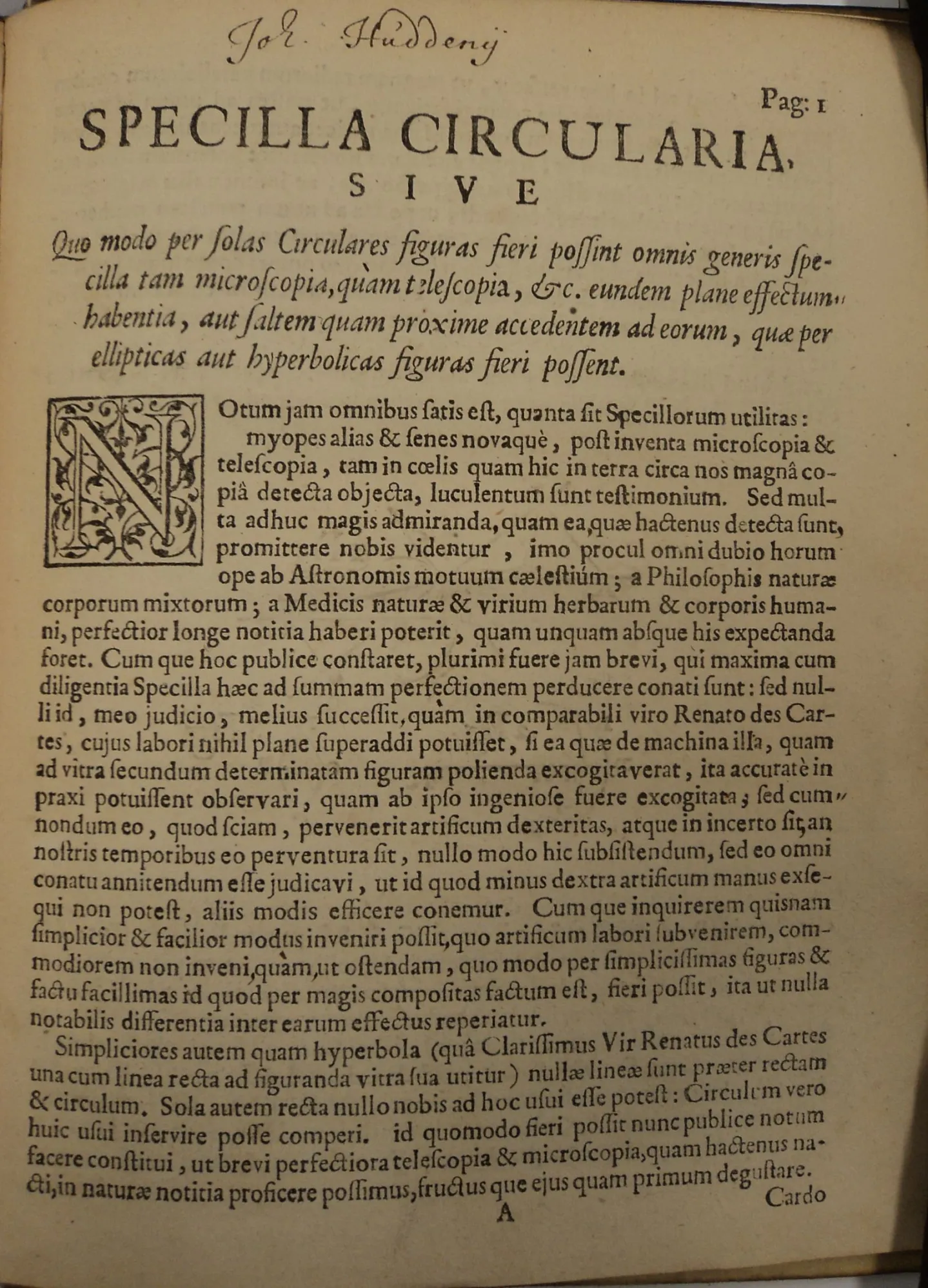
Johannes Hudde, Specilla cicularia (Leiden? 1656)
Digital copy
One of the many almanacs that were added to the collection of the KB in the last years is the Nouvel almanach agreable de Saint Nicolas, pour la présente année, Part 1. Mastricht, sold by Gand, Ph. and P. Gimblet, [1799]
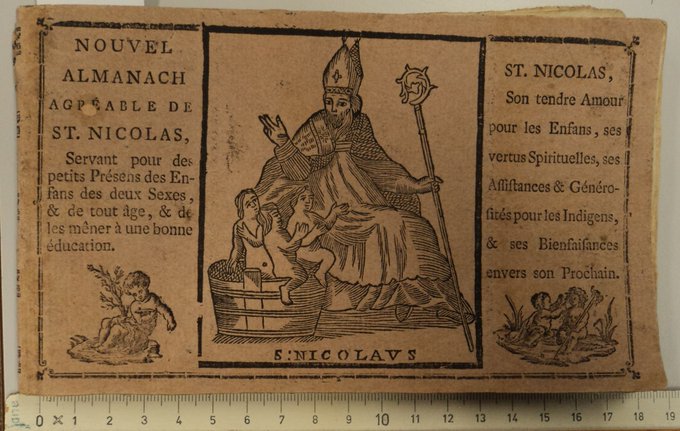
Nouvel almanach agreable de Saint Nicolas, pour la présente année, Part 1. Mastricht, sold by Gand, Ph. and P. Gimblet, [1799]
In 2013 the KB acquired an erotic work Akademie der dames or vermakelyke gesprekken van Alosia [Academy of ladies or entertaining talks] with very explicit images and the (for obvious reasons) fictitious imprint Paphos ca. 1770.
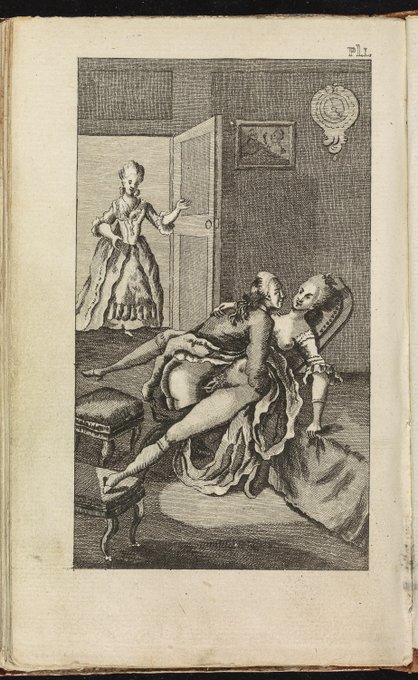
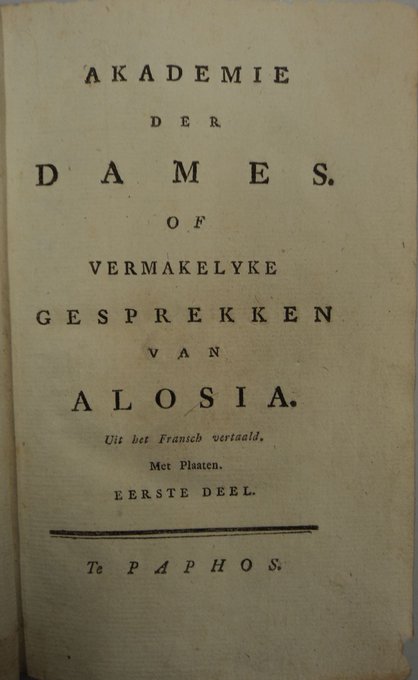
Akademie der dames or vermakelyke gesprekken van Alosia [Academy of ladies or entertaining talks] Paphos, ca. 1770
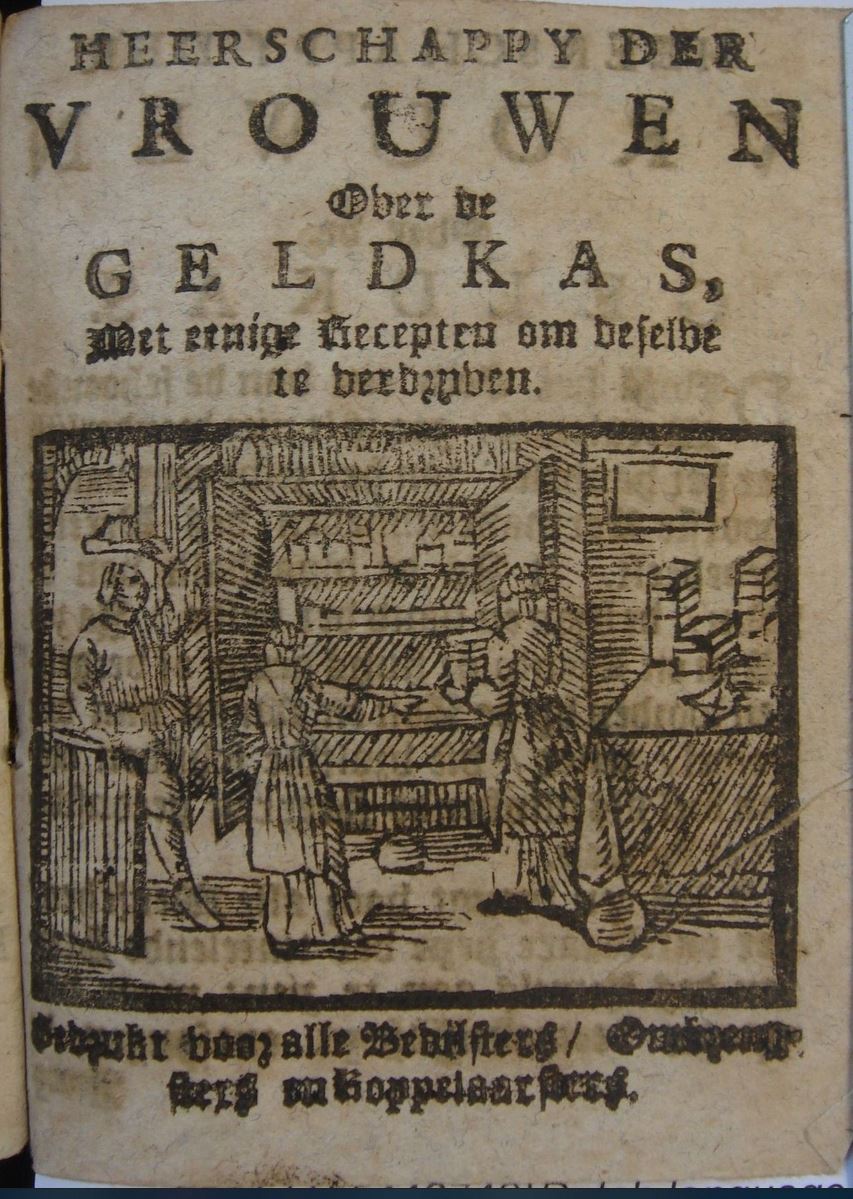
But I was equally pleased to lay my hands on many lesser-known works such as a booklet derived from an almanac from 1787 Heerschappy der vrouwen over de geldkas [the reign of women over money], a fully unknown edition of the alchemist J.F. Helvetius, Urims and Thumims (‘sGravenhage, printed by H. Groenhout, 1693), two unknown Dutch songbooks: ‘t Maes-Sluysche Lust-hofje (1684) en De wel-klingende luyte (1647).
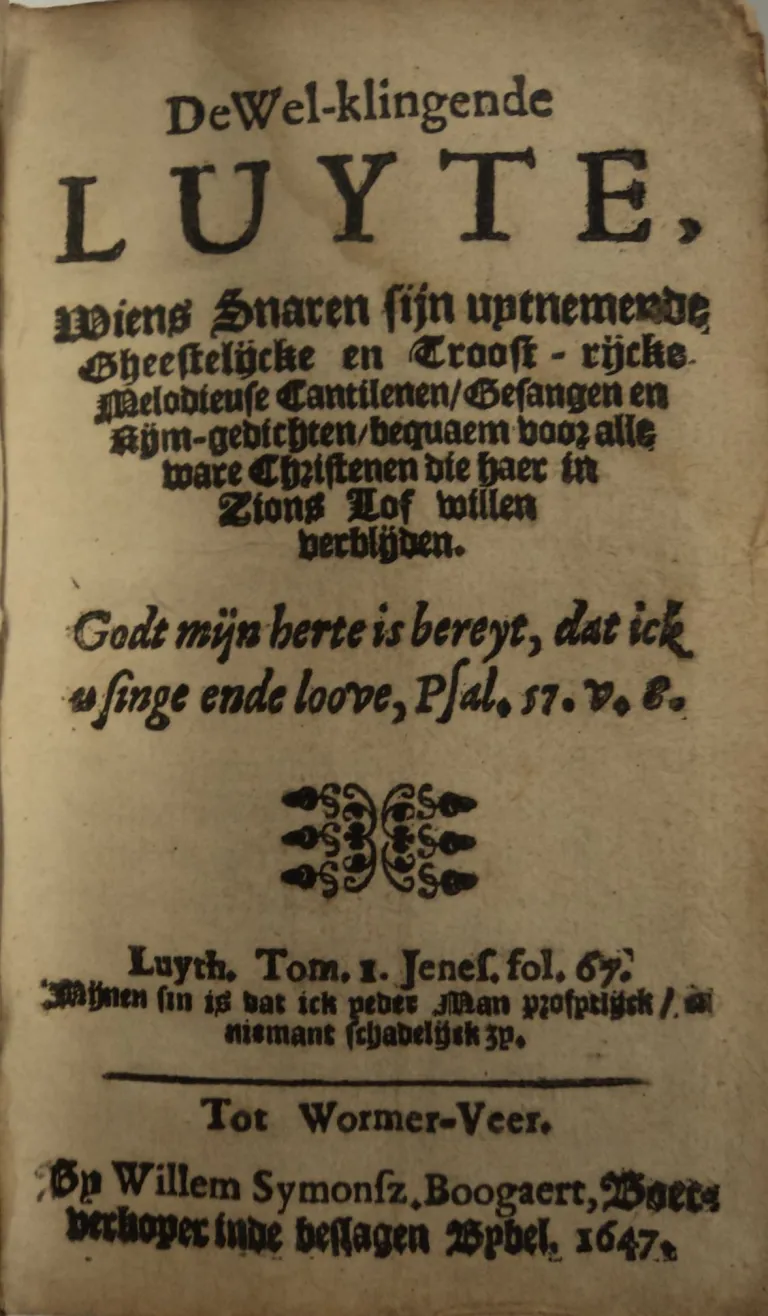
Do not worry: I will not sum up all early modern books that entered the KB during my curatorship. This blog and the short list of examples is to show the variety of books that were added to the KB-collection during my curatorship and illustrate the process of deciding which early modern books from the broad field of Dutch heritage were acquired by the KB to be safe for the future – and of course all of this depends on the availability of certain books on the antiquarian book market.


MvD singing a song from
t Maes-Sluysche Lust-hofje (1684)
Related articles
by Markéta Kučerová and Vojtěch Šícha, Library of the Czech Academy of Sciences
November 9, 2026
by Konrad K. Szymański (Ossolineum National Library, Wrocław)
November 9, 2026