
Early Origins
The origins of CERL can be traced to the late 1980s, when European library leaders recognised the need for a central database to make printed heritage more widely accessible. The first exploratory meeting took place in Munich in 1990, bringing together major national and research libraries. Out of these discussions grew a consensus to create a collaborative framework for sharing bibliographical data across borders, supported by the momentum of European integration following the fall of the Berlin Wall.
Incorporation and Database Development
In 1992, an interim consortium was formed, and on 24 June 1994 CERL was formally incorporated in London as a company limited by guarantee. This gave CERL a legal foundation, with fourteen founding members and the ability to contract services, appoint directors, and employ staff. Early decisions focused on building the Hand Press Book Database (HPB), which integrated records from national catalogues and retrospective bibliographical projects such as the ESTC, STCN, and ISTC. By 1997, the HPB was available online, marking a breakthrough in access to Europe’s printed heritage.
From left to right, sitting, are Dr Ann Matheson (National Library of Scotland, Edinburgh), Dr Mike Smethurst (CERL Chairman and Director-General, British Library), Mr Philippe Bélaval (Director Général, Bibliothèque nationale de France, Paris), and Dr Hermann Leskien (Director, Bayerische Staatsbibliothek, Munich). Standing: Mr Chris Kirk (Consultant, KC Switch Enterprises Ltd, London) and Dr Lotte Hellinga (CERL Secretary and Deputy Keeper, British Library).
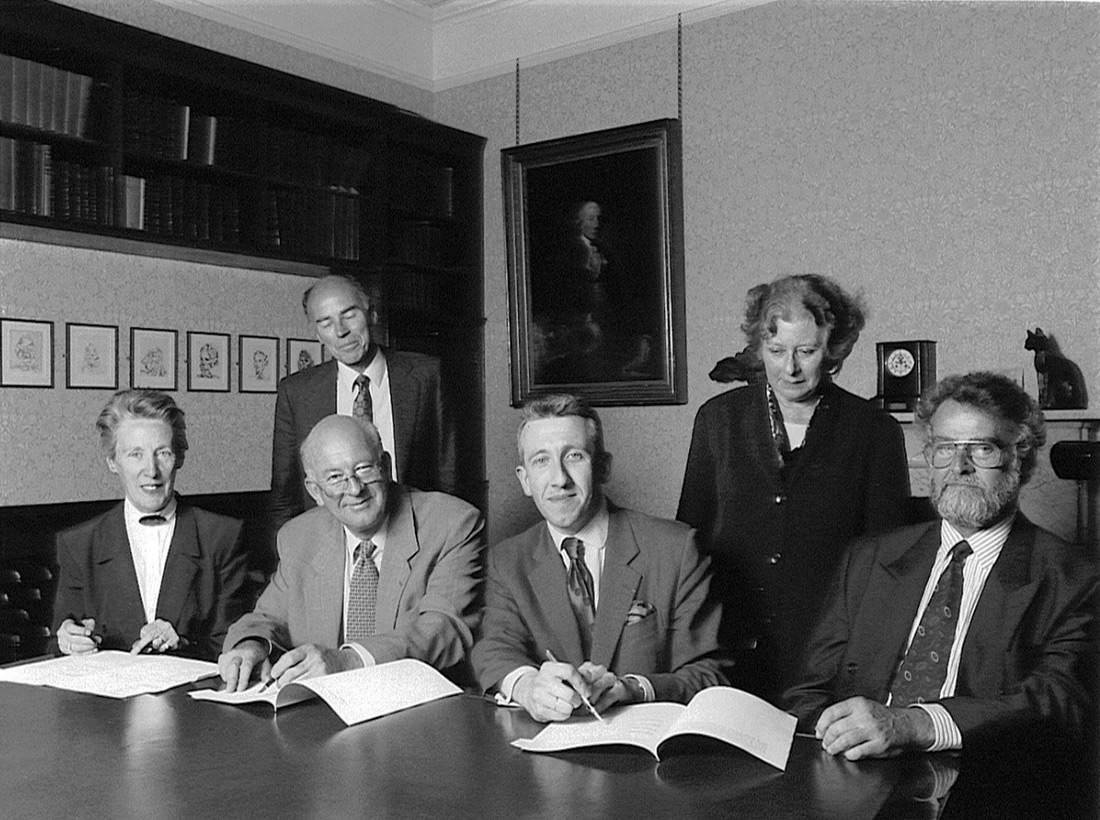
From left to right, sitting, are Dr Ann Matheson (National Library of Scotland, Edinburgh), Dr Mike Smethurst (CERL Chairman and Director-General, British Library), Mr Philippe Bélaval (Director Général, Bibliothèque nationale de France, Paris), and Dr Hermann Leskien (Director, Bayerische Staatsbibliothek, Munich). Standing: Mr Chris Kirk (Consultant, KC Switch Enterprises Ltd, London) and Dr Lotte Hellinga (CERL Secretary and Deputy Keeper, British Library).
Expansion and International Collaboration
From the late 1990s onwards, CERL expanded its membership and international outreach, welcoming libraries from across Europe and beyond. A major focus was supporting colleagues in Central and Eastern Europe through workshops and collaborative projects, strengthening scholarly networks in a rapidly changing political landscape. CERL also developed unique tools such as the CERL Thesaurus of place names and personal names, ensuring interoperability across diverse cataloguing traditions. Today, CERL continues to provide databases, training, and collaborative services, remaining true to its founding mission of advancing access to Europe’s book heritage.
From January 2021, the Consortium has been registered as a company limited by guarantee under Irish law, while the company limited by guarantee under English Law is in the process of dissolution.
–
Read more about CERL’s history in the Special Issue of our Newsletter: [Link to special issue of the CERL Newsletter (forthcoming) which will focus on CERL’s History]
CERL’S logo
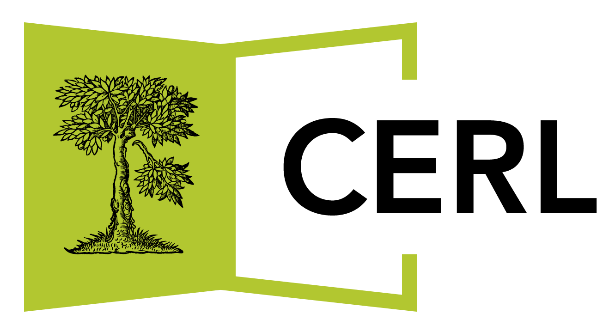
The Olive-Tree Logo
CERL’s logo is based on a printers’ device first used by the Estienne (Stephanus) dynasty of Renaissance printers in Paris and Geneva. A similar image was also adopted by the Elsevier family in Leiden and Amsterdam during the 17th and 18th centuries.
The emblem shows an olive tree with a falling branch. CERL follows the traditional interpretation that identifies the olive tree with Pallas Athene, goddess of wisdom and learning. The falling branch represents divine knowledge descending to earth, to be gathered and used by scholars for the benefit of humanity.
Scholars such as Fred Schreiber have shown that when Robert I Estienne (1503–1559) first used the device in 1526, it appeared with the biblical motto “Noli altum sapere” (“Do not be proud”), later expanded to “Noli altum sapere, sed time” (“Do not be proud, but be afraid” from Romans 11:20). Some versions included a male figure beside the tree, interpreted not as a philosopher but as St Paul, reflecting Robert Estienne’s sympathies with the Protestant Reformation.
Another interpretation connects the family name Estienne with the Greek word στέφανος (stephanos, crown), a reference to the olive crown awarded for intellectual or athletic success in ancient Greece. This underlines the link between the emblem and scholarly achievement.
Evolution of CERL’s logo
Over time, CERL’s logo has been adapted for clarity and modern use while retaining its symbolism. Early versions reflected detailed Renaissance devices, often including figures and elaborate design.
The current logo incorporates a fresh green colour and a stylised open-book shape, symbolising both growth and the dissemination of knowledge. The olive tree remains central, connecting CERL to its historical roots, while the open-book outline reflects access to Europe’s printed heritage and the collaborative spirit of the consortium.
The design is a clean, streamlined silhouette, working effectively at different sizes and in digital contexts. The logo visually unites CERL’s mission and identity, making it both modern and rooted in tradition.
CERL members who organise an event that is relevant to the CERL remit, and want to use the CERL logo for their publicity materials can contact [secretariat@cerl.org].
Citation
Fred Schreiber, The Hanes Collection of Estienne Publications: From Book Collecting to Scholarly Resource. Paper presented at the Fourth Hanes Lecture. Hanes Foundation, Rare Book Collection, University Library, University of North Carolina at Chapel Hill, 1984.