
My CERL Internship and Placement Grant 2026 at the Seminario Barbarigo library in Montefiascone
by Konrad K. Szymański (Ossolineum National Library, Wrocław)
Share this article
This summer, thanks to the support of the CERL Internship and Placement Grant, I had the opportunity to undertake a one-month project focused on cataloguing, physical analysis, and provenance documentation of early printed books of the Seminario Barbarigo in Montefiascone (Italy). My internship combined both in situ fieldwork and remote data synthesis. The on-site component in Montefiascone provided direct physical access to the collection for material examination and photographic documentation, while the subsequent remote phase allowed for the thorough integration of these findings into CERL’s international bibliographical resources, including MEI and ISTC.
The Library
Located at the highest point of Montefiascone in central Italy (100 km from Rome), the library of the Seminario Barbarigo preserves a remarkable historical collection built over several centuries. The core of the library dates back to its foundation in the late 17th century by Cardinal Marcantonio Barbarigo (1640–1706). He enriched the library with rare works, including 15th-century editions that had belonged to his Venetian ancestors. Among them were books associated with Pierfrancesco Barbarigo, a principal investor in the Aldine Press. The library also preserves vital archival records alongside material evidence of its former printing office (Typographia Seminarii), which operated on site until World War II.
Following decades of neglect, the Montefiascone Conservation Project, conceived by Cheryl Porter (book conservator from the University of the Arts London) and Nicolas Barker (former Head of Conservation at the British Library 1976-1992) in the late 1980s, helped secure the physical preservation of the collection.
The Ossoliński National Institute (popularly called Ossolineum) was founded by a Polish nobleman, Count Józef Maksymilian Ossoliński (1748-1826), whose bust stands in the Institute’s beautiful courtyard. Interestingly, the Institute was founded in 1817 in Lwów (now Lviv), but after World War II in 1947, part of the salvaged collection was transferred to Wrocław. The Ossolineum’s library belongs to the oldest and most valuable collections in Poland. Over the centuries, book collections from various noble families have been brought here. Today, the Institute houses periodicals, various printed items, microfilms, incunabula, manuscripts, a rich coin collection, seals, paintings, etc. The central core of the Institute’s collection is Józef Maksymilian Ossoliński’s precious private collection. He also persuaded another Polish nobleman, Prince Henryk Lubomirski (1777-1850), to donate a rich collection of artwork and objects from the Lubomirski Museum to the Ossolineum Institute. The collection included early printed books which bear Prince Lubomirski’s provenance marks.
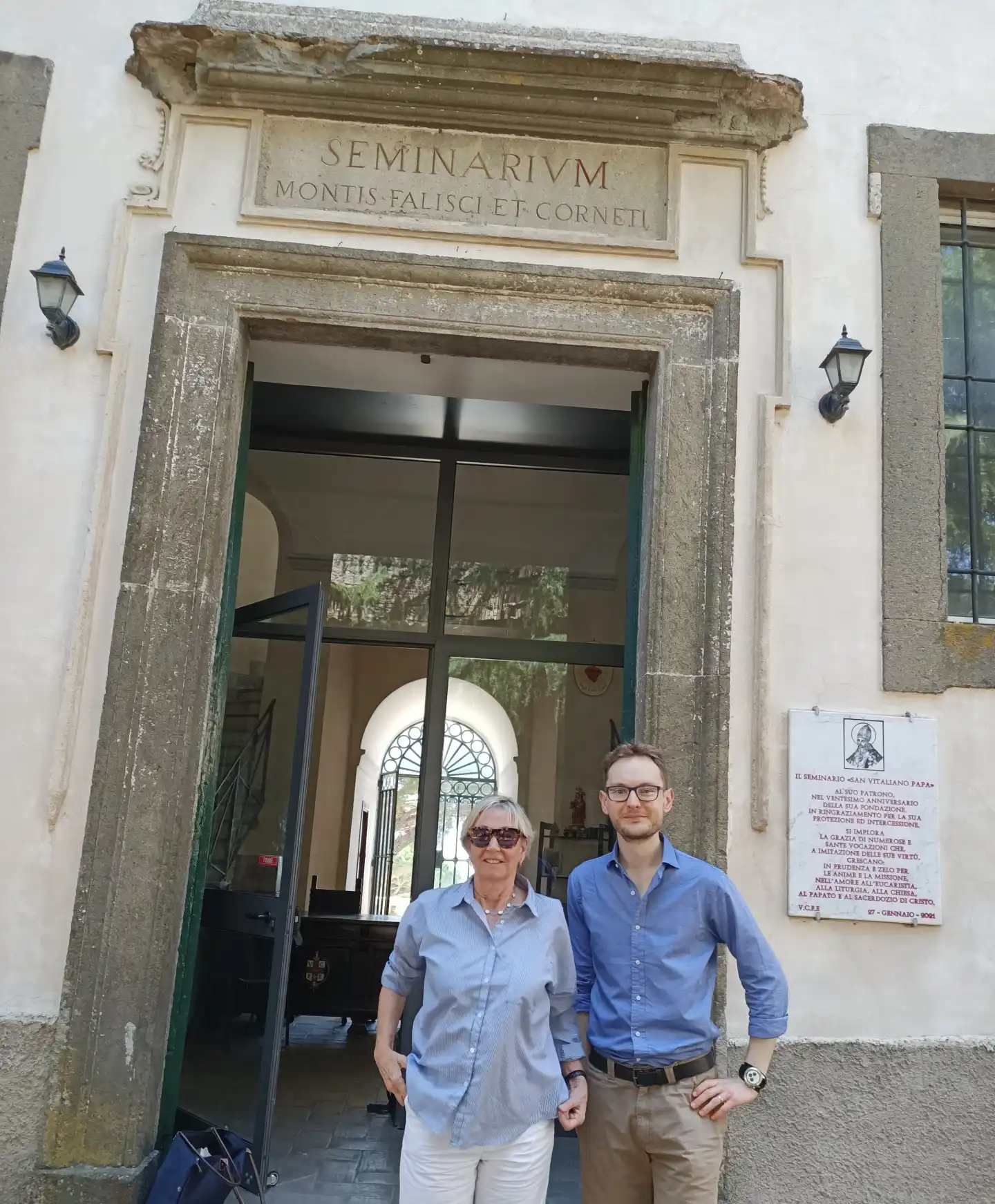
Cheryl Porter (founder and director of the Montefiascone Conservation Project)
and I at the entrance of the Seminario Barbarigo.
The cataloguing process was subsequently developed with the involvement of Nicolas Barker and Julianne Simpson (John Rylands Library, Manchester), who oversaw the work for many years and began the creation of the card catalogue as well as the currently used LibreOffice Base database.
This work was continued by Charlotte Miller (Sotheby’s London), and presently by Dr Renae Satterley (Middle Temple Library, London). Many catalogue records from the library are available in the Servizio Bibliotecario Nazionale (SBN), 1 as a result of cataloguing work carried out by students from the Università degli Studi della Tuscia in the late 1990s.
Today, the cataloguing work is carried out during the annual project weeks by professional librarians and volunteers from around the world
Today, the library collection is housed in a single room with modern metal shelving.
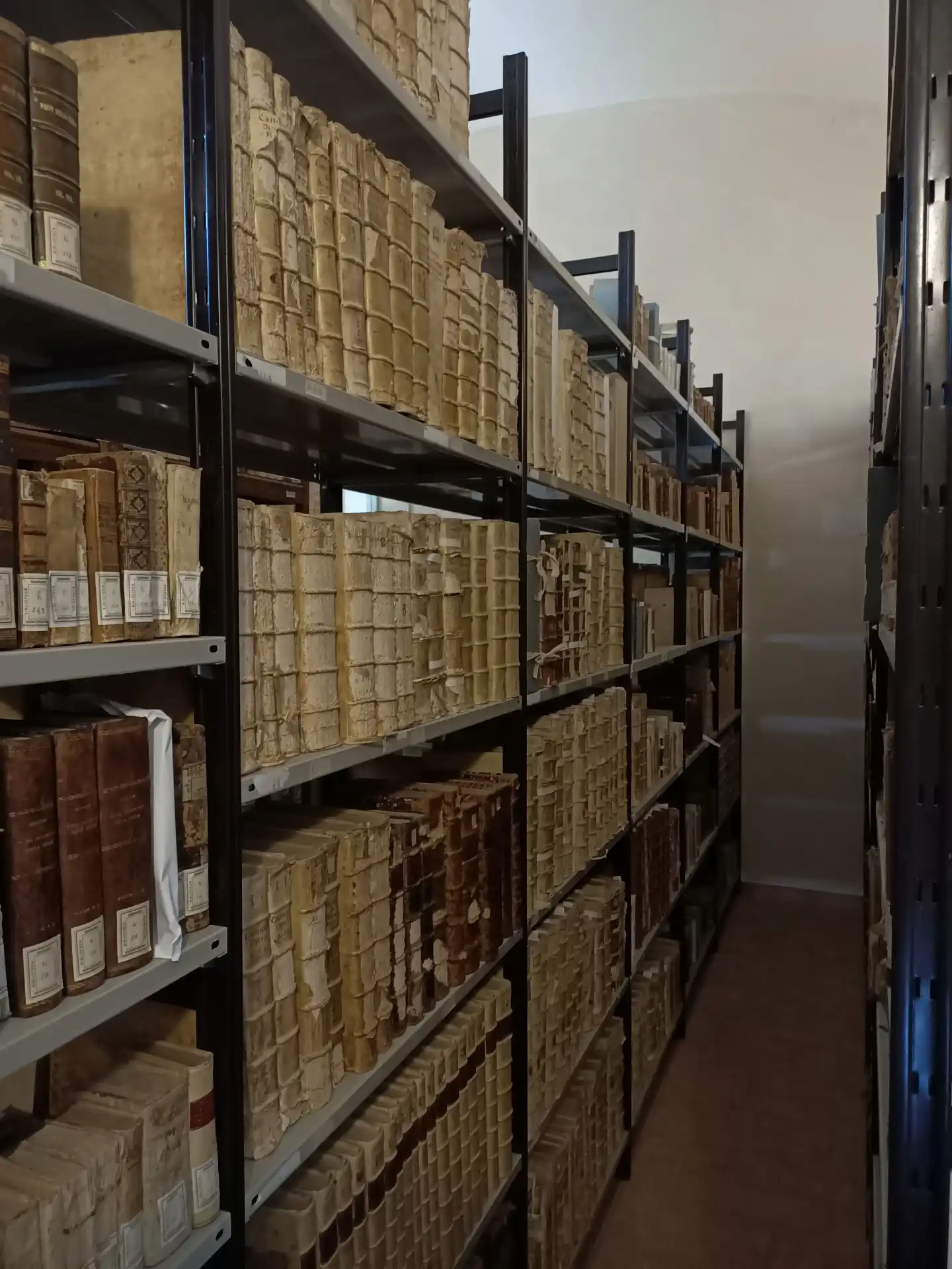
Modern metal shelving currently housing the library collection.
Earlier, the collection occupied two separate rooms. The original library room (with vaulted ceiling, painted walls and arched window with iron balcony incorporating the Barbarigo arms) contained approximately 2,100 works in 4,300 volumes, including around 10 incunabula, 70 manuscripts (mostly from the 18th century), 220 16th-century editions, 1,000 17th-century editions, 700 18th-century editions and 100 19th-century editions.
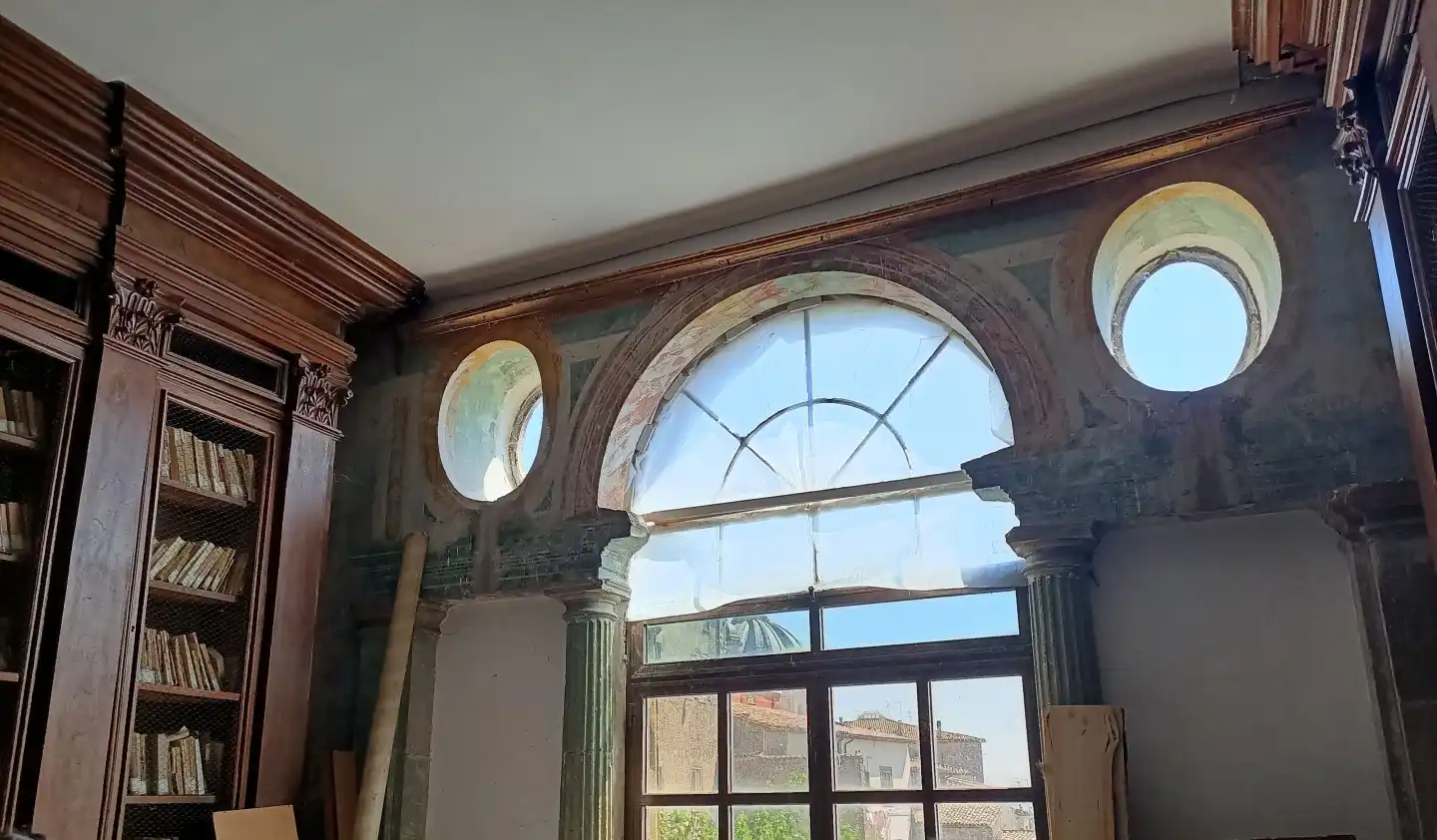
The original library room featuring painted walls, historic wooden bookcases, and an arched window
The second room, originally the theology chamber, contained approximately 11,000 volumes, including 128 16th-century printed editions. 2 This distinction is reflected in the division of the present collection into an ‘Old Library’ and a ‘New Library’, which is also visible in the shelfmarks of the volumes.
The Montefiascone Study Programme
During my stay, I also had the opportunity to experience first-hand the annual Montefiascone Summer Study Programme. 3 I observed Weeks 3 and 4, which focused on the reconstruction of historical bookbinding techniques (Italian long-stitch and 14th-century Irish Manuscript bindings). Watching these intensive, hands-on courses – led by internationally recognised conservators and attended by international specialists – provided me with invaluable practical context for my own work, bridging the gap between material preservation and cataloguing.
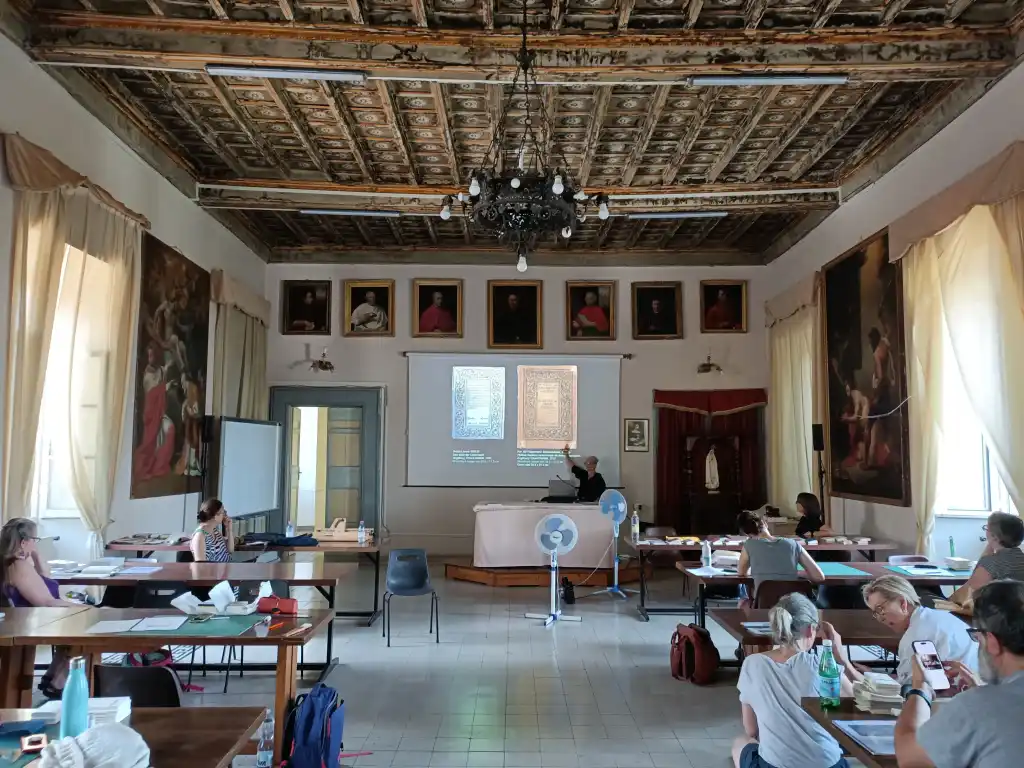
Participants during a lecture session of the Montefiascone Summer Study Programme.
The Incunabula
During my first week, my supervisor Dr Renae Satterley turned my attention to the incunabula, which formed the main focus of my work in Montefiascone. My task was to establish how many 15th-century books were preserved in the Seminary and to compare the surviving copies with the records in the ISTC and with the catalogue of Mario Bevilacqua published in 1938. 4
The comparison revealed a considerable discrepancy between the historical and present-day picture of the collection. Bevilacqua recorded twenty incunabula in Montefiascone. I was able to identify only eight incunabula still physically present in the library, together with 1 post-incunabulum. 5 Five of the eight surviving incunabula already had an indication of the Montefiascone copy in ISTC, while the remaining three lacked a corresponding holding statement for the Seminary. At the same time, a further fifteen incunabula continued to be associated with Montefiascone in ISTC, although I could not match these records with the surviving copies in the library. Interestingly, ISTC contains records corresponding to nineteen of the twenty incunabula listed by Bevilacqua, as well as one additional incunabulum that is not recorded in his catalogue. 6
This made the work more than a simple inventory. Each bibliographical identification had to be checked against the physical object, while older shelfmarks had to be reconciled with the current system. This was particularly important because the shelfmarks recorded by Bevilacqua are no longer current. Consequently, a straightforward comparison of an old catalogue entry with the present shelves could easily lead to an incorrect identification.
I therefore attempted to trace the fate of the incunabula recorded by Bevilacqua but no longer identified in the Seminary. Bevilacqua’s catalogue reflects the state of the collection in 1934, 7 just before the transfer of 114 works in 735 volumes to the Regional Seminary of Santa Maria della Quercia in Viterbo in October 1935. I was able to compare Bevilacqua’s list of twenty incunabula with the handwritten list of the volumes transferred to Viterbo preserved in the Seminary archive. 8 None of the 20 incunabula can, however, be securely identified in that transfer list. 9
This comparison therefore did not provide a straightforward explanation for the disappearance of the incunabula recorded in 1934. It did, however, demonstrate the importance of treating historical catalogue records, transfer lists and present-day physical evidence separately rather than assuming that an older holding statement necessarily represents a book’s current location. In the case of Montefiascone, the history of the collection, its changing shelfmarks, transfers between institutions and later reorganisation all have to be taken into account when reconstructing the history and present location of individual copies.
The physical examination of the surviving copies was an essential part of the project. In addition to establishing their bibliographical identity and recording their imperfections, I examined their bindings, former and current shelfmarks, ownership evidence, annotations, lecture notes, marginalia, and traces of use. These features often provided information that could not be obtained from bibliographical records alone.
I identified two volumes that contained the original armorial bookstamp of Marcantonio Barbarigo, the 1482-1483 Bible 10 and the 1488 edition of Vergil. 11
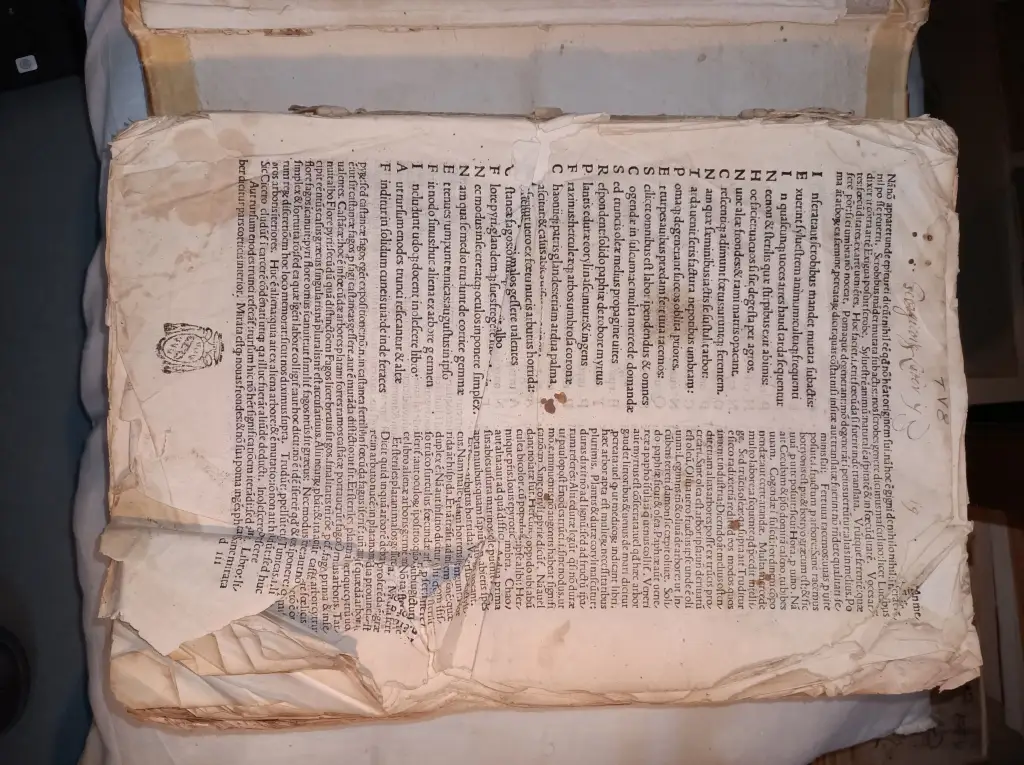
First extant page from the 1488 edition of Vergil with the
original armorial bookstamp of Marcantonio Barbarigo.
This edition of Vergil is particularly rich in evidence of use: it contains numerous lecture notes and marginal annotations in several hands, including inscriptions by Nicolaus Pisticus 12 from the beginning of the 18th century.
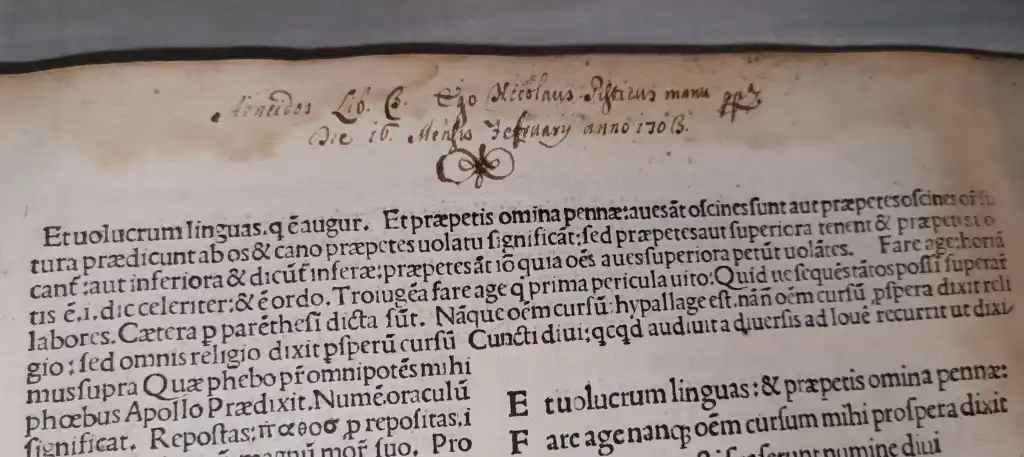
Inscription by Nicolaus Pisticus in the 1488 edition of Vergil (“Aeneidos Lib. 3.
Ego Nicolaus Pisticus manu ppr. | Die 16. Mensis Februarij anno 1703. […]”).
On m5 recto of this copy you can even see a flower made in dark ink.
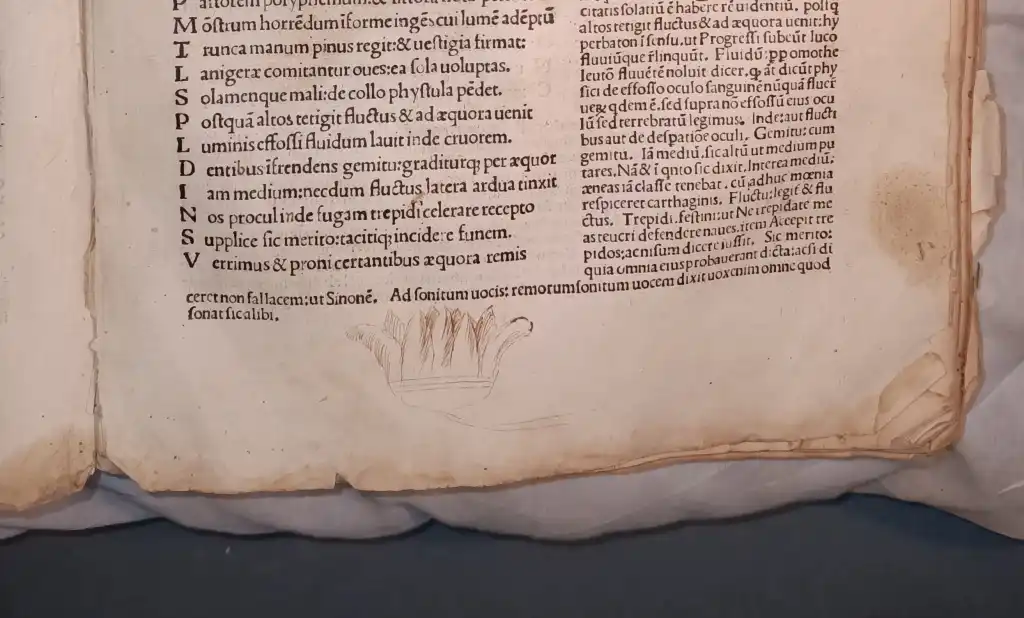
Ink drawing of a flower on leaf m5 recto of the 1488 edition of Vergil .
I was also able to establish that the 17th-century parchment binding currently attached to this volume belonged to another book. It had previously been used for an edition of Plutarch’s Lives, which, judging from the traces on the endpapers, had originally had its fore-edges coloured with blue paint.
The surviving copies also demonstrate the often-fragmentary condition of the collection. Several of the incunabula are substantially incomplete, and some no longer retain their original bindings. The 1476 Bible, for example, survives only from leaf n3 onwards and is preserved in a paper cover. 13 The 1491 Expositio in libros Posteriorum Aristotelis by Paulus Venetus lacks its final leaf, 14 while the 1486 Decretales of Gregory IX begins only with leaf b1 and retains a damaged 16th-century binding. 15
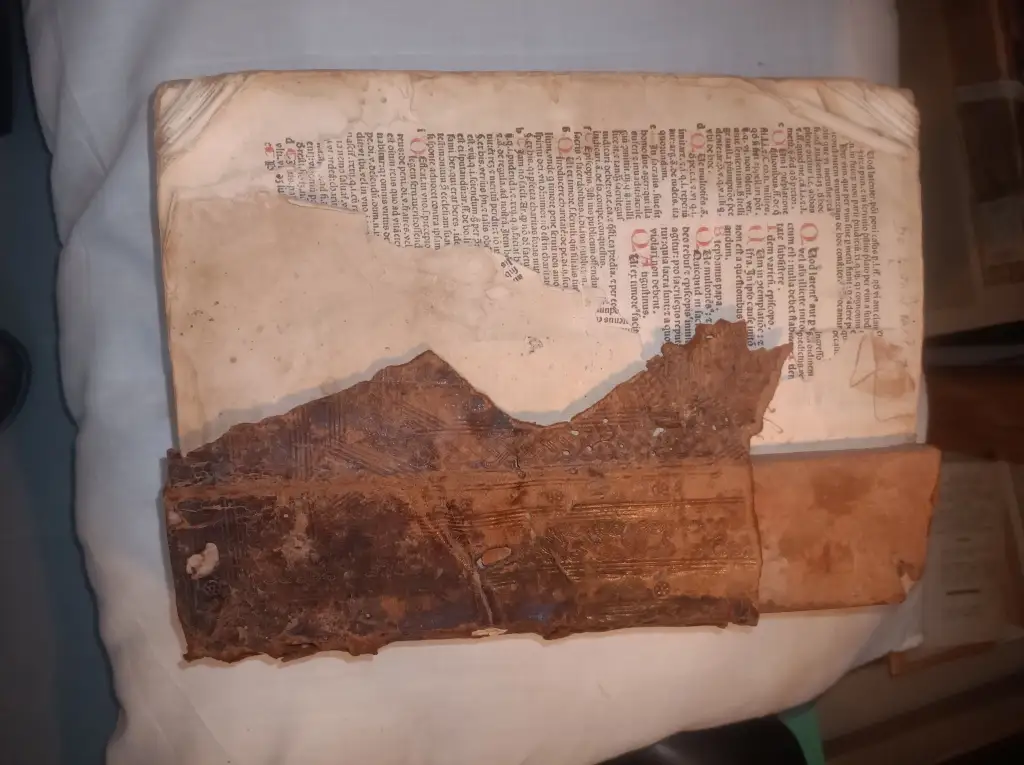
Damaged 16th-century binding with exposed wooden board of the 1486 edition of Gregory IX’s Decretales .
The imperfect copy of the 1496 edition of Cicero’s works, not recorded in Bevilacqua’s catalogue and without a Montefiascone holding statement in ISTC, is currently stored in an acid-free box. This last volume is bound together with four later works produced by the Seminary’s own printing press, the Typographia Seminarii, in the 18th century. 16
The final stage of my work with incunabula was to translate these findings into bibliographical data during the remote part of my internship. For the surviving copies, I checked the existing ISTC records and identified cases in which the Montefiascone holding statement needed to be added or corrected, including information about the imperfect condition of particular copies. For the 15 additional records still associated with Montefiascone, the absence of corresponding physical copies called for a separate review of their holding statements. Following Professor Cristina Dondi’s suggestion, I entered the available information on these former Montefiascone copies in MEI, recording them as ‘Historical Copies’.
Combining the traditional examination of the book with the systematic correction of international bibliographical databases was definitely one of the most valuable aspects of my internship. Creating data that is visibly connected and easily accessible to scholars around the world highlights the essence of research into early books and their owners.
Cataloguing the Seminary Press and the ‘New Library’
Another important part of my work in Montefiascone was devoted to cataloguing the books produced by the Seminary’s own printing press, the Typographia Seminarii.
While examining these books, I also read and recorded provenance evidence, identifying ownership inscriptions and other marks that could provide information about the history and use of individual copies. Most of the evidence came from students of the Seminary or from religious institutions in Italy, such as Farnese or Gradoli. The books were subsequently checked against the HPB and other bibliographical databases in order to verify their bibliographical details and, where possible, to compare them with records held in other collections. As might be expected, early printed books produced by the Typographia Seminarii are very rare, and some may even be unique.
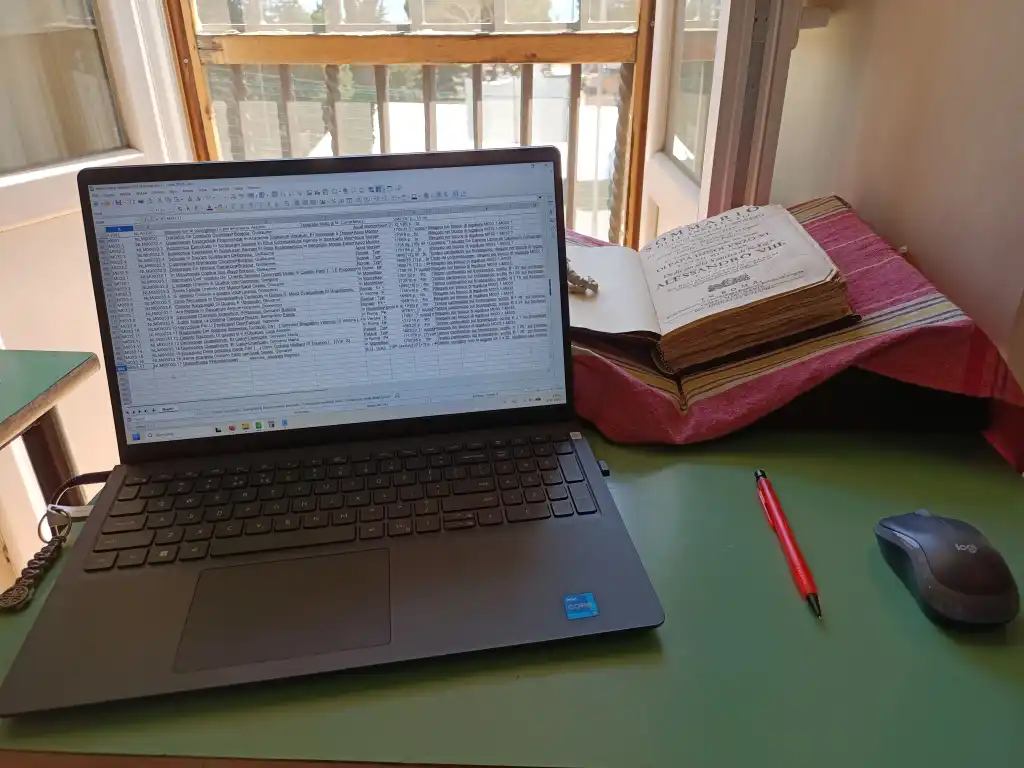
Cataloguing books from the ‘New Library’.
Among the earliest publications produced by the Seminary press, there is a considerable number of musical prints, including oratorios performed at the Seminary. These works provide a particularly interesting insight into the cultural and musical life of the institution and constitute an important part of the material produced by its own printing press.
One of the interesting examples is S. Maria Maddalena De’ Pazzi. Oratorio a quattro Voci, printed in Montefiascone in 1719. 17 This is an oratorio performed at the Seminary in the presence of James Francis Edward Stuart (1688–1766), recognized by the Jacobites as King of Great Britain – James III, and his wife Maria Clementina Sobieska (1702–1735), granddaughter of the Polish King John III Sobieski (1629–1696). The royal couple had married earlier that same year in Montefiascone.
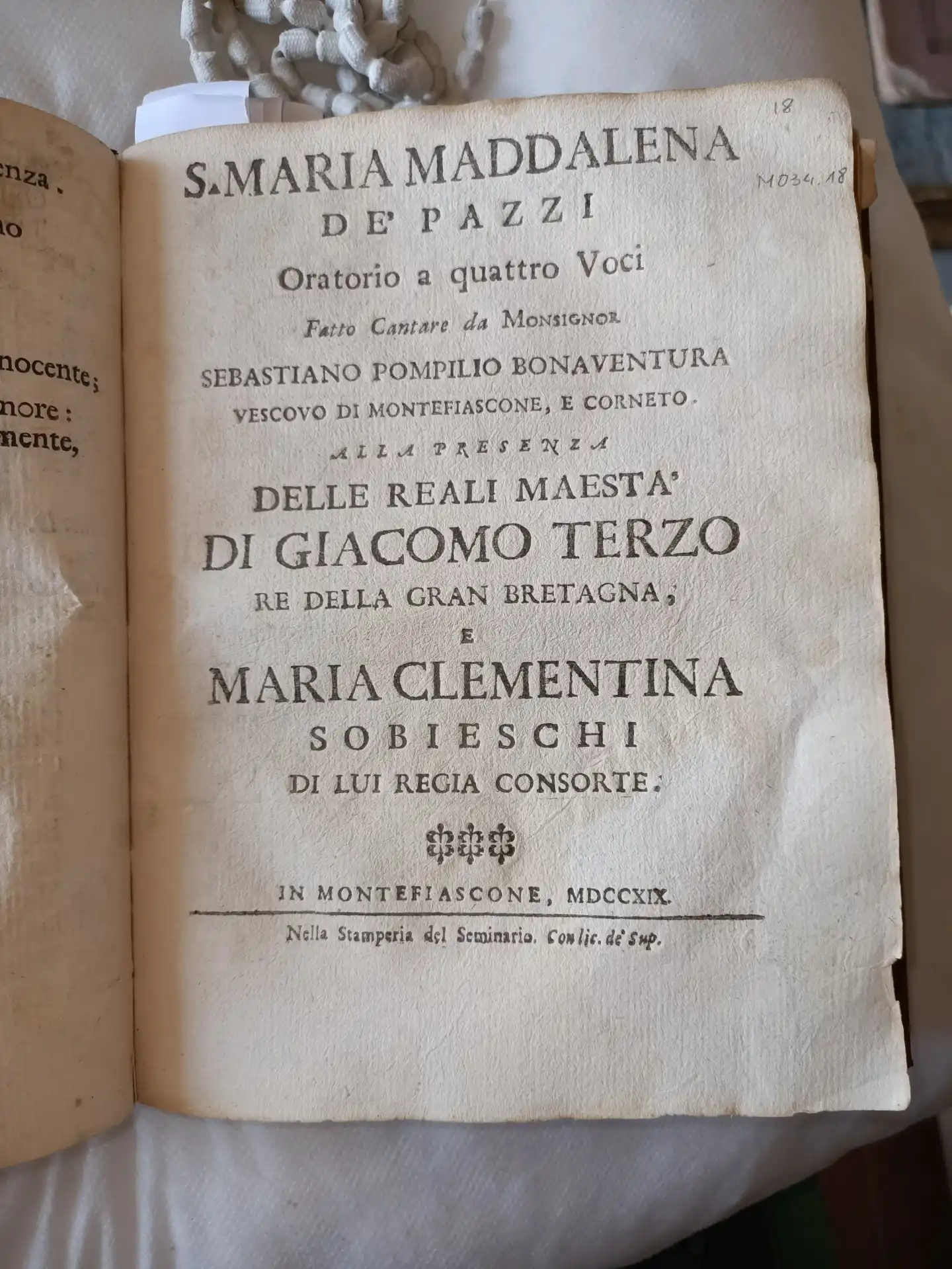
Title page of S. Maria Maddalena De’ Pazzi. Oratorio a quattro Voci
(Montefiascone, 1719), performed in the presence of James Francis Edward Stuart and
Maria Clementina Sobieska <shelfmark M034.18>.
Another particularly interesting item is Exercitatio Theologica by Januarius de Simone, printed in Montefiascone in 1732 18 and preserved in a beautiful 18th-century binding bearing the coat of arms of the Chigi family.
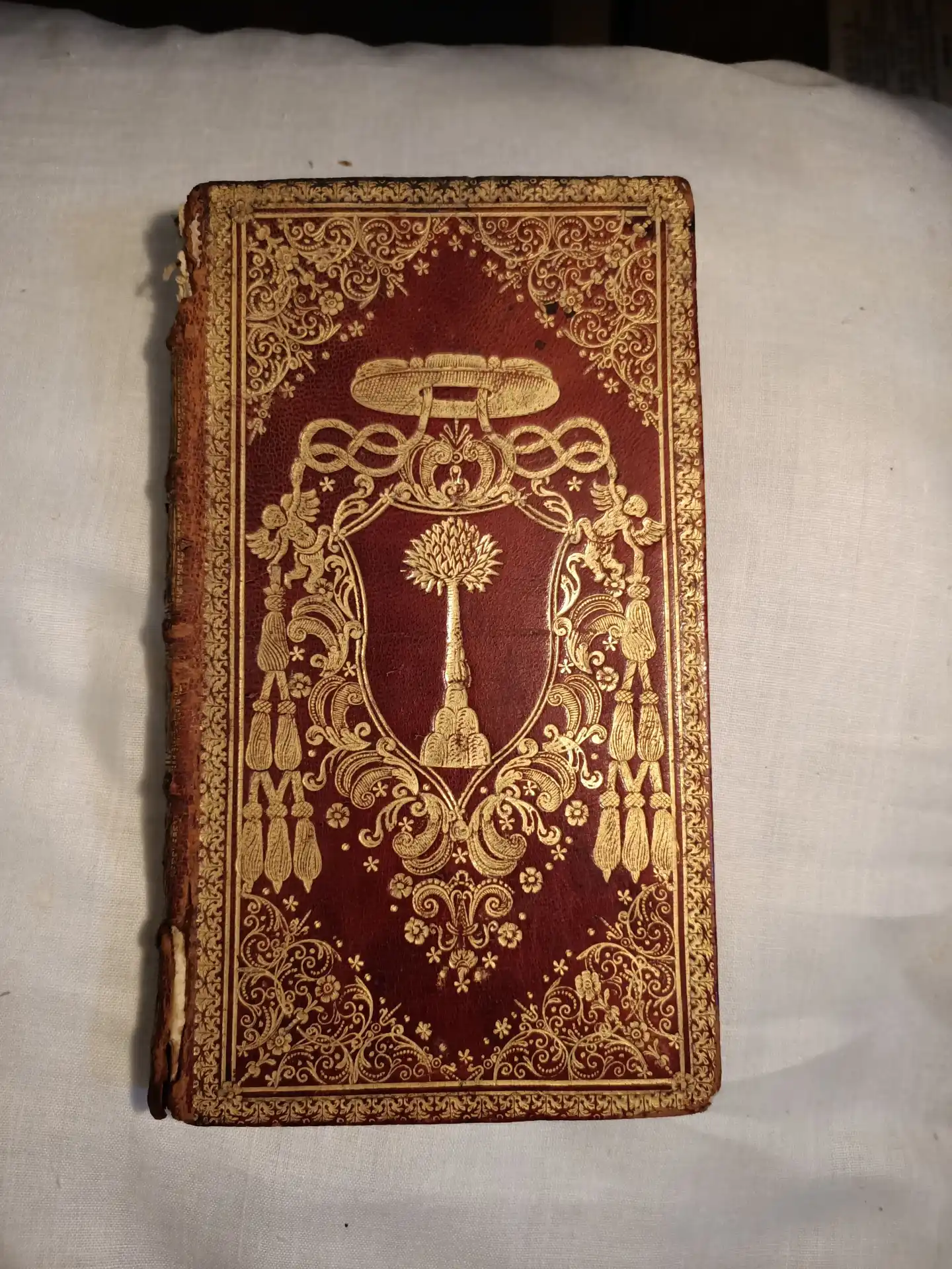
18th-century armorial binding featuring the coat of arms of the
Chigi family on Januarius de Simone’s Exercitatio Theologica (Montefiascone, 1732) <shelfmark M028>.
In addition to the books produced by the Seminary press, I also catalogued other early printed books from the ‘New Library’. This part of the work extended the cataloguing project beyond the material produced by the Seminary itself and allowed me to examine another part of the historical book collection.
Some of the volumes I catalogued bear the annotation “prohibetur”, indicating that their use was restricted or even forbidden at the Seminary in Montefiascone. One example is the 1669 edition of the theological treatise by Antoine Arnauld (1612–1694), De la Fréquente Communion, printed in Orléans and Paris, 19 in which the author presents an understanding of the sacraments of Penance and the Eucharist from a position that later became closely associated with Jansenist theology. Although the work itself was not placed on the Index Librorum Prohibitorum, the preface written by Martin de Barcos (1600–1678) was placed there in 1647.
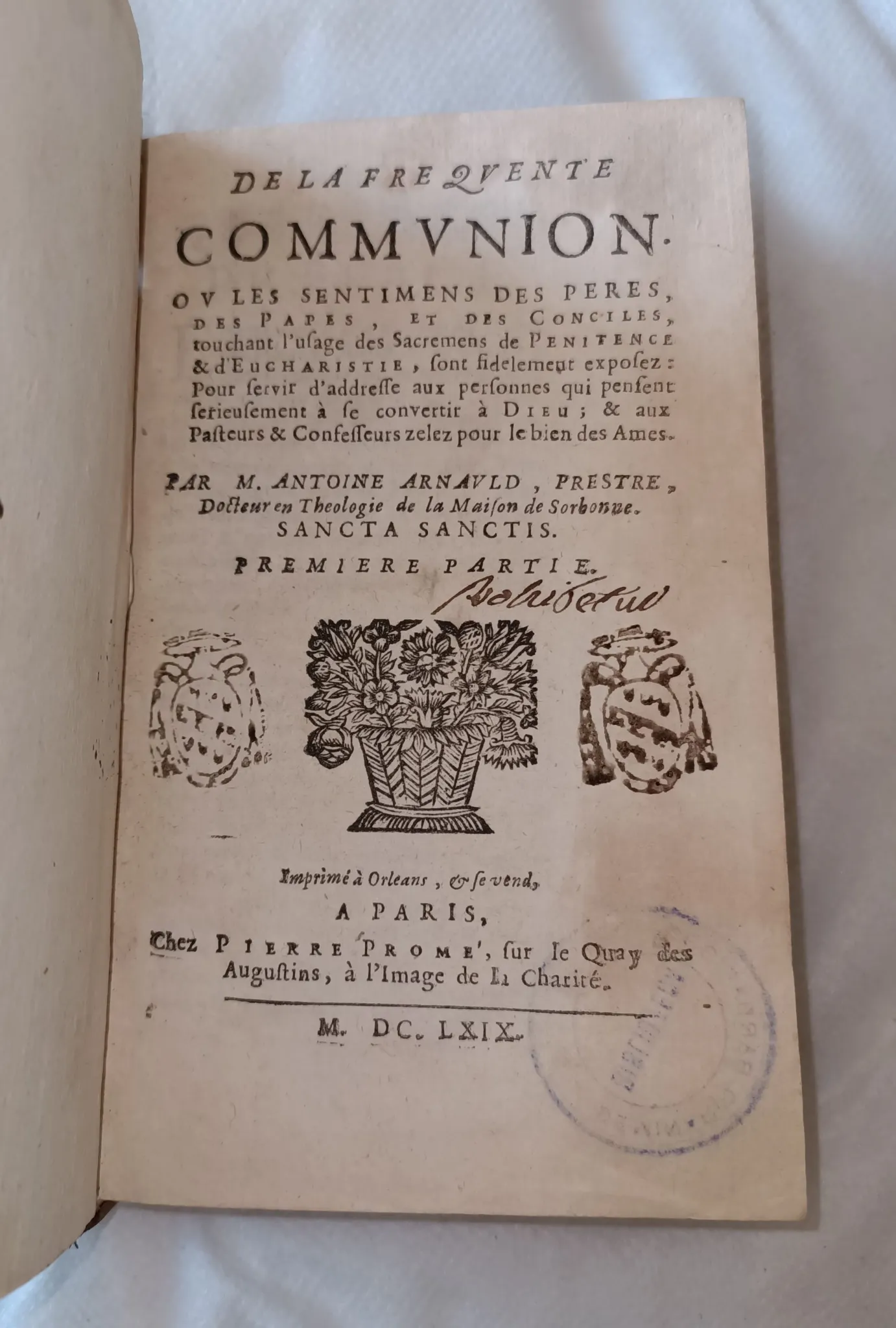
Title page of Antoine Arnauld’s De la Fréquente Communion (Orléans-Paris, 1669)
bearing the handwritten annotation “prohibetur” <shelfmark A2143–2144>.
Beyond Cataloguing
During my internship in Montefiascone, I also had the opportunity to visit the museum dedicated to the Seminary’s printing press. This provided an opportunity to become acquainted with the printing machines and types used by the former press, as well as with selected examples of books produced there.
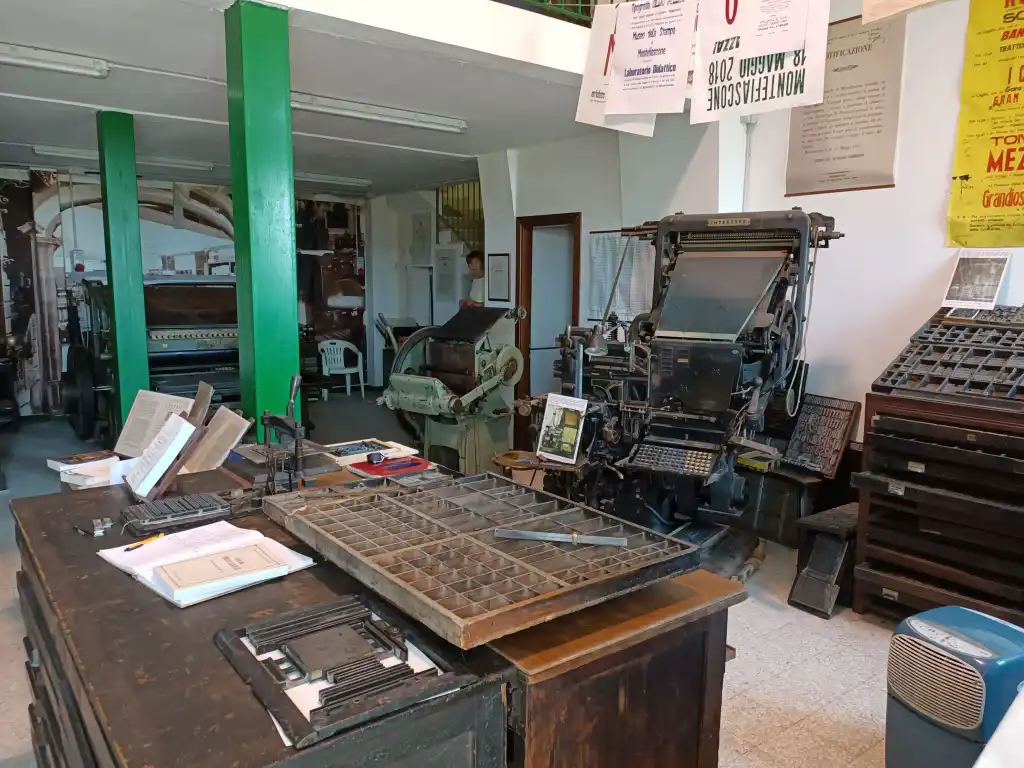
Printing equipment and typesetting cases displayed at the museum
dedicated to the Typographia Seminarii press.
Alongside the cataloguing and bibliographical work, I also took part in the everyday practical activities necessary for the preservation and organisation of the library. These included removing acidic paper slips from books, protecting printed volumes with acid-free paper, and dusting the books.
I also participated in updating the library’s floor plan, indicating the location of the different parts of the collection and the shelfmark ranges they contain.
Finally, it is worth emphasising that this ordinary, everyday work of maintaining the organisation of the library and preservation of the collection as a whole, including seemingly very basic tasks, is particularly important in the specific circumstances of Montefiascone, where the continued care and organisation of the collection depend heavily on volunteer involvement.
The future of the collection therefore depends not only on professional cataloguing and research, but also on the continued involvement of people willing to devote their time and expertise to its care and development.
I hope that my work in Montefiascone will contribute to this ongoing effort and that it will encourage other specialists in early books to become involved in the further cataloguing, study and preservation of this remarkable collection.
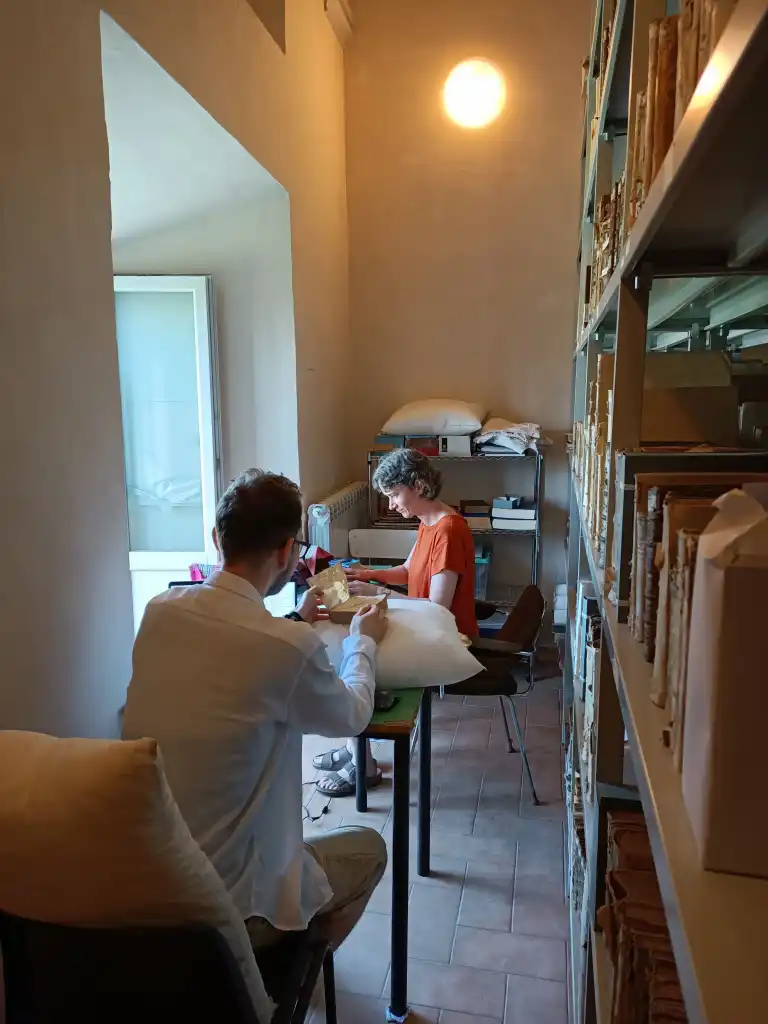
Examining books alongside Niamh Delaney in the Seminario Barbarigo library.
Acknowledgments
I would like to express my sincere gratitude to the CERL Grants Sub-Committee for awarding me the CERL Internship and Placement Grant. I am especially grateful to Professor Cristina Dondi for her continuous guidance throughout the process, from administrative and technical coordination to expert advice on integrating historical copies into MEI and ISTC. Special thanks also go to the management of the Ossolineum National Library, in particular to Dr Dorota Sidorowicz-Mulak and Dr Agnieszka Franczyk-Cegła, for supporting my application and granting permission for my participation in the internship.
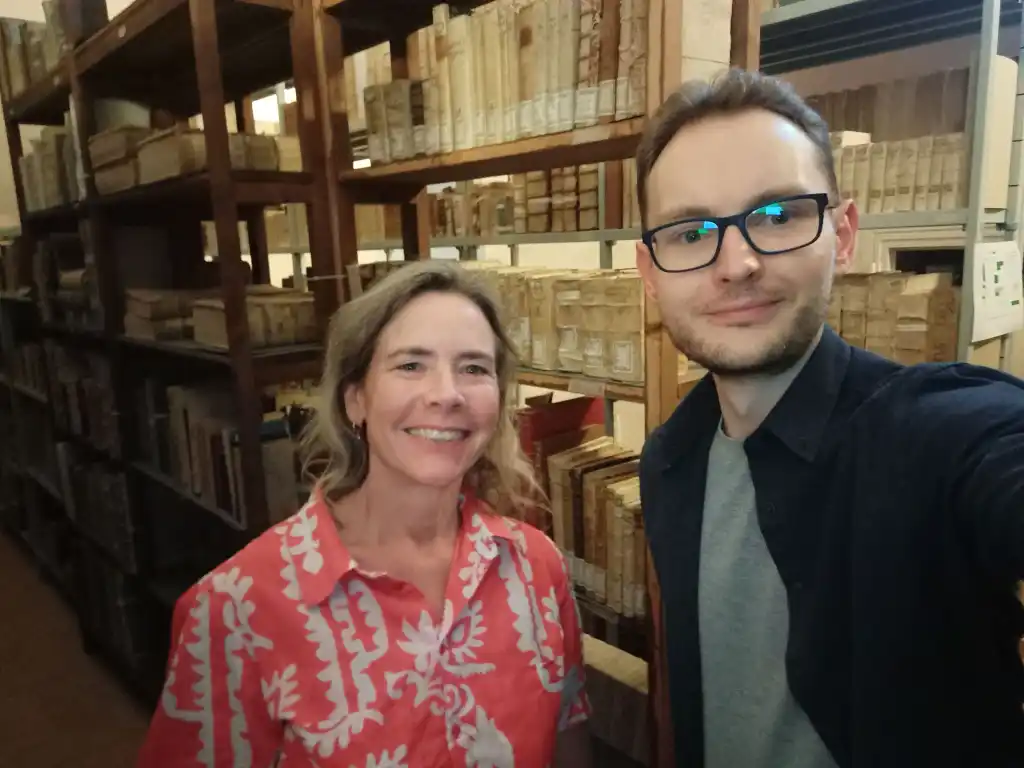
My supervisor Dr Renae Satterley and I in the Seminario Barbarigo library.
Notes
1 – See: https://opac.sbn.it/risultati-ricerca-avanzata?item_nocheck:3088:Biblioteca=VT0034#1661936730146 [2026-09-08].
2 – G. Breccola, La biblioteca del Seminario Barbarigo di Montefiascone, „Biblioteca e Società”, n. 32 (1999), p. 14; G. Breccola, La biblioteca del Seminario Barbarigo di Montefiascone: problemi di conservazione, ipotesi di valorizzazione, in: Le biblioteche dei seminari delle antiche diocesi di Viterbo, di Tuscania, di Montefiascone, di Acquapendente, di Bagnoregio e del Seminario regionale della Quercia: problemi di conservazione, ipotesi di valorizzazione, ed. L. Osbat, Viterbo 2009, p. 22.
3 – See more: https://www.monteproject.com/study-programme/ [2026-09-08].
4 – M. Bevilacqua, Notizia bibliografica degli Incunaboli delle Biblioteche Seminarile e Comunale di Montefiascone con un’ appendice su tre incunaboli di Tuscania, Roma 1938.
5 – Which, because of its imperfections, was long considered an incunabulum. It is actually the 1514 edition of Vergil, printed in Venice by Bartolomeo Zani, see more here: https://edit16.iccu.sbn.it/en/resultset-titoli/-/titoli/detail/CNCE065003 [2026-09-09].
6 – ISTC notes Quaestiones in Universalia Porphyrii by Johannes Duns Scotus (Venice : Johannes and Gregorius de Gregoriis, de Forlivio, 5 Jan. 1492/93), ISTC No. id00390000, which is not recorded in Bevilacqua (1938). However, Bevilacqua (1938) on p. 22, n. 5 noted incunabulum Regula musicae planae by Bonaventura Brixianus (Venezia, Iacomo de Pensi; senza anno, ma secolo XVI), i.e. ISTC ib00973000, where Montefiascone’s copy has not been recorded.
7 – G. Breccola, La biblioteca del Seminario Barbarigo…, p. 14, see Appendice n. 2 on p. 18
8 – This list, signed by Don Ferrero Conti, is transcribed by Breccola in La biblioteca del Seminario Barbarigo…, as Appendice n. 3 on p. 18-20.
9 – There are only 3 apparent correspondences at the level of author: Ptolemy, Cicero and Virgil and closer examination shows that these do not establish an identification of the same editions. The Ptolemy appears to refer to a sixteenth-century edition with commentary by Wilhelm Pirckheimer; the Cicero entry seems to describe a volume containing several of Cicero’s works rather than the Orator recorded by Bevilacqua; and the Virgil recorded by Bevilacqua is in fact still preserved in the Seminary library.
17 – Shelfmark M034.18.
18 – Shelfmark M028.
19 – Shelfmark A2143–2144.
Related articles
November 9, 2026
by Markéta Kučerová and Vojtěch Šícha, Library of the Czech Academy of Sciences
November 9, 2026