
Dogs in early printed books
by Kathleen Walker-Meikle
Share this article
Dogs abound in medieval manuscripts, from hounds scampering after hares in the margins (and occasionally finding themselves the target of lupine rage) to full page illuminations in folios depicting pet dogs, guard dogs, hunting dogs, wild dogs, and generally just being very dog-like. Early printed books might have (alas) less planned marginalia but the dogs never disappear. They might appear in hand-painted illustrations, spontaneous doodles on the part of a reader or in printed woodcuts.
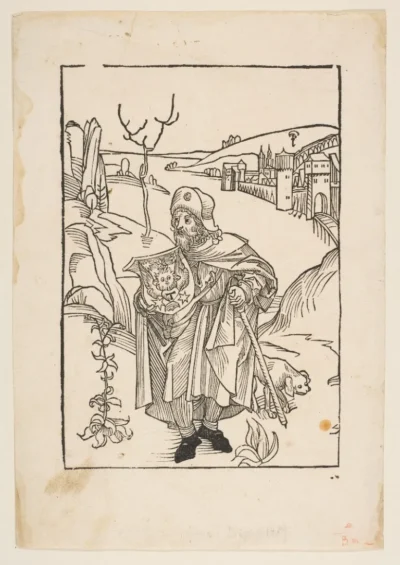 In the woodcuts of early printed books, they command the centre of attention or take up a supporting role. An example of the latter is the rather marvellous dog who accompanies the author Jean Gerson (1363–1429), in the guise of a Christian pilgrim, in the woodcut frontispiece to the 1489 edition of his collected works (printed by George Stuchs in Nuremberg).
Today the illustration’s main claim to fame is that it arguably Albrecht Dürer’s first work. But the eagle-eyed viewer might be drawn to the loyal hound on Gerson’s left, who valiantly trudges on, loyally following his master. The faithful hound is a stock motif, as the loyal dog was considered the most praise-worthy of all animals. Saint Roch, his leg swelled with plague buboes and exiled from human habitation, wanders around alone apart from a kind dog, who accompanies him (and helpfully sneaks into dining halls and comes back with bread for the saint’s supper). In the same vein, Gerson as a pilgrim is alone, removed from the city, in the proverbial wilderness, but he has a furry companion at least!
Conrad Gessner’s monumental Historia animalium was first printed in four volumes between 1551-1558 by Christoph Froschauer in Zurich. A highly abbreviated version with copiously more woodcuts, titled Icones animalium, was first printed by the same publisher in 1553 (with a second edition quickly appearing three years later).
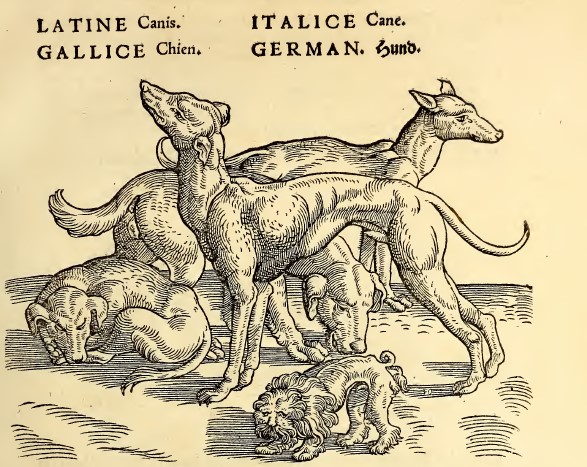
Image from the Smithsonian copy of Icones animalium, 1560, p. 25.
https://library.si.edu/digital-library/book/iconesanimaliumq00gess (public domain)
Icones animalium focused on few types of hunting dogs: bloodhounds, greyhounds, and water spaniels, nearly all from England or Scotland. The British dog dominances is due to his correspondent for canine matters: the English physician John Caius (and second founder of Gonville and Caius College, Cambridge). Caius wrote a treatise devoted only to British dogs: De Canibus Britannicis (1570), which was translated by Alexander Fleming in 1576 under the title Of Englishe Dogges: The Diuersities, the Names, the Natures, and the Properties (London, 1576). Caius doesn’t only detail hunting dogs but also very diverse dogs, such the ‘Daunser’, described ‘a mungrell kind which are taught and exercised to daunce in measure at the musicall sounde of an instrument, as, at the iust stroke of the drombe, at the sweete accent of the Cyterne, & tuned strings of the harmonious Harpe showing many pretty trickes by the gesture of their bodies’ (!). Dogs fulfilled all tasks, from turning the spits of fireplaces to carrying messages hidden in their collar, and the very spoiled little lapdogs of ladies: “These puppies the smaller they be, the more pleasure they prouoke, as more méete play fellowes for minsing mistrisses to beare in their bosoms, to keepe company withal in their chambers, to succour with sleepe in bed, and nourishe with meate at bourde, to lay in their lappes, and licke their lippes as they ryde in their waggons”.
All the facets of dogs appear in the Bolognese naturalist Ulisse Aldrovandi’s (1522 – 1605) posthumumous work De quadrupedibus digitatis viviparis libri tres (Bologna, 1637), covering subjects as diverse as their emblematic symbolism, their use in food and medicine, monstrous specimens, dog statues and even a selection of rather maudlin Latin epitaphs for beloved pets. This is followed by specialist chapters on rabid dogs, the Melitean dog (a small fluffy dog, kept as pets since Classical times) , the hunting dog, the rabbit-chasing dog, the bloodhound, the fighting dog and even the ‘useless dog’ (de cane inutili), which covered pet dogs, including a woodcut of a rather obese specimen with a fancy collar titled ‘Gaulish dog’:
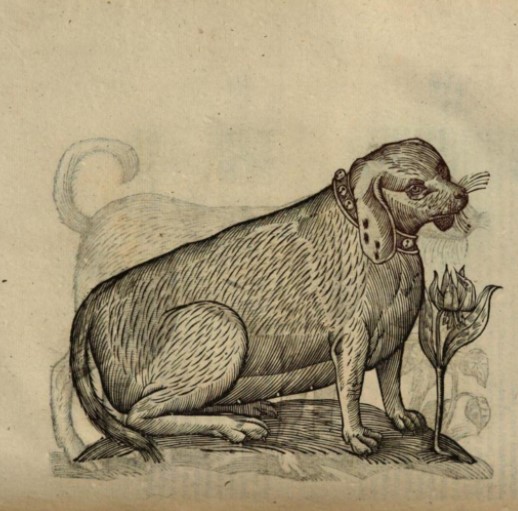
Ulisse Aldrovandi, De quadrupedibus digitatis oviparis libri duo
(Bonon. : Apud Nicholaum Tebaldinum, 1637), p. 560.
(Copy in Google Books)
Finally, dogs are often the centre staged in printed books on the art of hunting. An excellent example being Jacques du Fouilloux’s La venerie (Poitiers:Marness and Bouchetz brothers, 1662), packed with everything needed to hunt a diverse collection of game animals, including otters, hares, rabbits, badgers, wolves, deer, badgers, wild goats, and boars. There were also full instructions on breeding the best hunting hounds, taking care of their puppies, training them, the hunt itself, and very detailed instructions on canine ailments. For example, chapter seven of Jacques du Fouilloux’s text explains that to have beautiful puppies, you need a beautiful bitch, and is illustrated by a rather striking woodcut of a bitch looking at her litter of puppies, who are enclosed in a caged barrel. Apart from choose a good-looking dog from the outset, du Fouilloux recommended boiling a stew of mutton with garlic, castoreum (from the anal glands of beavers), cress, and cantharides (Spanish flies) and feed it to the bitch, which would make her (and the dog) keen to mate and produce the desired-for puppies.
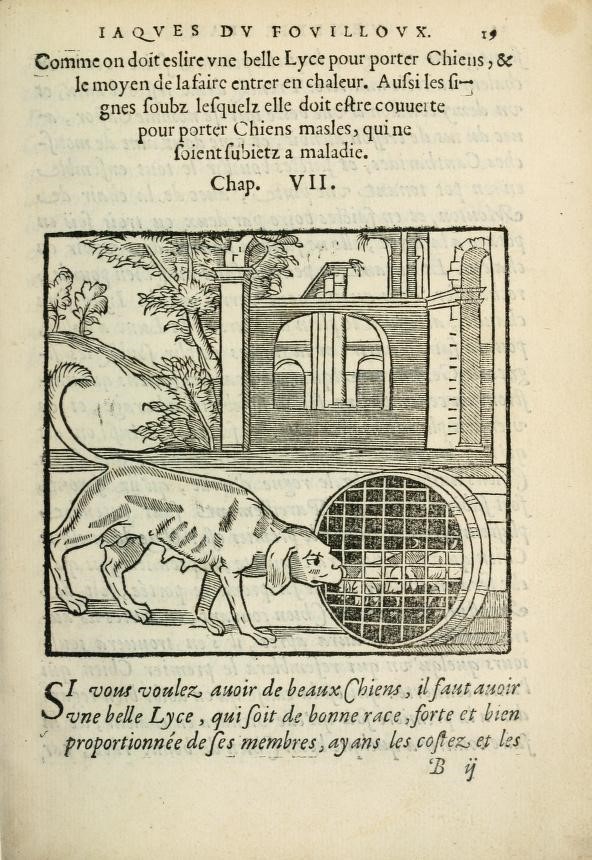
La venerie de Jacques du Fouilloux (Poitiers, 1562), p. 19.
(Copy of Biodiversity Heritage Library)
Veterinary advice appears at the end of the book, to treat mange, ringworm, rabies, animal bites (from vipers, serpents, boars, bears, wolves, and others), sore feet, fleas, and ear cankers. George Gascoigne translated Fouilloux’s text into English and it was printed to great success in London in 1575. It used the same woodcuts from du Fouilloux’s book, with a few extra woodcuts thrown in (including one of Queen Elizabeth out hunting, which was replaced by James I and VI in the 1611 edition). Gascoigne also added some commentary to the text, including noting that while wolves were hunted in France, they could not be found in England but he translated the text nevertheless (as he did for the section on bears, which were also extinct).
This post has presented just a small section of early modern canines in printed books, and I leave it to the reader to enjoy discovering many more!
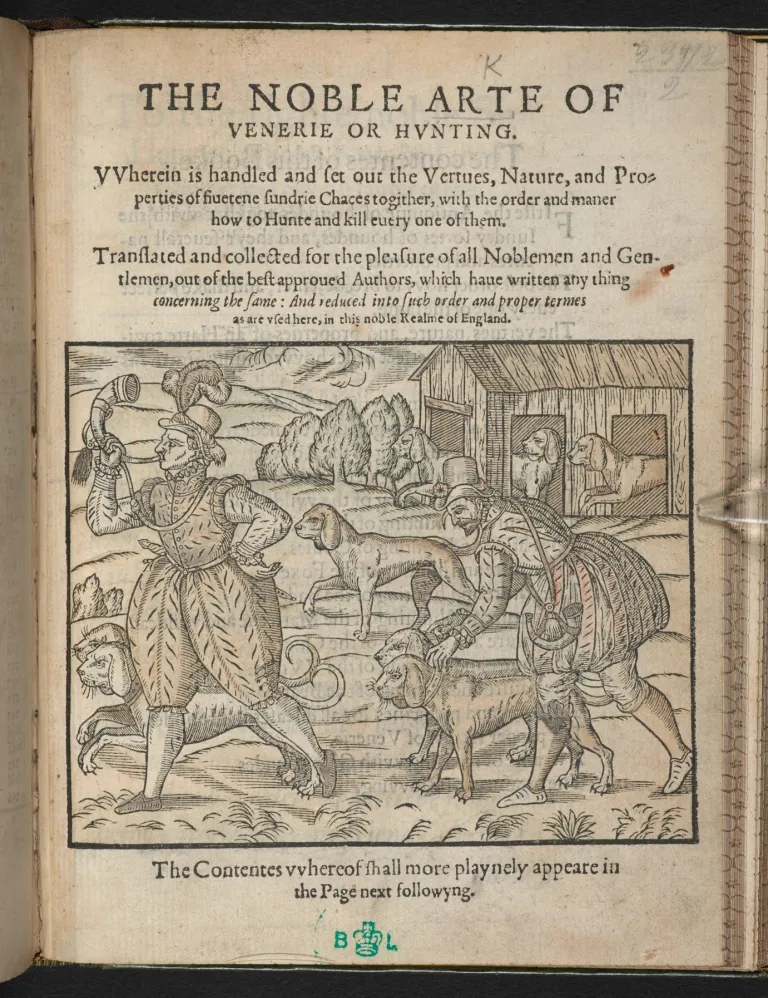
George Gascoigne, The Noble Arte of Venerie or Hunting (London, 1575).
Image from British Library
Dr Kathleen Walker-Meikle (k.walkermeikle@gmail.com) specialises in the history of animals and medicine. Dogs in Medieval Manuscripts (British Library Publications will be republished in October 2020.
Her books include :
- Medieval Pets (Boydell & Brewer, 2012)
- Dogs in Medieval Manuscripts (London: British Library Publications, 2020) [republication of Medieval Dogs (London: British Library Publications, 2013)]
- Cats in Medieval Manuscripts (London: British Library Publications, 2019 [republication of Medieval Cats (London: British Library Publications, 2011)] French translation: Chats du Moyen Âge, trans. Laurent Bury (Paris: Les Belles Lettres, 2013)
- The Horse Book: Horses of Historical Distinction (London: Bloomsbury, 2017)
- The Cat Book: Cats of Historical Distinction (London: Bloomsbury, 2015)
- The Dog Book: Dogs of Historical Distinction (London: Bloomsbury, 2014)
Related articles

by Markéta Kučerová and Vojtěch Šícha, Library of the Czech Academy of Sciences
November 9, 2026
by Konrad K. Szymański (Ossolineum National Library, Wrocław)
November 9, 2026