
500 Years On: Christopher Plantin’s Legacy Today
by Karen Attar, Senate House Library, University of London
Share this article
Notable both for the quantity and the physical quality of his books, this man and his heirs dominated northern European printing and publishing for over a century. We all accept the importance of Christopher Plantin alongside the Estiennes, Manutius family, and Elzeviers in book history. The Plantin-Moretus Museum in Antwerp has carried awareness of Plantin far beyond European Renaissance book historians. The year 2020 is, we think, the 500th anniversary of his birth. Yet Covid-19 and ignorance of his precise date of birth have conspired against Plantin celebrations along the widespread international lines of the Manutius exhibitions and conferences of 2015.
Senate House Library, the central library for the University of London, has never set out to collect Plantin editions. Yet the extent of the Plantin reach ensured its acquisition of exempla across Plantin’s diverse subject matter from various sources. Plantin’s authors came from throughout Europe, and the largely English provenances of the Senate House Library copies add an additional post-production layer to Plantin’s own internationality.
Starting out with maths and science
L’arithmetique de Simon Steuin de Bruges (Leiden, 1585) is among the first Plantin publications to have entered the University of London. The author, Simon Steven (1548-1620) wrote five of the nine mathematical works Plantin printed between 1560 and 1585. This work one is a landmark, making the first announcement of decimal fractions. Our copy belongs to the Library’s founding collection, the mathematical library of the mathematician and mathematical historian Augustus De Morgan (1806-1871), who describes Stevin’s characteristic as ‘originality, accompanied by a great want of the respect for authority which prevailed in his time’. The copy includes not only De Morgan’s note on the front flyleaves but a title page inscription attributed tentatively by De Morgan to Stevin himself: ‘L’autheur donna … a … Monsieur Cornelle[?] … de Groot’.
The books of the classical historian and University of London Vice-Chancellor George Grote (1794-1871) entered the University shortly after De Morgan’s. As a Classicist, it is perhaps unsurprising that Grote owned Plantin’s editio princeps of ‘On the nature of man’, by the fourth-century Greek Christian philosopher Nemesius, Bishop of Emesa in Syria; the first known compendium of theological anthropology with a Christian orientation (Nemesiou episkopou kai philosophou Peri physeōs anthrōpou, biblion en = Nemesii Episcopi et philosophi De natura hominis, lib. unus, Antwerp, 1565). The copy contains Grote’s light annotations. Annoyingly, early marginal annotations have been washed. Less obviously typical of Grote’s interests is Plurimarum singularium & memorabilium rerum in Graecia, Asia, AEgypto, Iudaea, Arabia, aliisq[ue] exteris prouinciis … (Antwerp, 1589), by the leading French naturalist Pierre Belon (c.1517-1564).
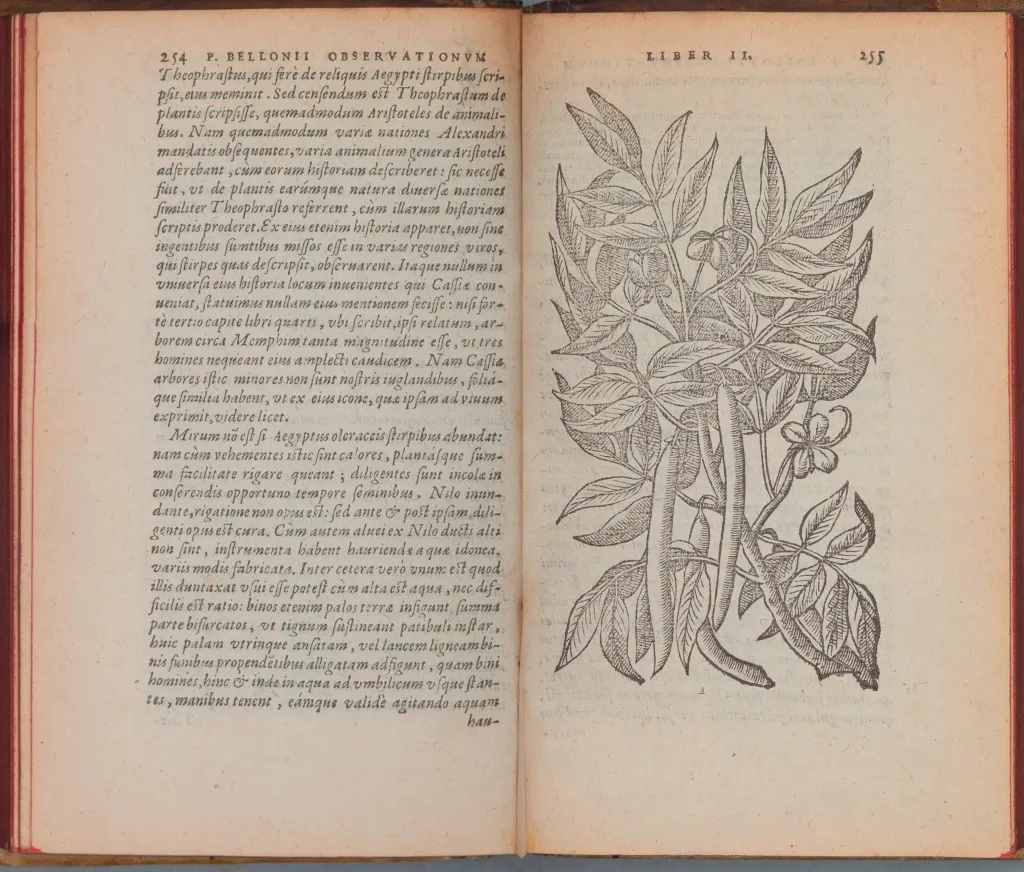
Pierre Belon, Plurimarum singularium & memorabilium rerum in Graecia,
Asia, AEgypto, Iudaea, Arabia, aliisq[ue] exteris prouinciis … (Antwerp, 1589)
The classical association remains, though, because Belon visited various middle eastern countries between 1546 and 1549 to compare their flora and fauna with descriptions made by classical authors. This edition is the Latin translation Plantin commissioned from his French edition of 1555, with most illustrations copied by Pieter van der Borcht from those in the 1555 edition (the blocks for which Plantin had sold). The copy came to England within the first century of its existence. We have not yet identified the Henry Whyte whose seventeenth-century signature is on the title page, nor the Ayleworth who gave him the book.
Emblems galore
In 1929 Senate House Library was bequeathed the library of Sir Edwin Durning-Lawrence (1837-1914), a Baconian protagonist who believed that Sir Francis Bacon was involved in the production of continental emblem books and that such books demonstrated to the initiated that Bacon was the real author of William Shakespeare’s plays. He therefore owned a fine clutch of early emblem books. As Plantin produced some fifty emblem books between 1564 and 1590, it is hardly surprising that he features. Outstanding examples are Omnia Andreæ Alciati V.C. emblemata cum commentariis (Antwerp, 1577) and Geffrey Whitney’s A choice of emblemes, and other devises (Leiden, 1586).
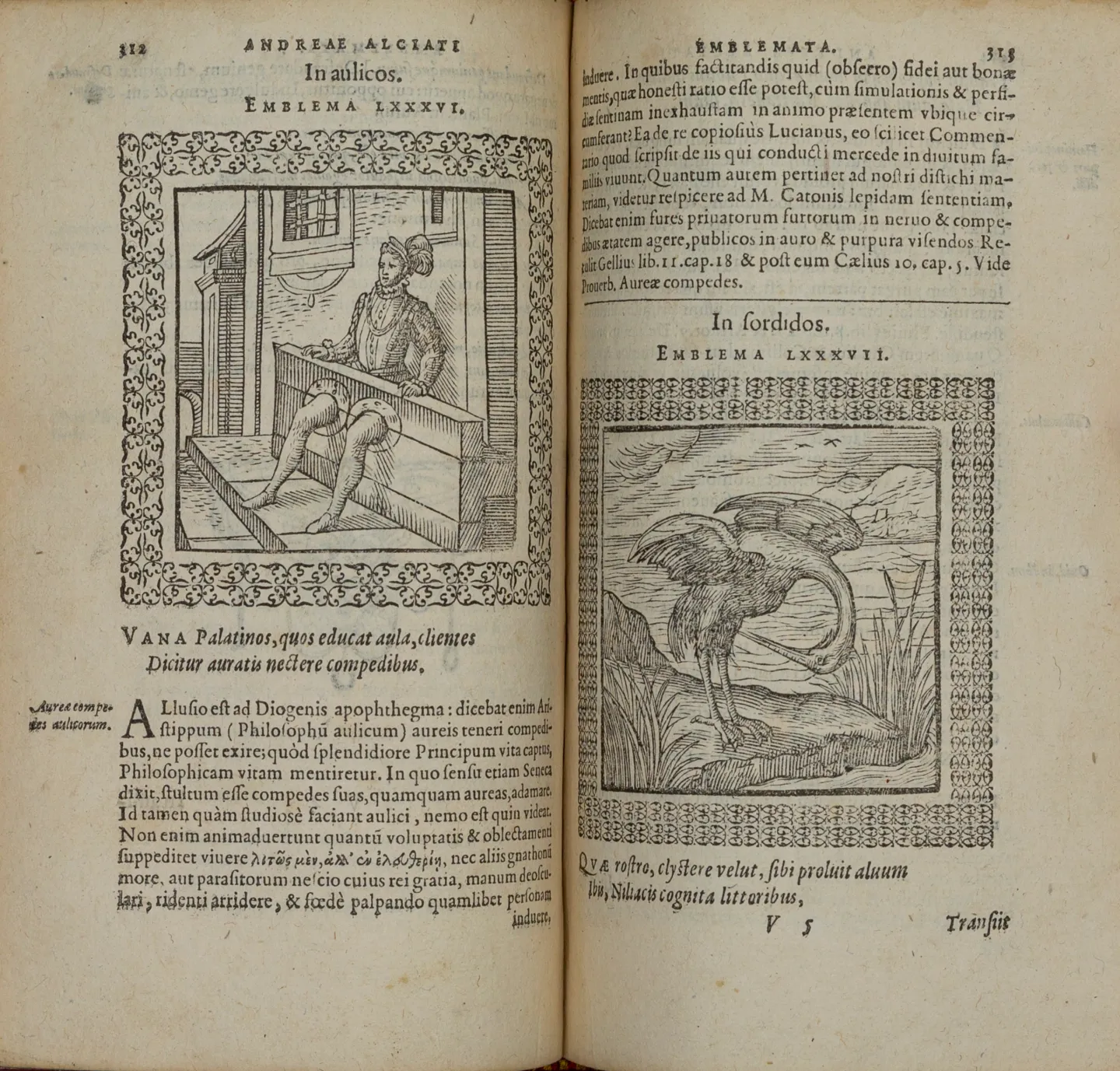
Left: Andrea Alciati, Omnia Andreæ Alciati V.C. emblemata cum commentariis (Antwerp, 1577)
Right: Geffrey Whitney, A choice of emblemes, and other devises (Leiden, 1586)
The former is considered to be the finest of the twelve editions of Andrea Alciati (1492-1550; the first and most successful writer of emblem books) printed by Plantin, with its specially cut illustrations: 197 from 196 wood blocks, larger than those in previous editions. Claude Mignault (1536-1606), the Parisian law professor who edited Alciati’s emblems for Plantin from 1573 onwards, revised and expanded his text for this edition. Whitney’s title is the earliest English-language emblem book and the only English emblem book that Plantin printed. Whitney was in Leiden when he developed the book from a manuscript he had presented to the Earl of Leicester the previous year, which explains the continental printing. Plantin re-used illustrations from earlier emblem books, including Alciati.
History from the London Institution
Senate House Library owes much of the richness of its general early printed book collections to the London Institution, a subscription library in East London whose stock passed mainly to various parts of the University of London when it ceased to operate in the 1910s. This is how we acquired the Anglo-Irish literary scholar and translator Richard Stanyhurst’s history of Ireland down to the time of Henry II, De rebus in Hibernia gestis, libri quattuor (Antwerp, 1584), one of two Stanyhurst works printed by Plantin.
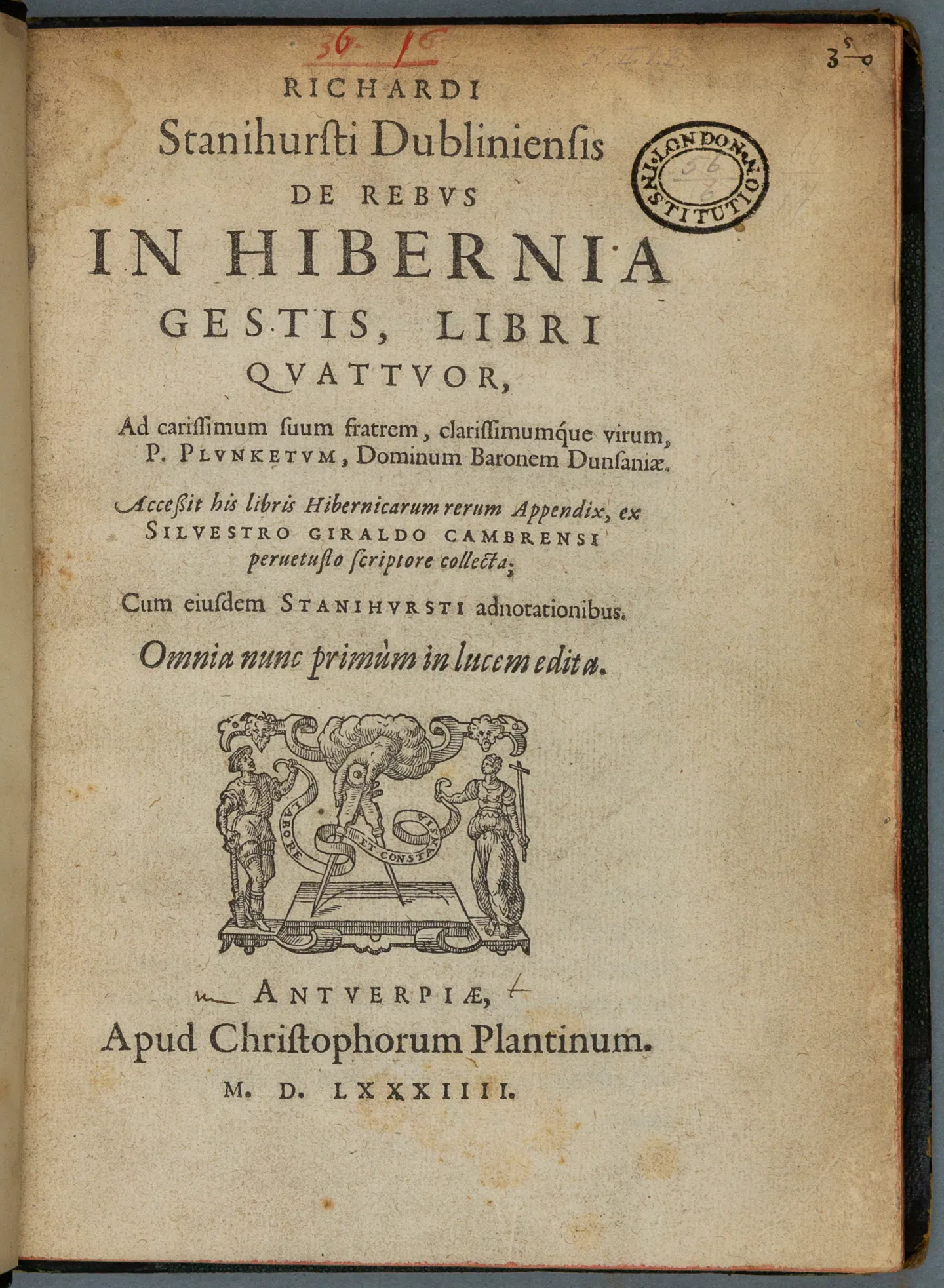
Richard Stanyhurst, De rebus in Hibernia gestis, libri quattuor (Antwerp, 1584)
History – including books and pamphlets on topical events – was one of Plantin’s staple subjects. Whilst Plantin’s connections were orientated far more towards the continent than the British Isles, Stanyhurst, a Catholic convert, made his lists as a resident of Leiden and Antwerp from 1579 onwards.
One library loses, another gains
After the Second World War, English public libraries began to shed their rare books, a movement that has continued ever since. Hence Senate House Library acquired the posthumously published Opera of the linguist Joannes Goropius Becanus, or Jan van Gorp, of Hilvarenbeek (1519-1573) from London’s Hampstead Public Libraries in 1947. The work is remarkable for its illustrations, a mixture of copper engravings and woodcuts, which are drawn from original monuments and depict Egyptian figures unusually accurately. It continues the argument Goropius has propounded in his Origines Antwerpianane, also printed by Plantin, of the supremacy of Flemish as the world’s oldest language: a theory which initiated the study of comparative philology. The former owner of our copy was Hampstead resident Henry Morley (1822-1894), professor of English at University College London. Numerous English librarians know his name from the Henry Morley Building at University College, for many years the home of that College’s School of Library, Archive and Information Studies.
Thinking nationally and beyond
Some Plantin books at the University of London betray their Netherlandish origins. The Thesaurus geographicus, recognitus et auctus by the Antwerpian cartographer and humanist Abraham Ortelius (1527-1598) in 1596, printed by Plantin’s son-in-law Jan Moretus (1543-1610) at the Officina Plantiniana after Plantin’s death in 1589, formerly belonged to the Dutch church in London. Two former owners recorded their names in our copy of Thomas Aquinas’s Summa totius theologiae (Antwerp, 1585). They are Philippus Josephus Van Ghindertaelen, of whom we know only that he flourished in the mid-eighteenth century, and J.F. Nelis of Zele, (1793-1867), a pastor in Erwetegem in Belgium and elsewhere, and a biblical editor. Our rarest Plantin book was unknown to Voet in his bibliography of Plantin. It is a 1562 edition of the Concordantiae Bibliorum utriusque Testamenti, Veteris et Novi, novae et integrae, based largely on the Parisian scholar-printer Robert Estienne’s Concordantiae (1555). Our copy retains a sixteenth-century binding of blind-stamped calf over pasteboards, with manuscript waste (possibly from a twelfth-century breviary) reinforcing the spine.
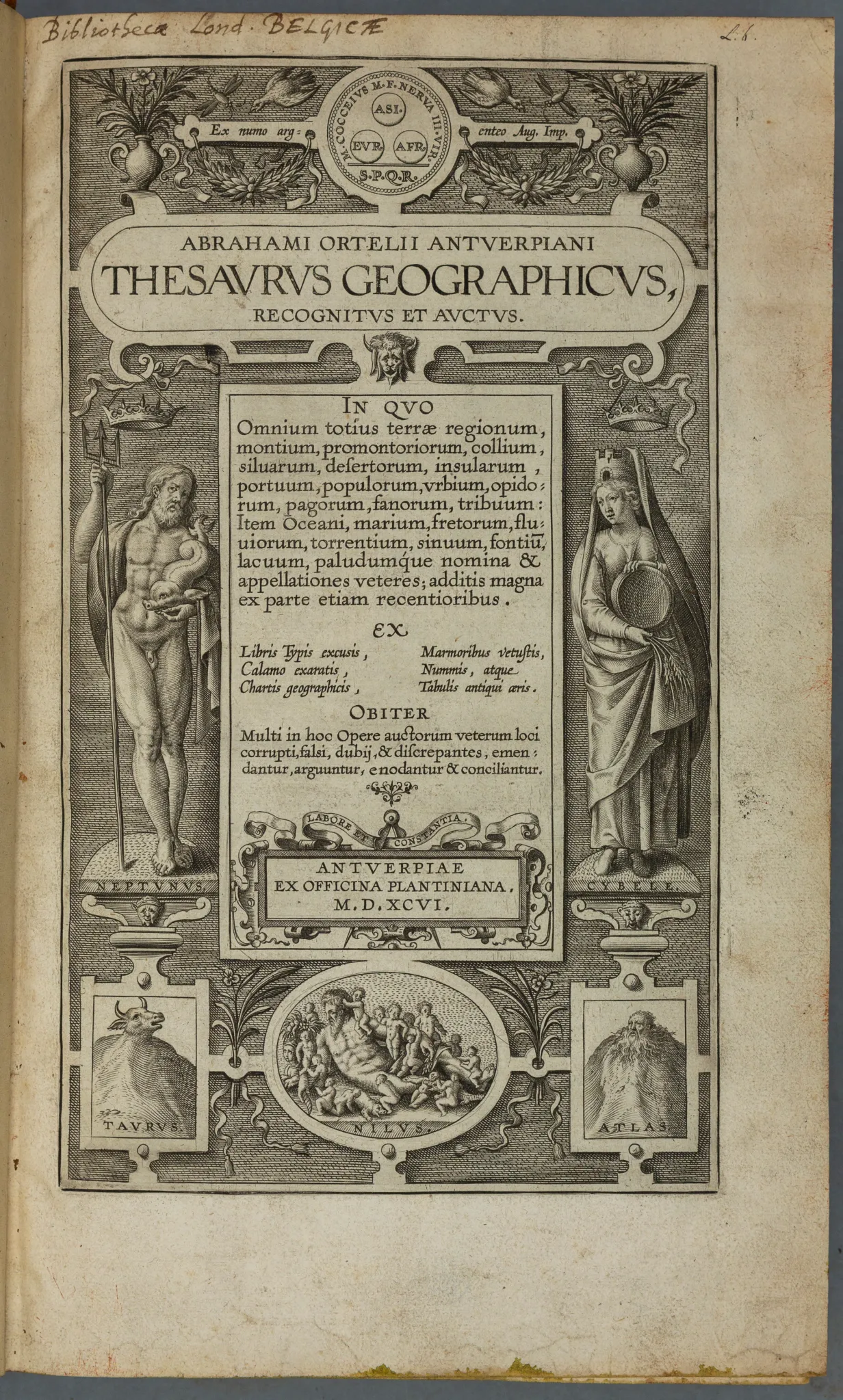
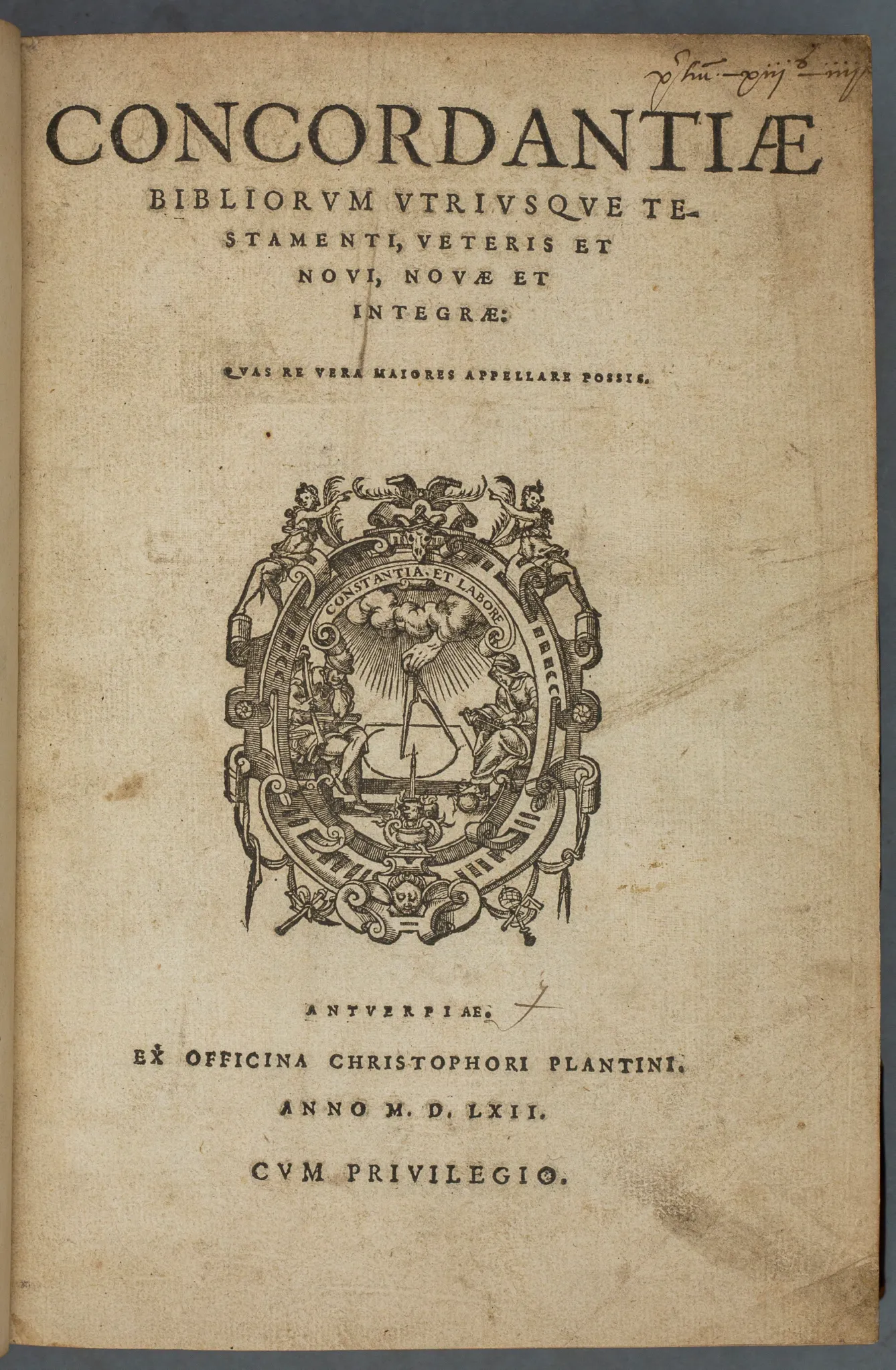
Left: Abraham Ortelius, Thesaurus geographicus, recognitus et auctus (Antwerp, 1596)
Right: Concordantiae Bibliorum utriusque Testamenti, Veteris et Novi, novae et integrae (1562)
Books by Christopher Plantin are part of the history of Senate House Library in the Bloomsbury area of London and of the growth of its collections, as they will be of many British libraries blessed with early printed books. I am writing this as the United Kingdom moves towards severance from Europe. Commemoration of Plantin in the same year reminds us of the strong cultural links between the United Kingdom and the continent, reaching back centuries. Happy anniversary, Christopher Plantin!

Many thanks to Dave Jackson, Senate House Library,
University of London, for producing these images
during one of the (short) windows of opportunity
for access to the collections that are
granted to us these days.
Related articles
by Tomás de Brito, Ampersand
November 9, 2026

November 9, 2026