
Zigzag Calendars: A case study in outreach with schools at Lambeth Palace Library
by Sarah M. Griffin, Curator of Unfolding Time: The Medieval Pocket Calendar
Share this article
From February to May 2025, Lambeth Palace Library hosted Unfolding Time: The Medieval Pocket Calendar. [1] The exhibition brought together a rare and remarkable type of medieval folded book for the first time—the concertina-fold almanac—and set them alongside treasures from Lambeth’s own collection. Folded in a zigzag pattern to form a neat, easily transportable packet of information, their playful form is emphasised by their colourful and almost entirely pictorial content, all of which relates to time.
The project was made possible with a grant of £53,418 from The National Lottery Heritage Fund, with additional support from the Friends of Lambeth Palace Library, The British Academy’s Neil Ker Memorial Fund (2021–22), Bibliographical Society (2022), and the University of Edinburgh (2022–24). [2] It is thanks to their contributions that we were able to bring together an important group of calendars from five lenders—The British Library, Bodleian Libraries, British Museum, Kresen Kernow and The Royal Society, London—and develop interactive interpretation materials that made these complex materials more accessible.
Click on the image to start the video. Explore the exhibition online by clicking on the arrow, and then on the floor to move through the space. Select the circular tags to learn more about the exhibition themes (purple), objects (blue), and details (green).
As our visitors discovered, concertina-fold almanacs are incredible tools for public engagement. Their complex, fold-out structures invite playful interaction, while their largely pictorial content make them accessible to those without knowledge of medieval Latin and palaeography. At the heart of each is a yearly calendar, a device understandable to people of all ages. [3] Exhibiting these colourful, puzzle-like books provided the Library with a valuable opportunity to connect with local schools and community groups, reinforcing our building’s identity as a welcoming place where everyone feels welcome to discover and learn. As part of this, engagement with primary school age children was always a key priority in our outreach strategy.
Our aim was to create a workshop that introduced children to these historical artefacts and encouraged them to reflect on their own experiences of time. During the exhibition, we delivered ourworkshops to over 200 children, focussing on pupils in years 5 and 6. We visited schools and libraries across London—in Enfield, Poplar, Lambeth, and Streatham—as well as our neighbours at the Evelina Children’s Hospital.
In this blog post, we take you behind the scenes of our Zigzag Calendar Workshop, sharing how we designed, tested, and refined the sessions for a specific key stage group, and how we built new partnerships with schools and teachers.
The Zigzag Calendar Workshop
For each 90-minute session, a team of three or four would visit a school classroom. The workshop was refined and delivered by members of our Archives and Printed Books teams—Victoria Gray, Matthew Harper, Lizzie Hensman, Julia King, and Katie Small—who were trained from a detailed plan. This has three key parts:
- Warm up: drawing time. To invite participants to think creatively about the concept of time, we began each session by giving pupils a sticky note and asking them to draw a picture of time. We then held a gallery walk, arranging the sticky notes on one large table, and gathering the pupils around to discuss the pictures. Clocks were by far the most common image, which prompted a conversation about why time—though invisible—is often represented through the tools we use to measure it.
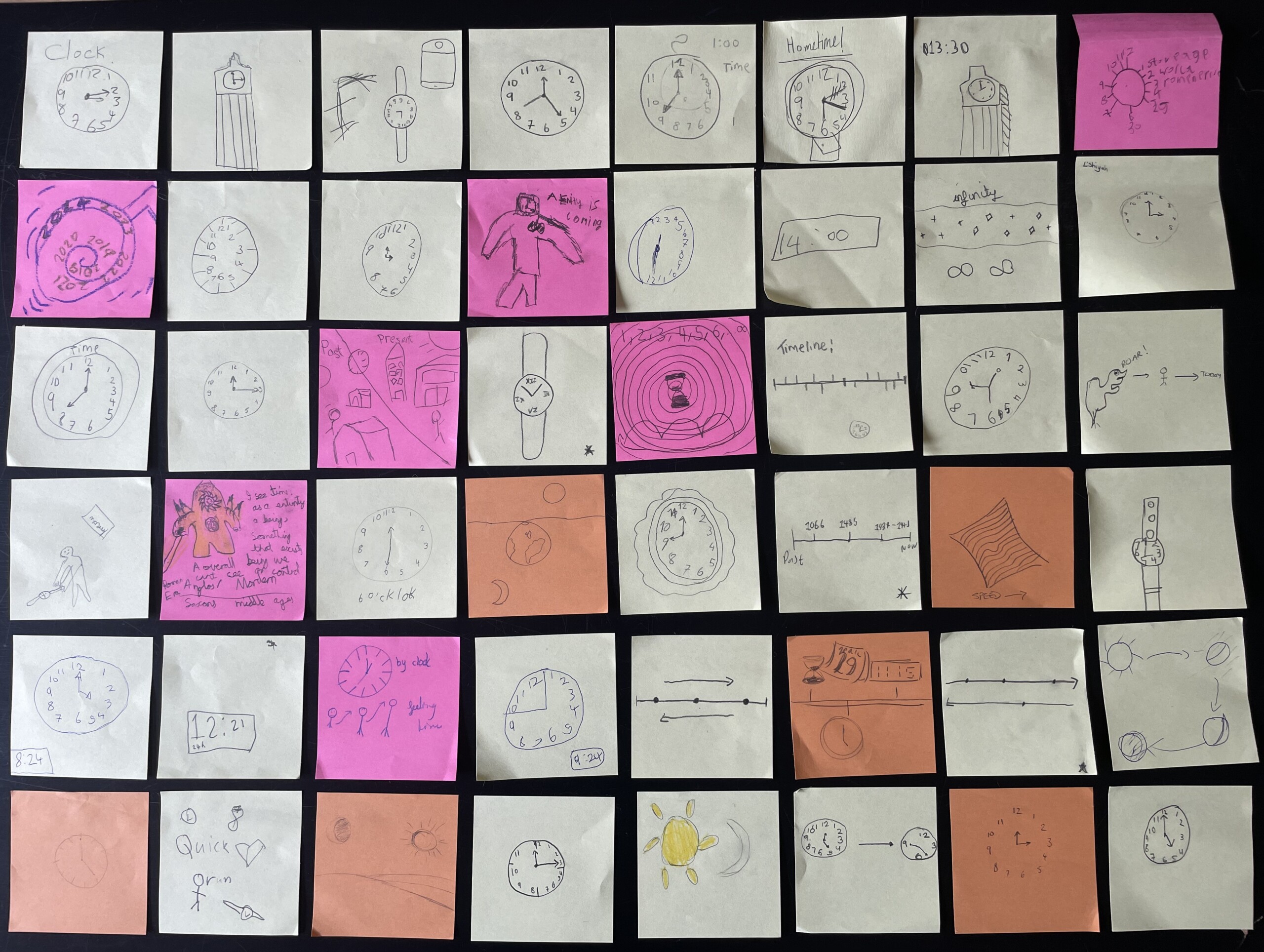
Drawings of time on sticky notes.
Courtesy of Lambeth Palace Library
We often saw drawings of timelines, the moon and stars, pictures of the past, and even a few black holes and a ‘time monster’or two. These began rich discussions about different systems of time, and how it has been tracked through observation of nature—an aspect that directly supports the Year 6 curriculum. After brainstorming different objects we use to track time, we introduced an unusual example:
- Medieval zigzag calendars. A combination of facsimiles and a slide deck helped us to introduce the concertina-fold almanacs. This included quizzing pupils, showing them pictures of (1) the labours of the months, getting them to use their visual analysis to answer what time of year the activity could have taken place, and (2) feast days, using a mixture of well-known examples (such as Christmas) alongside the lesser known, like the feast of Saint Margaret. We chose the below picture as an example of how a story about a saint’s life could be told through one image, in this case, showing Margaret bursting out of a dragon’s belly.
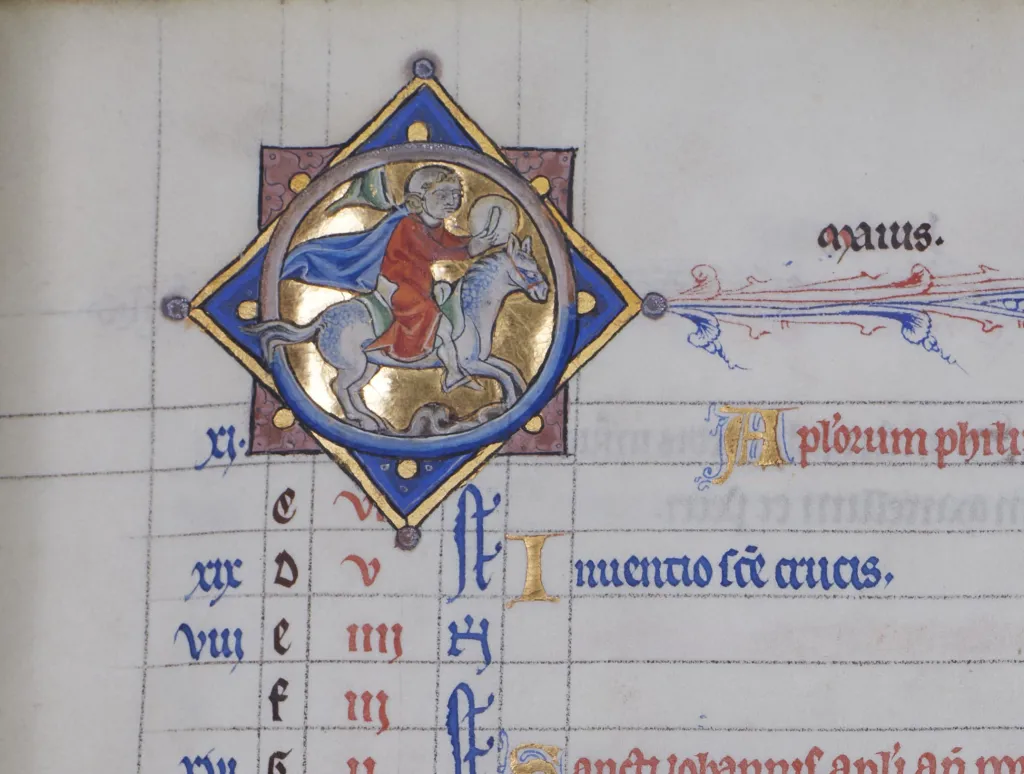
Detail of the labour of the month for May in an English psalter, c. 1260 (Lambeth Palace Library, Sion L40.2/L2, fol. 3r). Reproduced with permission of Lambeth Palace Library
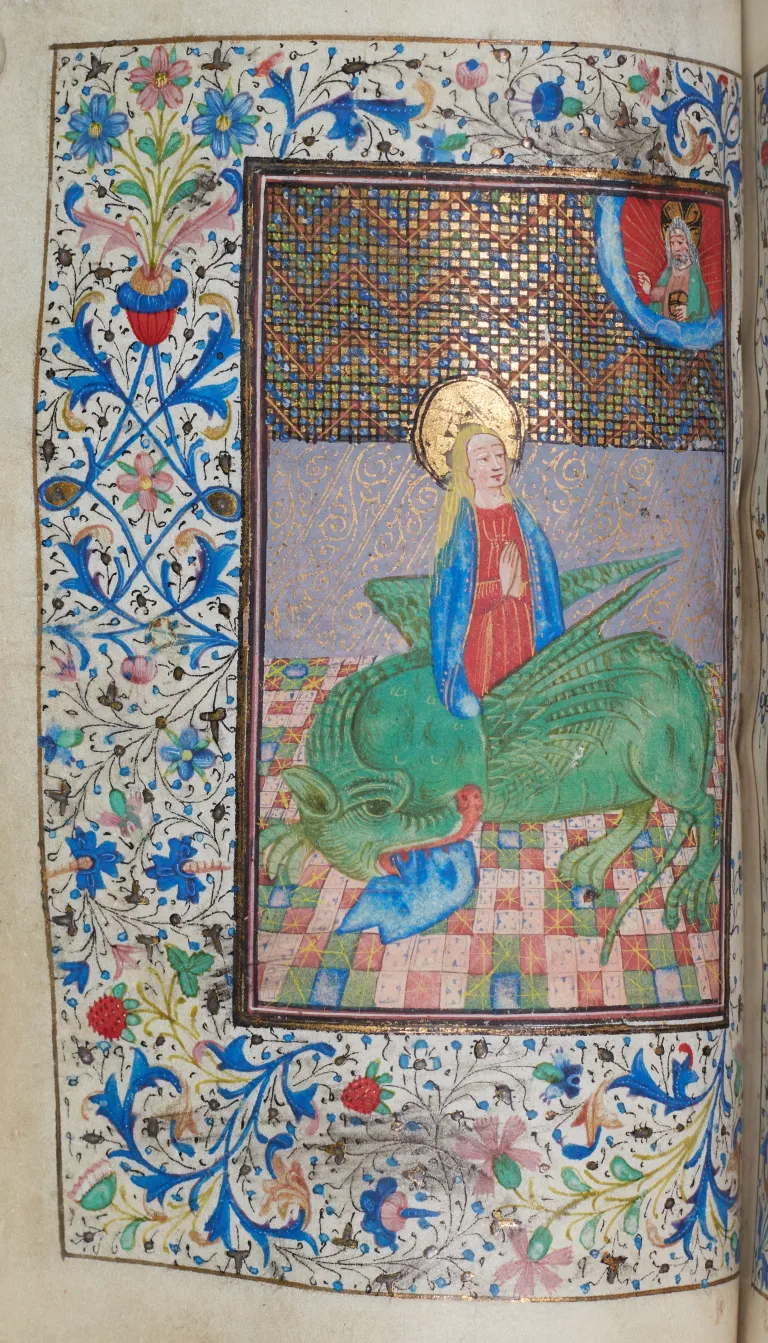
Saint Margaret pictured in a Southern Netherlandish Book of Hours, 15th century (Lambeth Palace Library, MS 455, fol. 30v). Reproduced with permission of Lambeth Palace Library
We then asked the pupils to compare these seasonal activities and feasts with their own traditions, inviting consideration of similarity and difference with the past. This prepared them for part 3.
- Make your own zigzag calendar.
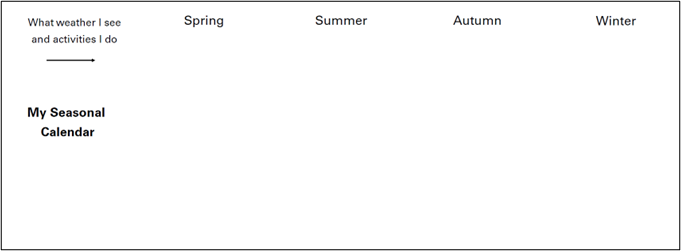
Each pupil received a template of a simplified concertina calendar: a strip of paper which has ‘What weather I see and activities I do’ on side A, and ‘The special days I celebrate’ on side B. Each side was divided into four parts, the seasons on A, and the months (January, February, March together—then—April, May, June etc.) on B. This meant that when turned over, the two sides captured corresponding parts of the year, as in the medieval concertinas.
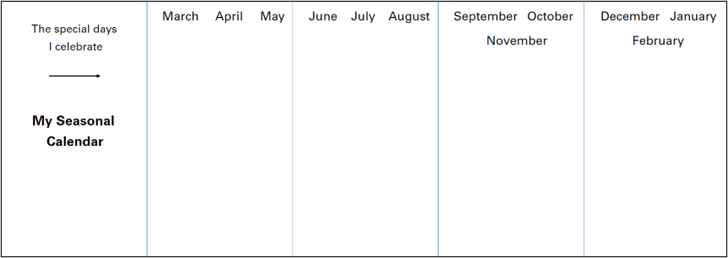
Side A of the zigzag calendar template
Side B of the zigzag calendar template
To make sure the participants understood the activity, we brainstormed one of the trickiest parts together by making a table of the summer months. Next, we encouraged pupils to draw pictures of these celebrations and activities in their own calendars, instead of writing them in. Using their birthday as an example, we discussed as a class what they might draw for their birthday, for which we saw many balloons, cakes, presents, and party hats.
During the activity, the workshop helpers would circulate and speak to the pupils. For inspiration, each helper carried their own facsimile of a medieval concertina. Some pupils were particularly captivated by the copies, asking questions about the languages, ciphers, and stories behind the martyred saints shown in the saints’ calendar. These one-on-one interactions provided valuable moments to explore their contents in depth.
To complete the activity, we gathered pupils together to fold the templates concertina-wise, thus demonstrating how sides A and B related to each other. This was accompanied by an exit ticket, where we asked pupils what they had learnt in the session, and what their favourite part was.
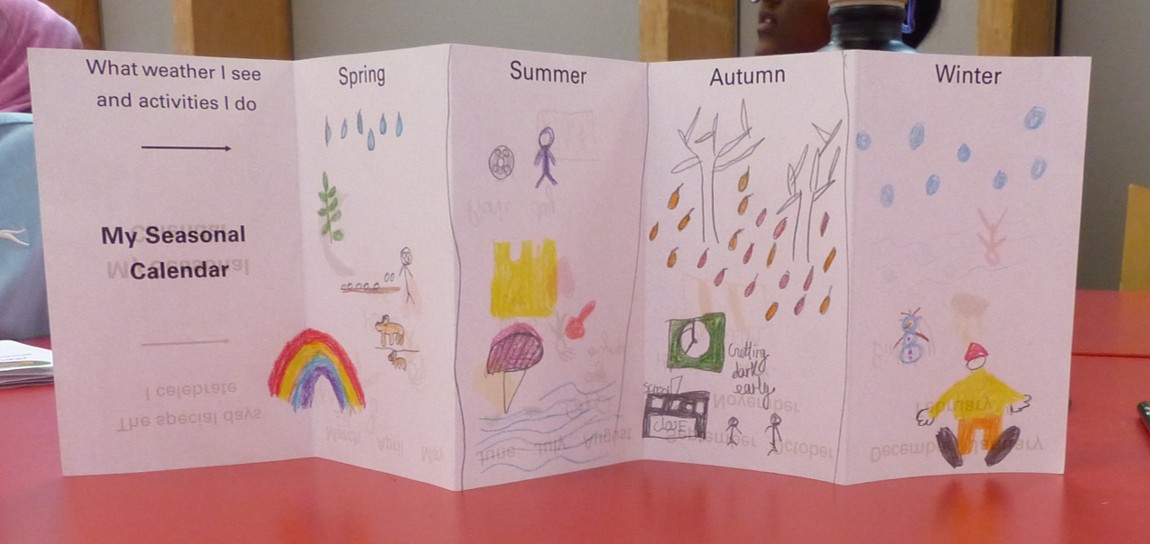
Side A of a completed zigzag calendar
The completed zigzag calendars showed huge variety. While some motifs proved popular—ice cream and swimming in summer, relative’s birthdays, and Christmas celebrations—we were always surprised by new ideas. One class was particularly enthusiastic about April Fools’ Day, while one pupil’s calendar was based heavily on the foundation date of Tottenham Hotspur, which they proudly celebrated every year. The message was clearly received: calendars are often personalised objects and their contents reflect the wider social, religious, and cultural communities to which their owners belong.
Refining the workshop
While the core concepts of the workshop remained unchanged, considerable work went into refining the content before reaching out to schools, ensuring the sessions were equally attractive to teachers and pupils.
We started by testing the make-your-own zigzag calendar template with the public at a Lambeth Palace Garden Open Day in August 2024 (pictured below). This particular Open Day was partnered with a children’s charity, Harry’s HAT, attracting many more children and family groups than normal. Alongside the activity we also offered colouring-in sheets based on woodcuts from one of the books related to the Unfolding Time exhibition, especially for the children who preferred a more familiar activity. This trial run allowed us to see the activity in action and identify areas for improvement.
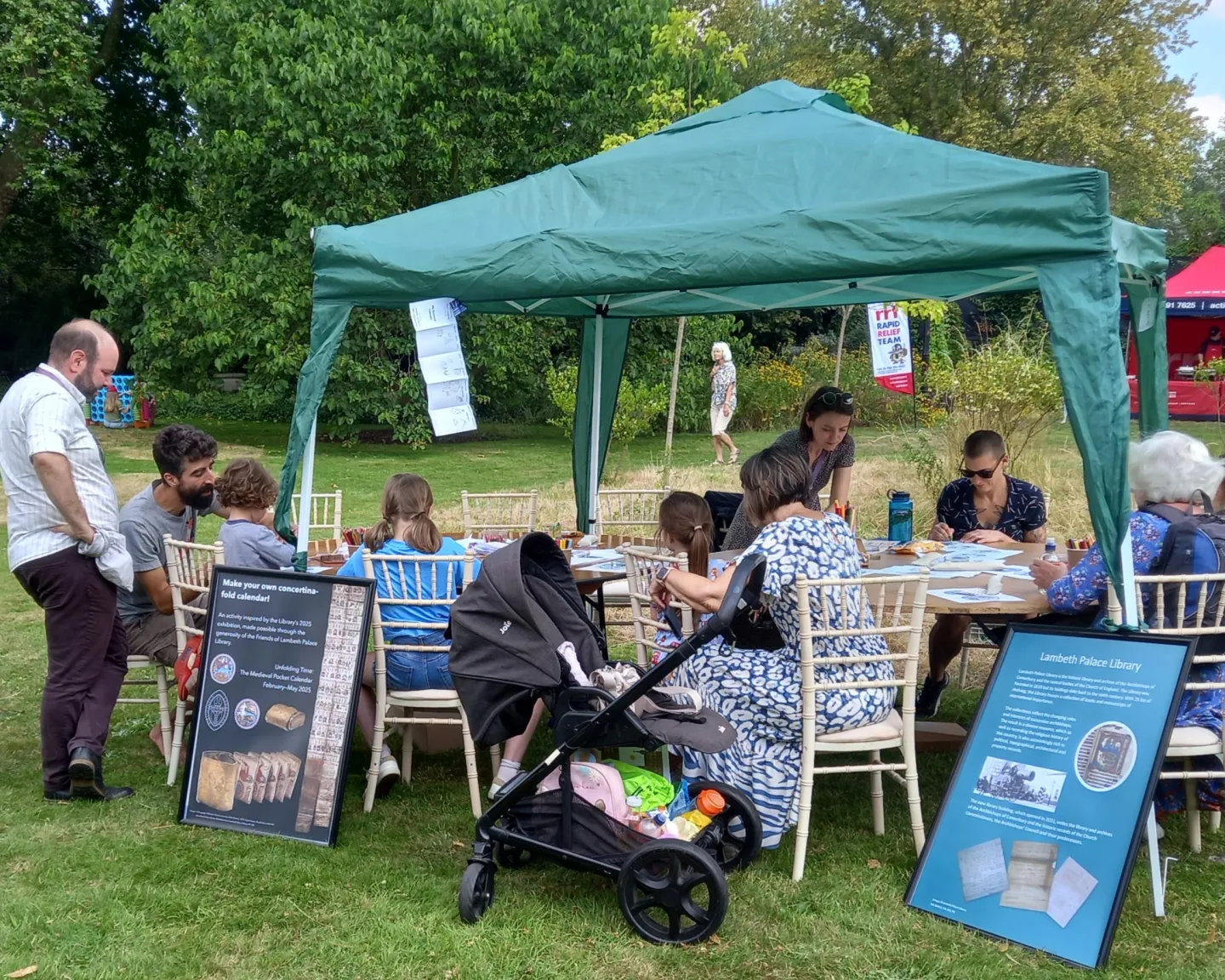
Zigzag calendar stall at the Lambeth Palace Garden Open Day (August 2024).
Courtesy of Lambeth Palace Library.
Once we had confirmed the template worked, the next step was to design a 90-minute session with focussed learning objectives to frame the activity. Our first session was delivered as a free Summer holiday drop-in at the Idea Store, Chrisp Street, a public library which offers children’s programming during school breaks. This gave us the chance to gauge public interest, observe how the workshop was received by children, and determine which age group the concertinas best resonated with.
A key question going in was how we could make these historic Christian objects as accessible as possible to an interfaith audience. We were fortunate to be joined at the workshop by families from a range of faith backgrounds, who made thoughtful comparisons between the moveable feasts in the medieval calendars (such as Easter) and their own, including Ramadan and Diwali. These comparisons later emerged in classroom discussions, leading to rich conversations about the calculation of moveable feasts and their long histories.
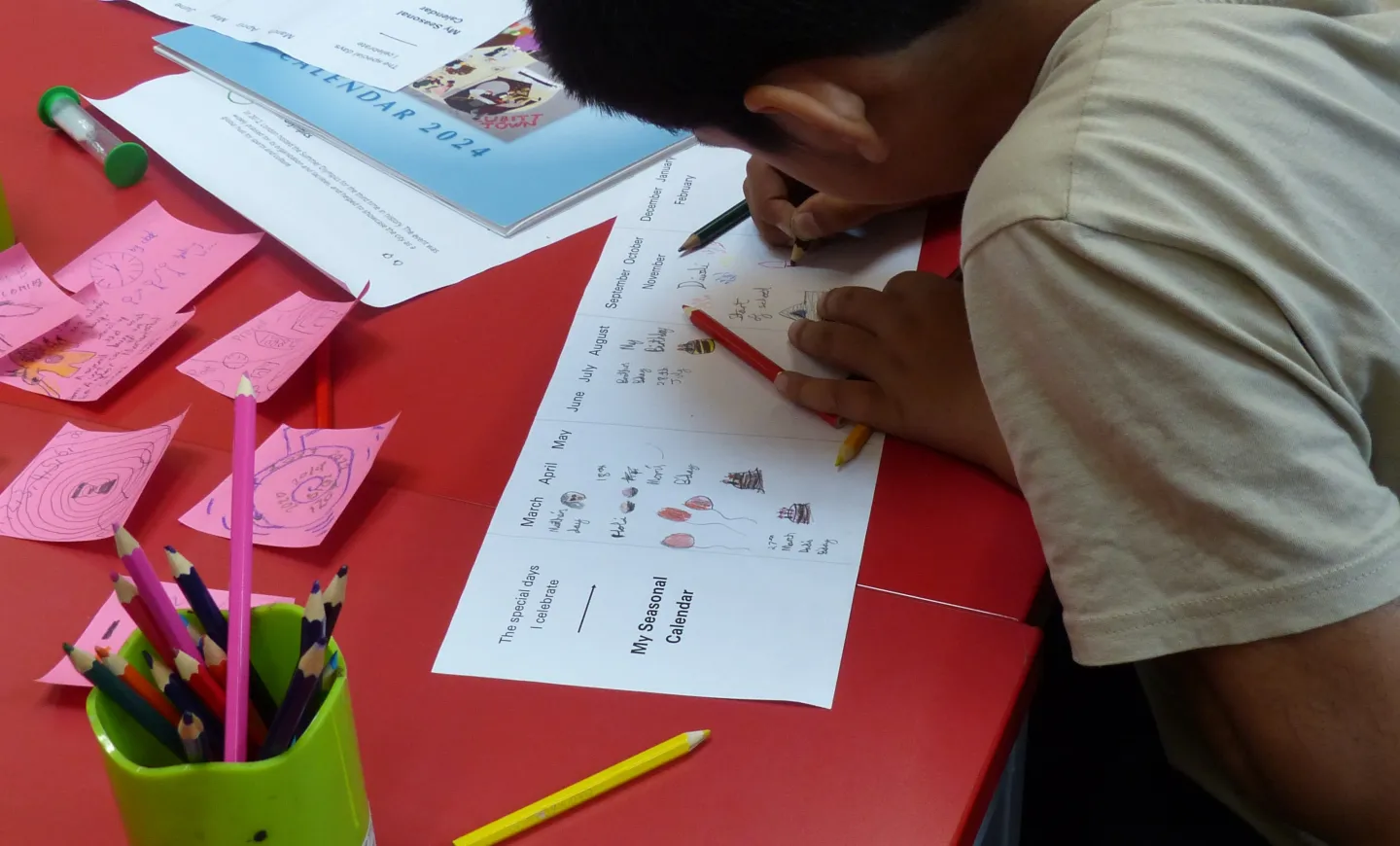
Making a zigzag calendar at the Idea Store, Chrisp Street, in August 2024.
Courtesy of Lambeth Palace Library.
Approaching schools
One of our greatest challenges was ensuring the activity appealed to schools. Here we benefitted from the guidance of Alysia-Lara Ayonrinde, National Education Lead for Racial Justice at the National Church Institutions and a member of the advisory group for the Unfolding Time exhibition. Alysia-Lara connected us with an education consultant, Hannah Edgeworth, whose extensive primary teaching experience helped us adjust our workshop plan and slides. Hannah also identified relevant areas of the curriculum and, by extension, the most appropriate key stage for the workshop.
With this revised workshop packet, we began to approach primary state schools across London. Following Alysia-Lara’s advice, we held three webinars that allowed us to connect with schools we hadn’t previously engaged with, and create a space where teachers could ask questions. Despite inviting many London schools to the webinars, attendance was low, highlighting a key challenge of our outreach plan: building new relationships. Those who did attend, however, were highly engaged, allowing for productive conversations about how the workshop could be tailored to their classrooms. As a result, the webinars proved to be a valuable stepping stone, helping us establish a small but promising network to build on in future projects.
Evaluating the activity
We delivered seven workshops to primary schools across London, ranging from one that was within walking distance of the Library, to another that required a day trip to zone 4. In most cases, we delivered multiple workshops in one day. The pupils’ enthusiastic responses suggested the workshops had been a success. However, we needed to ensure all their voices were heard, including those of the quieter children, so we built in 5–10 minutes at the end of the workshop for each participant to complete a survey. Based on the Kids in Museums evaluation forms designed specifically for primary school children, the surveys gave the option of either drawing or writing their answers.
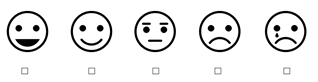
We’re still evaluating the Unfolding Time project, though initial analysis of the workshop surveys is highly encouraging. When asked ‘Did you enjoy the zigzag activity?’, on the below scale, approximately 66% pupils ticked  and 28%
 .
Zigzag calendars going forward
Although the Unfolding Time exhibition is closed, the project continues. In early June, we delivered a version of the zigzag calendar workshop to the school at the Evelina Children’s Hospital, with plans for another visit in Autumn in the works. We are exploring how we can make the workshop more widely available in future, particularly to those institutions who hold concertina-fold almanacs and who have been so generous in allowing us the use of their images for the facsimiles and teaching resources. More broadly, this project has enabled us to build entirely new relationships with schools and public libraries, connections which we hope to nurture with future outreach initiatives.
Primary school engagement is just one branch of the Unfolding Time outreach. During the exhibition’s run, we hosted a free events programme including public lectures and a symposium, and hosted multiple tours and university classes—undergraduate and postgraduate. To support these, we created a challenging digital quiz that encouraged close observation of the exhibits. Several lecturers have since told us they intend to use our materials, including our facsimiles and make-your-own concertina templates, in their own teaching.
The exhibition has a strong digital legacy, with blogs, videos and a 3D scan of the exhibition (see near the top of this post) for anyone who wants to continue learning about these objects after the gallery doors have closed. Through this programme of events and resources, we are proud to have witnessed these books resonate with audiences ranging from experts in medieval manuscripts to young children. This project forms part of Lambeth Palace Library’s ongoing commitment to introduce our collections to new audiences, finding creative, inclusive ways to share them and make them relevant to a diverse public. Keep an eye on our website for news of our future exhibitions and projects at www.lambethpalacelibrary.info.
About our funders
The National Lottery Heritage Fund is the largest funder for the UK’s heritage. Using money raised by National Lottery players we support projects that connect people and communities to heritage. Our vision is for heritage to be valued, cared for and sustained for everyone, now and in the future. From historic buildings, our industrial legacy and the natural environment, to collections, traditions, stories and more. Heritage can be anything from the past that people value and want to pass on to future generations. We believe in the power of heritage to ignite the imagination, offer joy and inspiration, and to build pride in place and connection to the past.
Generous additional support comes from the Friends of Lambeth Palace Library.

Notes
[1] Lambeth Palace Library is the historic library and archives of the Archbishops of Canterbury and the national archives of the Church of England, part of the Church Commissioners for England.
[2] The research underpinning Unfolding Time comes from a project to create a catalogue of all known medieval concertina-fold calendars by Drs Megan McNamee, Kathleen Doyle, and Sarah Griffin (see https://www.meganmcnamee.com/projects/folding-jglfy). McNamee and Doyle were research and curatorial advisors for the exhibition.
[3] Just one surviving manuscript (University of Oxford, Bodleian Libraries, MS Ashmole 8) is a fragment without a calendar, but almost certainly would originally have had one.
Related articles
by Markéta Kučerová and Vojtěch Šícha, Library of the Czech Academy of Sciences
November 9, 2026
by Konrad K. Szymański (Ossolineum National Library, Wrocław)
November 9, 2026