
The Democratization of Library Heritage Collections
by Louise Amazan, Daryl Green & Garrelt Verhoeven (IFLA RBSC)
Share this article
Introduction
On April 24th 2025 the Standing Committee for Rare Books & Special Collections (RBSC) of IFLA and CERL’s Bookbinding group joined together for a seminar at the Bibliothèque National de France. With the title Médiations du patrimoine en bibliothèque: enjeux et perspectives / Meditations on Libraries and Heritage Collections, the seminar was devoted to the different ways of reaching and engaging new audiences with our special collections (the programme is available here). From exhibitions to the creation of digital content, the objective of the symposium was to discuss how libraries can connect the public to heritage collections by developing innovative methods of engagement that emphasize respectful exchange and public participation.
Speakers from various European Countries and the United States gathered at the Salle des Conférences at the beautiful Richelieu Library and Museum of the Bibliothèque Nationale de France. This paper is an abstract of the session, based on the keynote paper by Garrelt Verhoeven and the concluding remarks of Daryl Green, intermingled with abstracts of the papers that were presented, prepared by Louise Amazan.
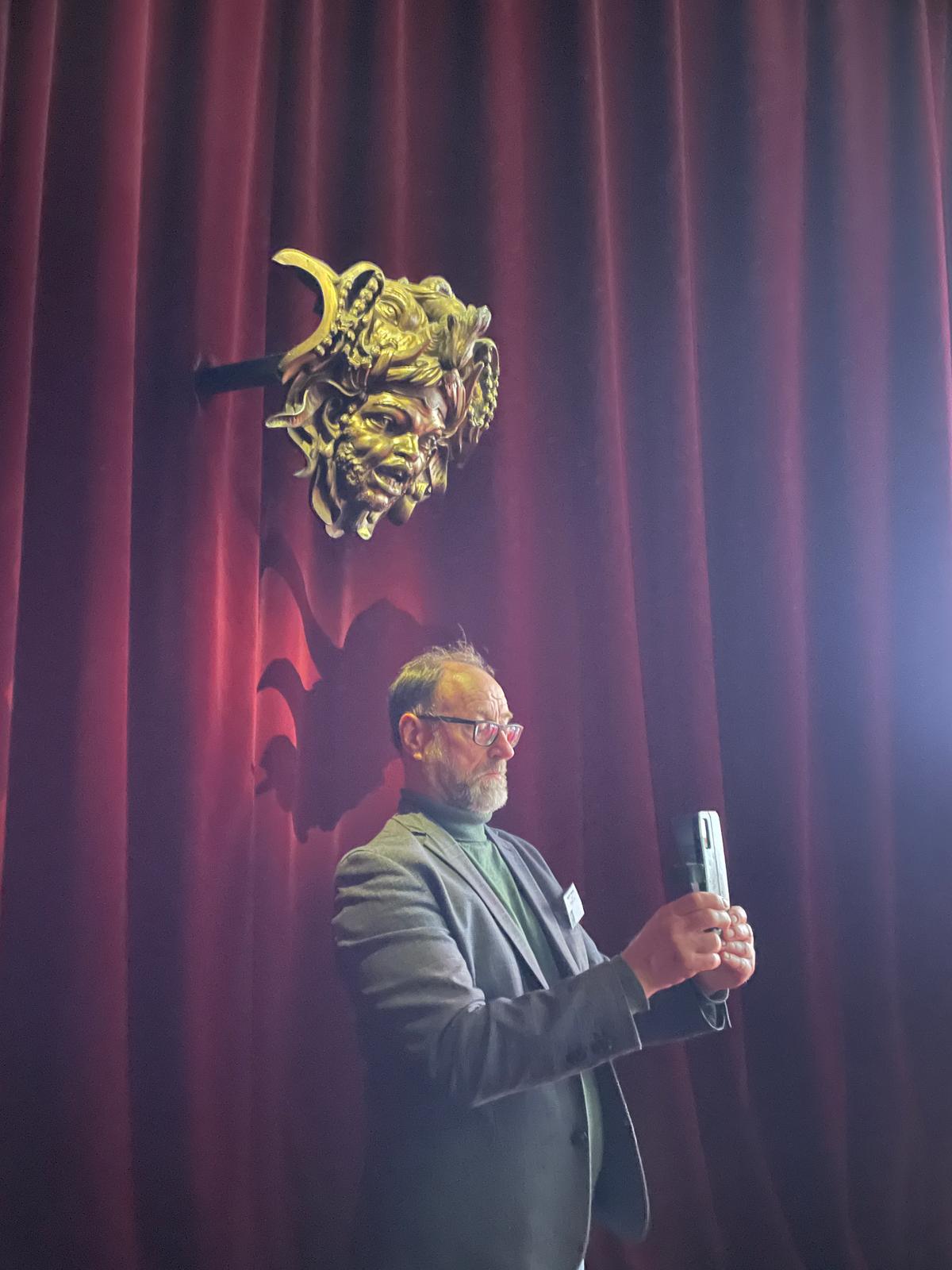

Left: Garrelt Verhoeven (UL Leiden) – Right: Louise Amazan (BnF) and Daryl Green (UL Edinburgh)
Mediations & Meditations
The French title of this seminar is Médiations du patrimoine en bibliothèque: enjeux et perspectives, while the English one reads: Meditations on Libraries and heritage Collections. I am not sure the English version has exactly the same meaning as the French one, but it is definitely a time for meditation and reflection, and this is a topic of great relevance and urgency, due to developments both within the heritage world and beyond.
A year ago, in the summer of 2024, IFLA’s RBSC section joined in Barcelona for a seminar on the theme of censorship, as an alternative meeting for the proposed IFLA-congress in Dubai. We were glad that the authorities of Dubai withdrew its candidacy after the loud protest that arouse during the Rotterdam conference in 2023. One of the questions that surfaced during the Barcelona-seminar was: Should librarians and curators be activists in the light of government censorship, fake news and restrictions of the free word?
And that was even before all the disrupting recent developments in the United States and elsewhere, where democratic values are seriously under threat. This menace is multiple and includes, among other things, the threat to free science, the threat to the value of knowledge and the threat to academic freedom. Only a few weeks ago, Harvard University refused to comply with the Trump administration’s demands regarding the topics it could research and teach.
It has always been, and it should be, unimaginable that American scholars, and especially those who specialize in colonial history, inclusiveness, gender studies or any other subject that is supposed to be ‘woke’, seek refuge in France. Scholars and scientists all over the world are withdrawing their data from American servers and we can foresee that it won’t take long before libraries are under threat as well, with restricting rules on acquisition, cataloguing, digitization and yes, also for ‘médiation’, mediation or public outreach of our heritage collections.
So yes, our fellow librarians and curators, we have to be activists, when our common democratic values are under clear and present danger! Every librarian, every curator, should be an ambassador of the free word. And if we don’t, we better hope the French government will reserve a plot on the other side of the River Seine to accommodate a new and free Library of Congress, with the reclaimed Statue of Liberty in front of it.
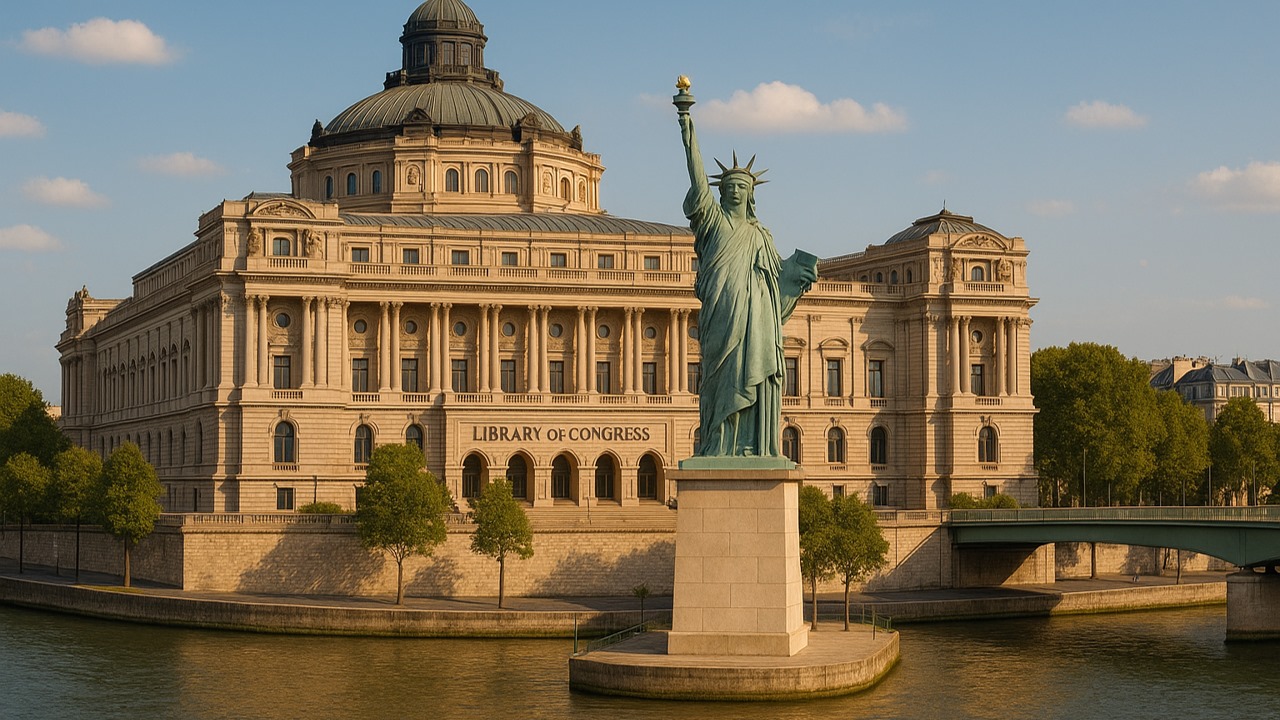
Generated by Garrelt Verhoeven
Democratization of Library Heritage Collections
In the light of all this, the theme of this workshop is more relevant than ever before. The phrase ‘democratization’ does not, however, refer to the implementation of democratic values in the library, but to the ability of documentary heritage collection to engage much wider audiences than the ‘traditional’ academic users we meet in our reading rooms.
Heritage collections are a powerful instrument in actual social debates, like the shifting attitudes towards colonial history, slavery, diversity and inclusivity, to name just a few. Books, manuscripts, letters, images of all kind and many other artefacts you can find in what we call Special Collections, can really help society in difficult discussions and it can bring historical truth and nuance in it.
We try to bring our Special Collections to a wider audience though exhibitions, both physical and digital, permanent or temporary, through publications, videos and social media, and through all kinds of programming in the library. We also use even more elaborate ways to engage different audiences. But we do need a rich and well equipped toolkit to bring our special collections alive and we have to look at our collections from different perspectives!
Let us demonstrate this by a recent example from the Netherlands: the story of a young man from Surinam, a former colony of the Netherlands. This man, Anton de Kom, did speak out for freedom and protested against colonial imperialism.
The Case of Anton de Kom
Anton de Kom was born in Paramaribo, the capital of Surinam, and grew up to be a bright and social human being, raising his voice against the oppression of the Dutch colonial authorities in his home country. Not so much for his own benefit, but to stand up for the poor working class that was suffering from it in the early twentieth century. De Kom was arrested in Surinam and subsequently exiled to the Netherlands in 1933.
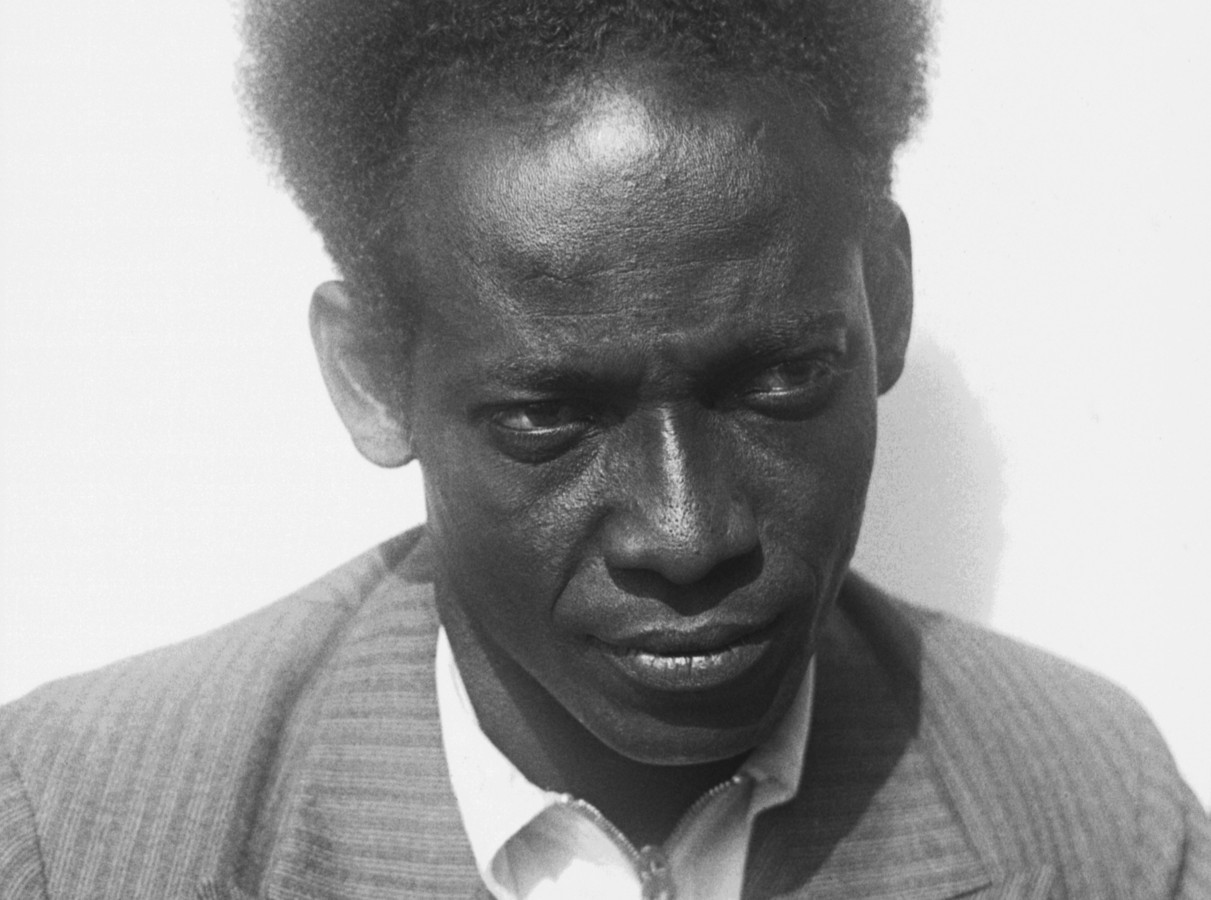
Anton de Kom (1898 – 1945)
He settled in The Hague to write his anti-colonial manifesto Wij slaven van Suriname – We Slaves of Surinam, which was published in 1934. It gained some attention in the left-wing newspapers, but it never reached a wider audience, neither in the Netherlands nor in Surinam. The upcoming national-socialism and the German invasion made De Kom shift his battle as freedom fighter from colonial oppression, racial discrimination and injustice to the German occupiers. He became an active member of the Dutch resistance, but after betrayal he was arrested by the Germans and deported to the concentration camp Neuengamme. He died of pneumonia only weeks before the camp was liberated by the allied forces.
Against the backdrop of the Second World War and the years of reconstruction, Anton de Kom and his manifesto for freedom and justice disappeared completely from view. De Kom was almost forgotten when, in the late sixties, a Surinamese student in Leiden, Rubia Zschüschen, found the book to her astonishment in Leiden University Library. Many students from Surinam chose to study in Leiden in the fifties and sixties. Under the influence of the emerging Provo movement and the protests against the Vietnam War, they began to have growing doubts about the self-evidence of Dutch colonial authority in their mother country.
Rubia leafed breathlessly through the pages of We Slaves of Surinam, in which the history of her country was not written from the perspective of the colonial ruler, but seen through the eyes of the freed slaves, the Maroons. She realized that the book expressed the feelings of her and her fellow students as an anti-colonial and inclusive manifesto. That is precisely why the book, more than thirty years after the first edition of 1934, made such an overwhelming impression on a new generation of readers. The students were touched by the topicality and relevance of De Kom’s words and they became aware that his manifesto could play an important role in their own anti-colonial protest and their search for a Surinamese identity.
They decided to take the Leiden copy from the library and Rubia, together with her fellow members of the Surinam Students Union in Leiden, tried to persuade the Dutch publisher to print a new edition of the book. Then it would be available to a new generation of readers that was struggling with the colonial past, only eight years before Surinam would become independent. After the refusal of the publisher to print a new edition of his controversial book, the students decided to publish it themselves, using the ‘printing press of the revolutionary sixties’: a stencil machine, or mimeograph! When I showed this picture to my students they had no idea what I was talking about! Can I see the hands of all of you who know the stencil machine?
In the summer of ’69 Leiden University’s copy of the first edition of Anton de Kom’s We Slaves of Surinam was torn apart in separate leaves, and several students copied the text page by page by typing it on stencil sheets. So it was reprinted as a cheap stencilled version in – of all places – the white, conservative city of Leiden! Even more than the first edition of 1934, the stencilled version contributed to the recognition of De Kom as a freedom fighter. Several stencilled reprints were subsequently published, both in the Netherlands and in Surinam. Many Surinamese people became acquainted with the militant words of Anton de Kom via these cheap stencils. They were the predecessors of the ‘real’ (printed) second edition of his masterpiece, which was published in 1971 by publisher Contact. Libraries don’t usually collect these stencilled booklets, but thanks to private collectors they have survived as the rare traces of the early dispersal of the manifesto.
Now everyone in Surinam could read the book that tells the history of their country from the perspective of the Surinamese. We Slaves of Surinam also gave the people of Surinam self-confidence. Until then, slaves who had run away from the plantations, Maroons, were portrayed as thieves, traitors and scum. De Kom, on the other hand, calls them heroes of the Surinamese people. In this way, the book plays an important role in the formation of the Surinamese identity, not only for the Creole Surinamese but for all ethnic groups in the country. It became the first step towards a national ideology, which would develop further in the sixties and seventies.
Of course, a few years later the Dutch publisher responded by publishing new printed editions – business is business – and gradually Anton de Kom became an icon of anti-colonialism, but also as a freedom fighter who stood up for the poor working class in Surinam and who joint the resistance in World War II. Still, only recently his name appears in Dutch schoolbooks and in 2020 De Kom was added to the so-called ‘Canon of the Netherlands’. De Kom is the first Surinamese citizen to be added to the fifty vital subjects to be taught in school in the Netherlands.
In 2020 Leiden University Library included De Kom in a major exhibition about Books that changed the World, with the stencil edition of We Slaves of Surinam proudly between venerable, impressive, highbrow, showy and valuable masterpieces of science. In 2023 we made an exhibition about the Surinam Student Union and the story of the stencil edition. I managed to find the exact type of stencil machine they used in 1969, so at the opening event several of the former Union members operated the machine again half a century later. A Dutch filmmaker made two short documentaries about this important episode in the history of Surinam and of course, Anton de Kom’s book has been reprinted many times now. The Amsterdam government even published a free edition to be distributed in the city’s schools and libraries. And finally, a few weeks ago, a major exhibition about Anton de Kom opened in Surinam, of course starring the stencil machine I found.
Anton de Kom is now an icon of freedom and resistance among new generations, both in the Netherlands and in Surinam. It would be too much honor to say that the revaluation of De Kom and his rise to icon status was due to the work of curators and librarians, but we did our part! For one thing, this example shows that library heritage is not just about Great Books and Manuscripts from a distant past, and creative outreach can really be of importance in present-day society.
The Importance of Outreach
So yes, libraries matter! Heritage matters! And for the future of heritage collections in our libraries and institutions it will be more and more important to find new ways of engaging new audiences. We were very pleased that despite the very short term we received so many promising proposals for our seminar!
1. Transitions in Exhibitions
Promoting heritage collections, whether through permanent displays or temporary exhibitions, is a crucial challenge for heritage libraries. However, we must overcome a major paradox: while the best way to preserve a book is not to open it, this is also the best way to ensure that it is forgotten, and with it, entire libraries and the memories they contain.
Therefore, the best way to raise public awareness of heritage preservation is to bring people into contact with the diversity and richness of what libraries have to offer. No longer reserved for consultation by specialists, library spaces are being transformed to allow visitors to wander around in new settings. Emmanuel Coquery, Director of Cultural Development and Museums at the Bibliothèque nationale de France, presented the cultural project for the new museum housed in the historic BnF building on Rue de Richelieu, which aims to create meaning and engage visitors through the fruitful interaction between works in a dynamic rather than static presentation of the collections.
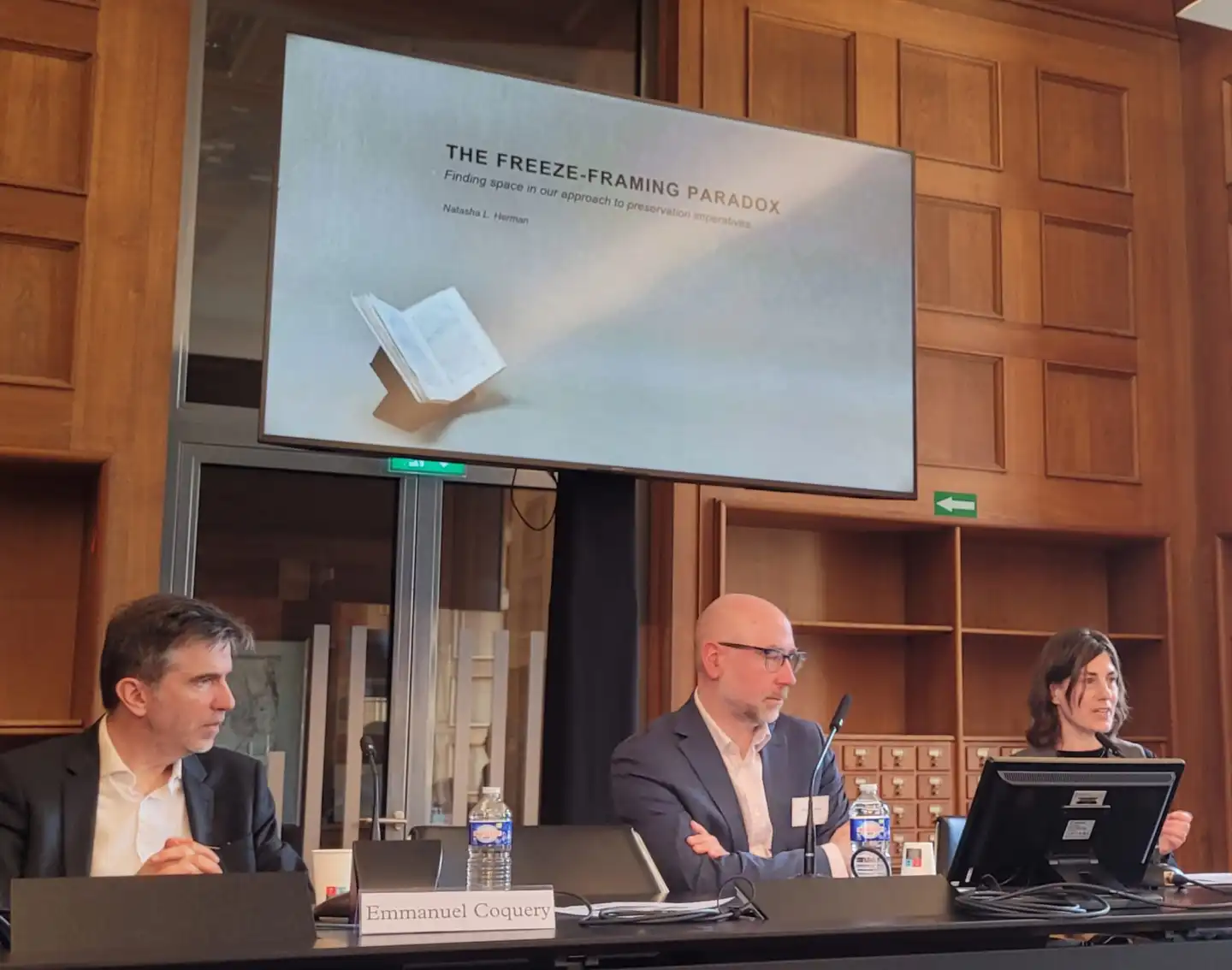
Emmanuel Coquery (BnF), Greg Prickman (Folger) and Natasha Hermann (Red Bone Bindery and Stilt)
Greg Prickman, Director of Collections and Exhibitions at the Folger Shakespeare Library, outlined the brilliant conversion of the museum spaces in this Washington library, whose location and nature have led to careful consideration of its relationship with the public. An immersive experience at the heart of the Shakespearean collections, highlighted by the exhibition of 82 copies of the First Folio in a specially designed display cabinet, the new presentation is eminently interactive and participatory.
The impact measures recorded for this first year of existence reveal a very strong public support for this new way of presenting the collections. Adopting the perspective of the object and evoking the risks associated with its exhibition, Natasha Herman, a trained restorer, developed a presentation on the concept of the freeze-framing paradox, showing how the survival of a book paradoxically depends on its exposure to a public that will later take care to preserve it.
2. Beyond the walls: building online user communities.
The library user community also extends beyond the walls of the library itself. Virtual exhibitions thus become not only an archive of a past exhibition but also an extension of it, allowing a wider community to appreciate a given collection. Chiara Cauzzi, from the Lugano University Library, spoke about the promotion of the collection of Carlo Dionisotti, a philologist and specialist in Italian literature, which highlights various rare works and collections in the library, in a fruitful collaboration between institutions.
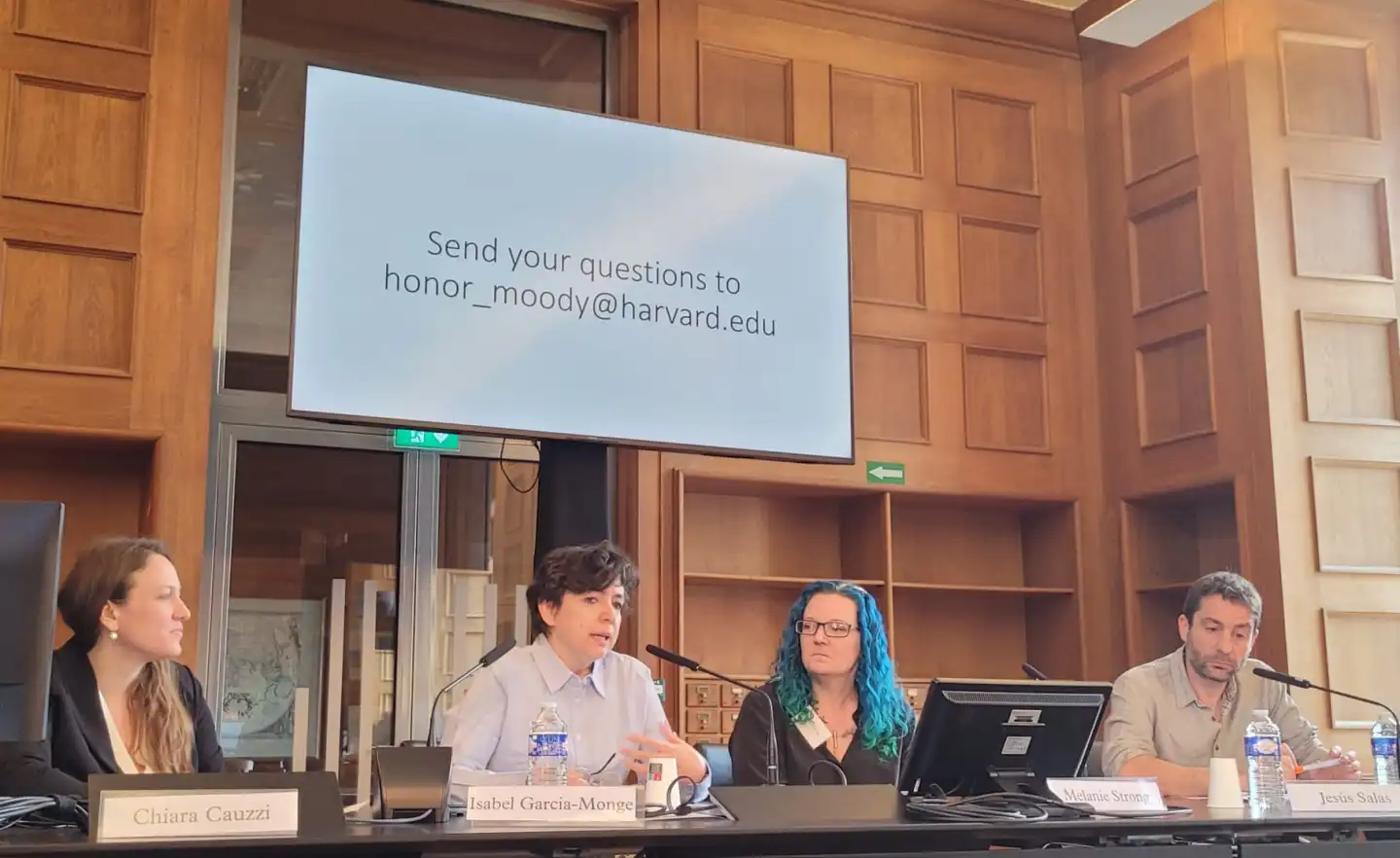
Chiara Cauzzi (UL Lugano), Isabel Garcia-Monge (Ministerio de Cultura, Spain),
Melanie Strong (Guildhall Library, London), Jesús Salas (University of Cantabria)
Jesus Salas, senior librarian at the University of Cantabria Library in Santander, presented a large-scale digital humanities project that opens up the library’s collections to new communities by by putting online the registers of shipping companies organizing voyages from Spain to America, which are kept at the library. A transcription is available, integrated into a database that facilitates searching. The project allows not only researchers but also anyone doing genealogical research to access archives that were previously underutilized.
Covid has accelerated the digital transformation of libraries and strengthened their online presence, as evidenced by the two presentations that followed: Melanie Strong, senior librarian at the Guildhall Library in London, explained how the pandemic has led to a change in the use of social media and the online broadcasting of library events, which has resulted in a significant increase in the traditional audience. After Covid, programming took these new user habits into account by maintaining a hybrid format for conferences held at the library, while encouraging the public to visit the collections in person to attend special presentations of works from the collections, with commentary by staff members.
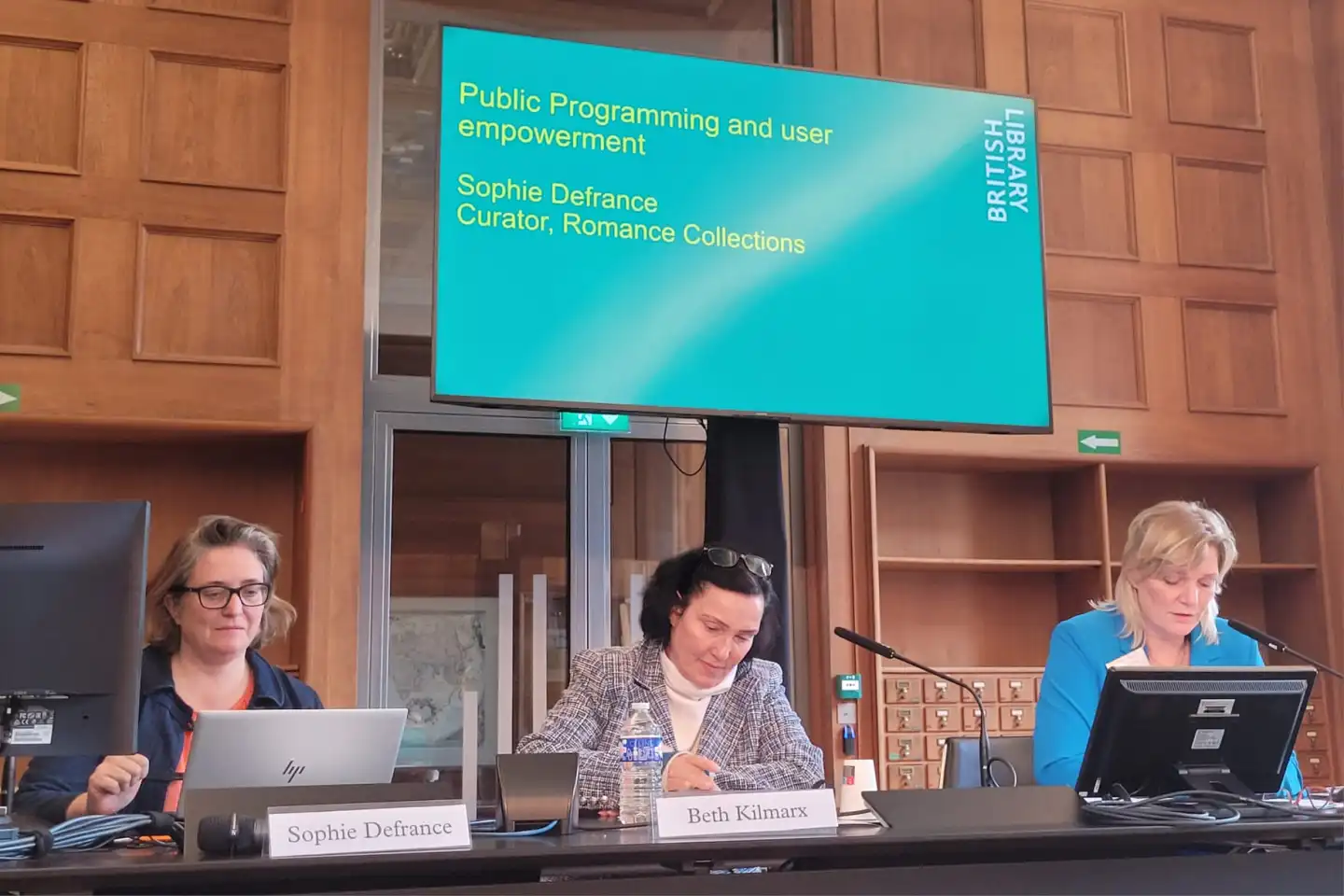
Sophie de France (BL), Beth Kilmarx (then Texas A&M University, now at Boston Medical Library),
Antje Theise (UL Rostock)
Beth Kilmarx explained how the Cushing Memorial Library, faced with remote use by readers—both in terms of information provided by librarians and on-demand digitization—has implemented tools to evaluate these uses, improve the service while expanding it with on-site training, and continue to offer exhibitions. The return of large numbers of users after the pandemic showed that online and on-site use were indeed complementary.
3. New audiences & new perspectives
The program also aims to reach a wider audience: library heritage collections are not meant to remain solely in the hands of researchers, but should be made accessible to everyone. This is the purpose of three events presented by Sophie Defrance, curator of Romance collections at the British Library. The third event is particularly noteworthy, as it relies on the active involvement of the community, who are invited to share oral testimonies or objects related to items from the collections. Bringing together the University of the Arts London and various sections of the British Library, the project aimed to create links between what the library is, what it contains, and how it can connect with the people around it, replacing the normative approach with a culture of resource sharing.
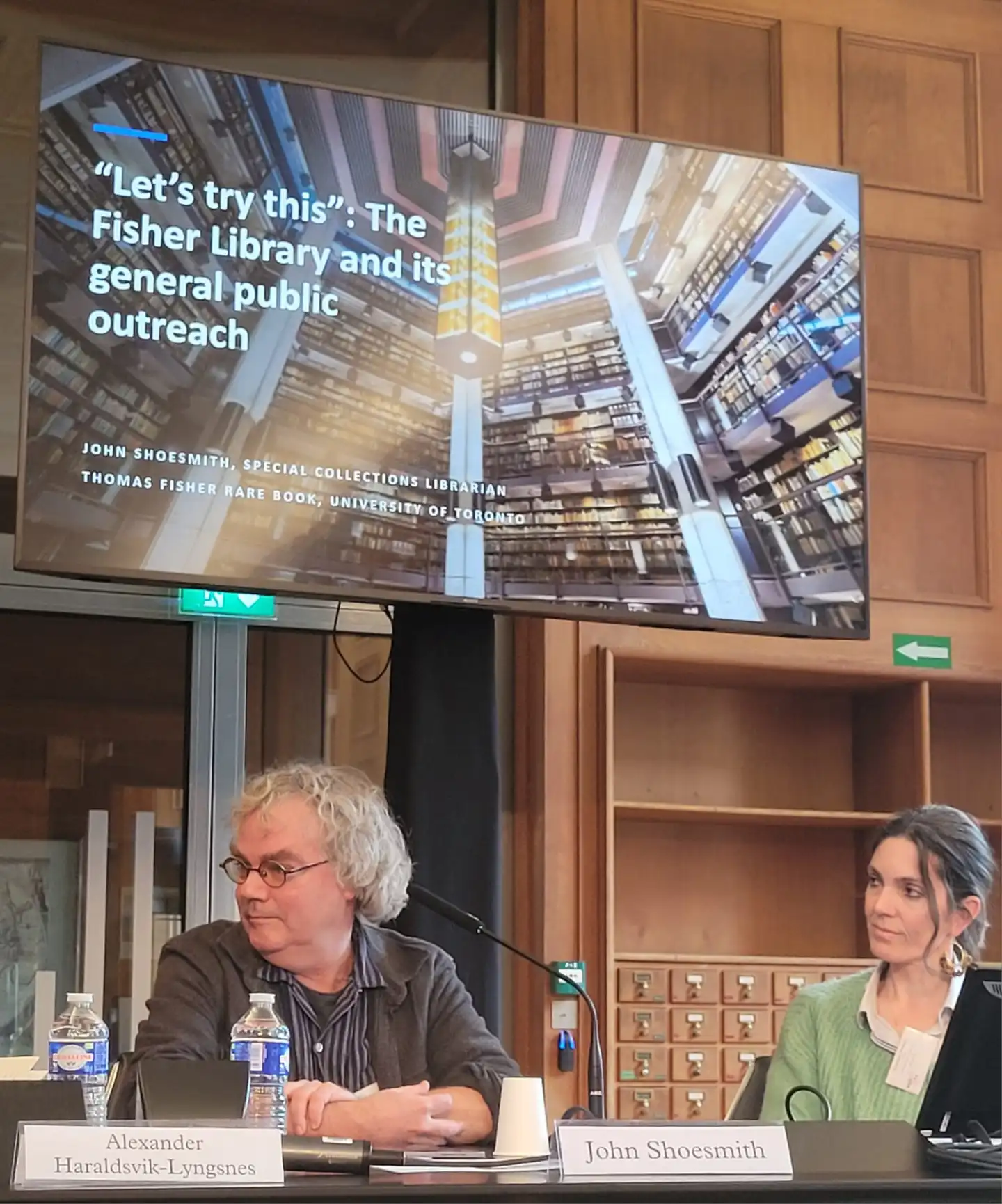
Joe Shoesmith (Thomas Fisher Library, Toronto) and Caroline Poulain (BiblioPat)
John Shoesmith, Special Collections and Outreach Librarian, describes the Thomas Fisher Library’s efforts to open up to a wider audience: Although the library has been holding open days for a long time, they can occasionally focus on a particular theme and are reinforced by conferences and hands-on workshops open to the general public, as well as guided tours of exhibitions. The regularity of these events, which are promoted on social media and linked to a wide range of online resources, helps to embed the library in the cultural practices of Toronto residents.
Finally, Caroline Poulain, president of an association of librarians responsible for heritage collections in France (BiblioPat), discussed the conclusions of a book published on the occasion of a colloquium on heritage mediation, highlighting in particular the importance of the library’s position in the community and its openness to other practices and communities.
Ambassadors of the free word
For the last 25 years, there has been a pushing out, an opening up, of our collections. So much work has been done to diversify our ways of working and our audiences, to change how we think and interpret our collections, and how our own biased practices need re-examining. However, at this geo-political moment, it feels like we’re at a recoil point, where we could all get under cover and let this storm blow over.
But we should not. We cannot. We need to do our part in protecting the free word. We need to support our colleagues internationally when they feel compelled to stand up and share their voice, their professional opinions, their minds. We need to act across borders and act as conduits for suppressed voices.
At the very essence of why we chose this profession is the wonder, the awe, of knowing that access to the world’s knowledge is possible. But, the more that we settle into our professional roles, our work, the more we become aware of the everyday struggles and the more grand battles that we have to fight to protect that possibility. Death by 1,000 budget cuts, huge swings in national and international politics, local societal tolerance of ideas of gender and race equality, metadata terms, publishers’ deals and so on are as much our work as being that human connective tissue between a curious mind and a book or object in our care.
We need to be aware of these daily struggles, to support each other when fatigue sets in, to bring up new generations and platform their voices and their concerns. We need to think carefully about how our spaces and our services can respond to an increasingly needy and diverse group of users.
We also need to be careful of our online presence and the ever changing, and resource hungry, nature of that environment. The ephemeral nature of social media, the bifurcated attention span of our users, are all contextual concerns that we has informational professionals need to be equipped to confront.
To focus in, then, on what binds us together professionally, is to focus in on the balance between access, preservation, and contextualization. So much work has been done by previous and current generations of professionals to break down historic barriers to cultural heritage (archives, documents, books, objects, art and others), and access is now our key principle – this is a huge step forward. At this moment, we need to recognise that even the most stalwart of institutional collections are not as permanent or as stable or benign as our founders might have hoped. Universities are closing and liquidating their collections. Political and societal opinion is once again threatening censorship and redaction. Governments have weaponized the rejection of information and data-based research and knowledge.
Although the stewardship of our collections is handed across generations, like a baton through time, we must not forget the race ahead. We must prepare ourselves and our profession to stay the course in protecting the free word, the free flow of information. We must play our part in carrying forward the light of the past into the uncertainty of the future.
We need to ensure that new generations of professionals are aware of this arena of action, and that they, too, are trained and equipped for this ever-present struggle.
To conclude, and return to a citation from this conference: “Collections not used are useless collections” (Sofacto, 1991). We’ve progressed as a profession to no longer being the road block to use. Now we need to pivot to the safeguarding of both our collections, and our users.
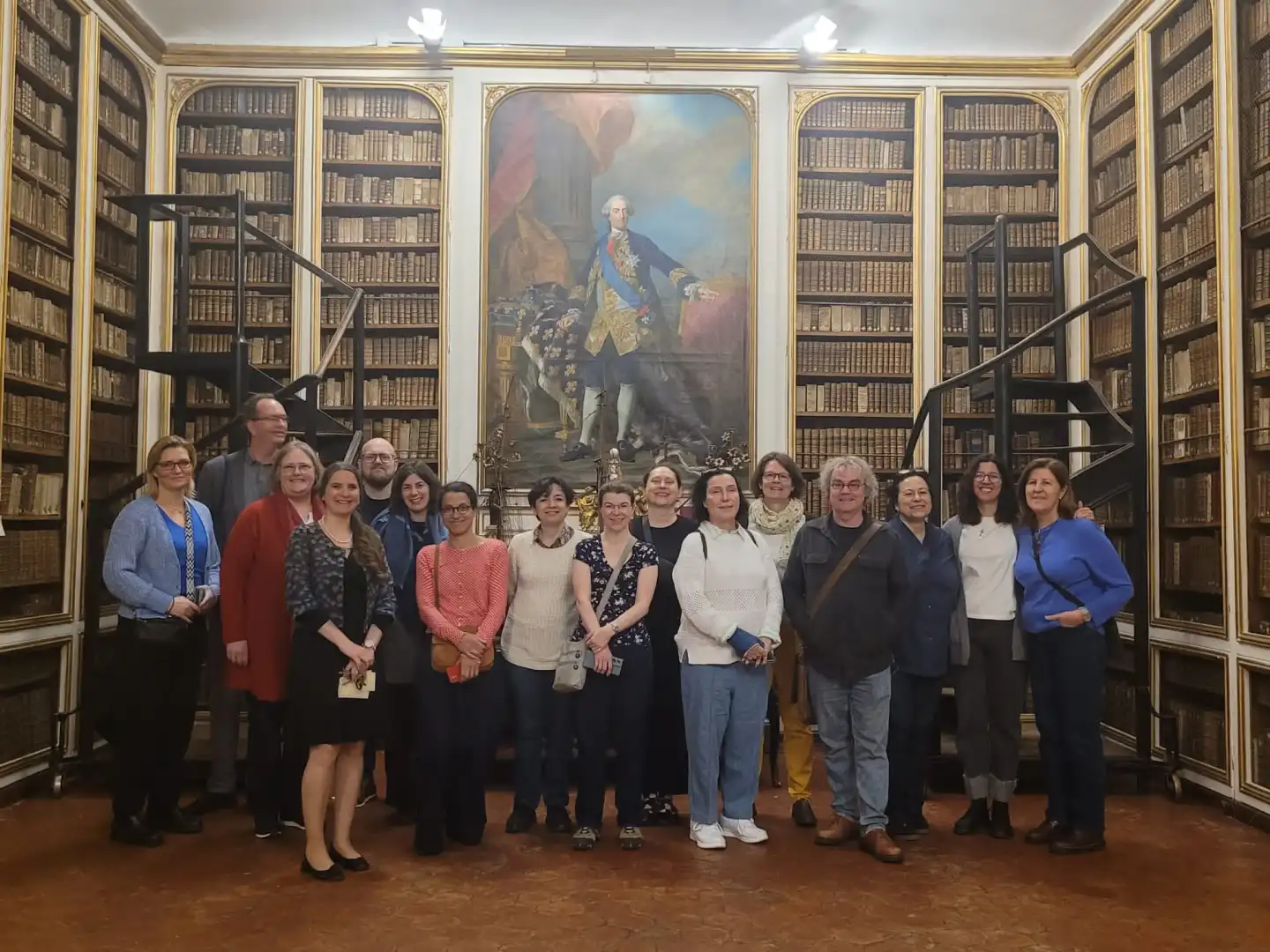
Conference participants visit the Versailles Library
Related articles
by Markéta Kučerová and Vojtěch Šícha, Library of the Czech Academy of Sciences
November 9, 2026
by Konrad K. Szymański (Ossolineum National Library, Wrocław)
November 9, 2026