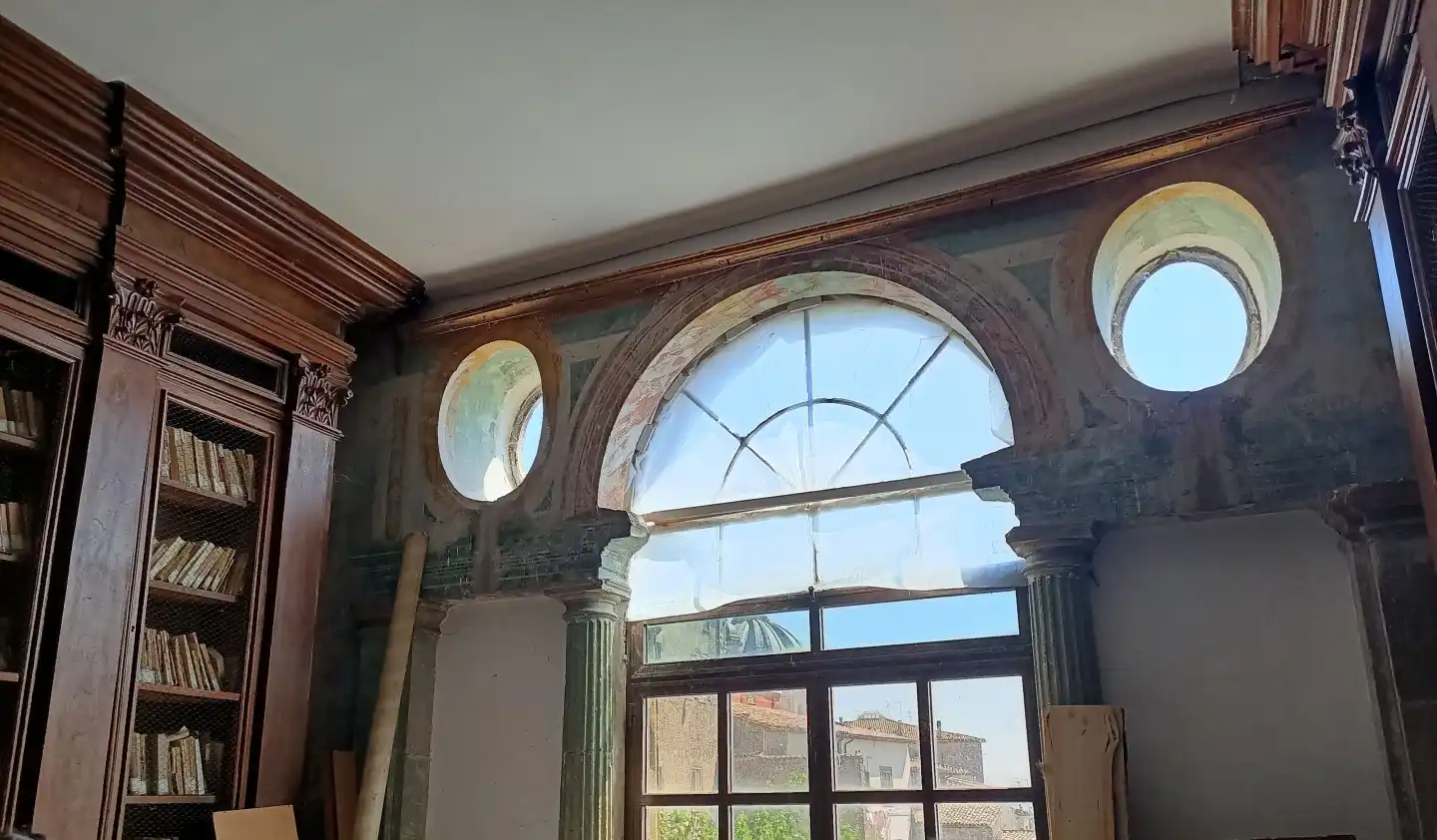
CERL Internships 2024 – Fagel Collection, Trinity College Dublin
by Costanza Ficorella, Assistant Archivist, Office of Public Works, National Monuments Services, Dublin
Share this article
The Fagel Collection at Trinity College Dublin is one of the best preserved and most important 18th c. private libraries in Europe. The collection was brought together over the course of five generations by the Fagels, a Dutch family of whom successive members held high public office in the roles of Greffier and Deputy Greffier of the Dutch States General.
In the winter of 1794-1795 the Batavian Revolution broke out, leading to the end of the Dutch Republic and the exile of the then Greffier Hendrik Fagel the Younger. Hendrik’s family house and possessions in the Hague were confiscated. After fighting a legal battle, he was eventually granted possession of his family art collection and library which he then had shipped to London in 1798. Driven by straitened circumstances Fagel decided to sell his collections. The private library was put up for sale at Christies in 1802. However, before it could be dispersed at auction, the governors of the Erasmus Smith Schools put in a successful bid on behalf of Trinity College Dublin to acquire the collection as a whole.
The governors of the Erasmus Smith Schools put in a successful bid at Christies in 1802, on behalf of Trinity College Dublin, and acquired the collection as a whole. The books, some 20,000 volumes containing over 30,000 titles covering virtually all areas of human undertaking, arrived in Dublin port in May 1802 and were placed in the Old Library where they have been housed since.
Between 2020 and 2023 the Library of Trinity College Dublin and the KB National Library of the Netherlands carried out the first phase of a collaborative project aimed at ‘unlocking’ the Fagel Collection. The main goal in this phase was to catalogue the Dutch publications collected by the
Fagels in the national retrospective bibliography of the Netherlands, the Short-Title Catalogue Netherlands (STCN), and in the Trinity Library catalogue. Preservation and conservation work was also carried out. In addition, the first steps were taken towards the digitisation of the collection.
Collaboration between the Library of Trinity College and the KB National Library of the Netherlands is continuing with a focus on increasing outreach and supporting future research and public use of this unique heritage collection. In particular, local cataloguing work has continued since 2023 on the non Dutch materials. This work incorporates copy-specific information. It is in this context that my CERL internship on the Fagel Collection took place.
Internship description
My task as an intern was to describe and document provenance marks from books in the Fagel Collection in the Provenance Digital Archive (PDA) of CERL. The internship focused on the materials catalogued in the (CERL hosted) STCN database.
The STCN being a short title catalogue, it does not allow for the recording of copy-specific information, such as provenance. Hence the need for provenance data to be recorded in a database such as the PDA.
I worked under the supervision of Dr Ann-Marie Hansen, Project Manager of Unlocking the Fagel Collection at TCD, and Dr Marieke van Delft, Former Curator at the KB, National Library of the Netherlands, CERL Honorary Fellow and CERL PDA coordinator.
The job entailed the following three steps:
1) Editing and uploading of images of the provenance mark to the database;
2) Describing the source of the provenance mark including bibliographic description as provided in the Classic Catalogue of Trinity College Dublin and/or in the Short Title Catalogue of the Netherlands (STCN);
3) Describing the provenance mark including a general description in English, the transcription of the text (when occurring) in normalised form, and the identification of the user of the provenance mark.
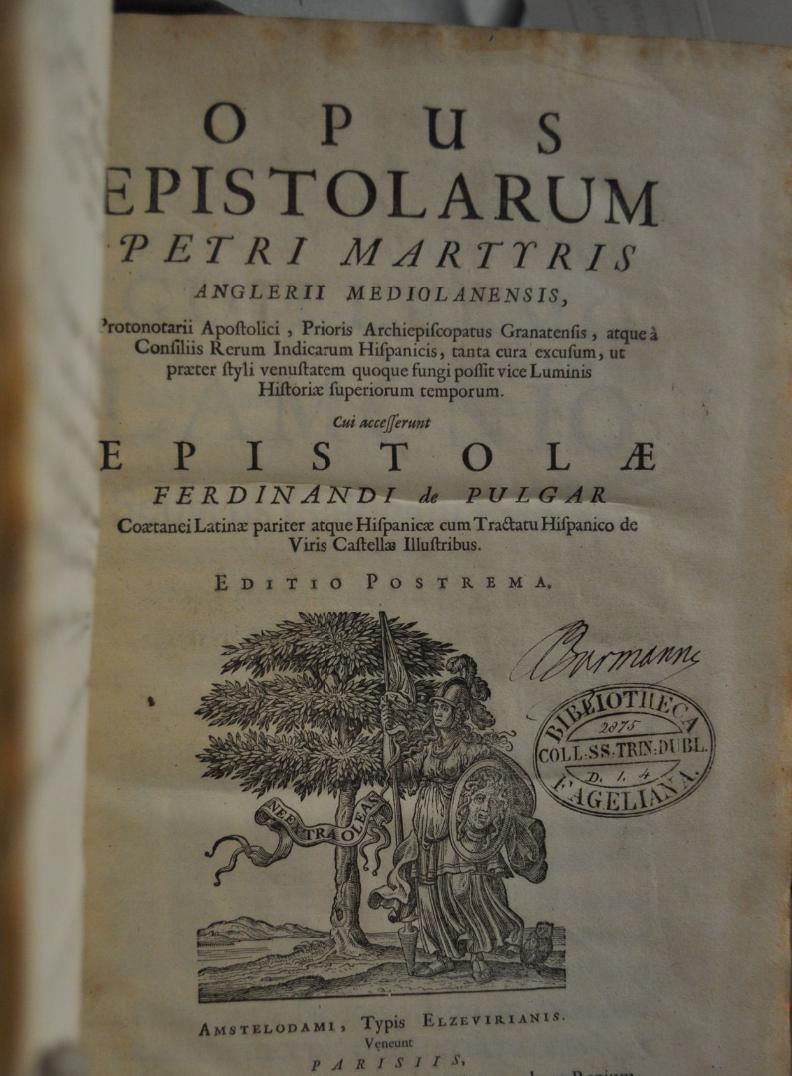
In total 74 records from 61 distinct items in the Fagel Collection were created in the CERL PDA and 3 entries for former owners were created in the CERL Thesaurus.
The provenance marks consisted mainly of owner’s signatures and ownership inscriptions (including dedications) (60), followed by monograms (2), mottos (2), marginalia (1) and supralibros (2). Where an inscription mentioned both donor and dedicatee a record was created for each former owner. The ownership marks pertain to both members of the Fagel family and previous owners that were either connected or not connected
to the Fagels, for a total of 39 individuals. Most of the users of the provenance marks were identified. Where former owners could not be identified, the ‘Can you help?’ input in the database was used to
make the image of the provenance mark available on the ‘Can you help?’ forum.
The internship took place remotely. After a suite of initial onboarding meetings, both in-person and online, online meetings were held with Dr Ann-Marie Hansen at the end of each week during which work was reviewed and editing discussed as needed. Further, I video called with Dr Marieke Van Delft after the first two weeks of work. Dr Van Delft provided additional feedback and helped clarify some doubts in relation to the description of provenance marks on the PDA and the use of the CERL Thesaurus.
Throughout the duration of the internship I liaised with the TCD Library team involved in the work on the Fagel Collection via a group chat on Microsoft Teams. The team provided great help when trying to decipher handwriting that was particularly hard to read.
Overview of internship experience
The CERL internship grant provided me with the invaluable opportunity to work on and learn about one of the most important 18th-century private collections in Europe. I thoroughly enjoyed working on provenance marks in the Fagel Collection and I found this experience to have been particularly valuable in improving my research and palaeographical skills. Thus, in my investigations trying to identify some of the users of provenance marks I learnt about new resources for researching Dutch names and individuals such as, for instance, the Nieuw Nederlandsch Biografisch Woordenboek (NNBW) or the Open Archives website for the search of genealogical data of Dutch and Belgian archives and societies.
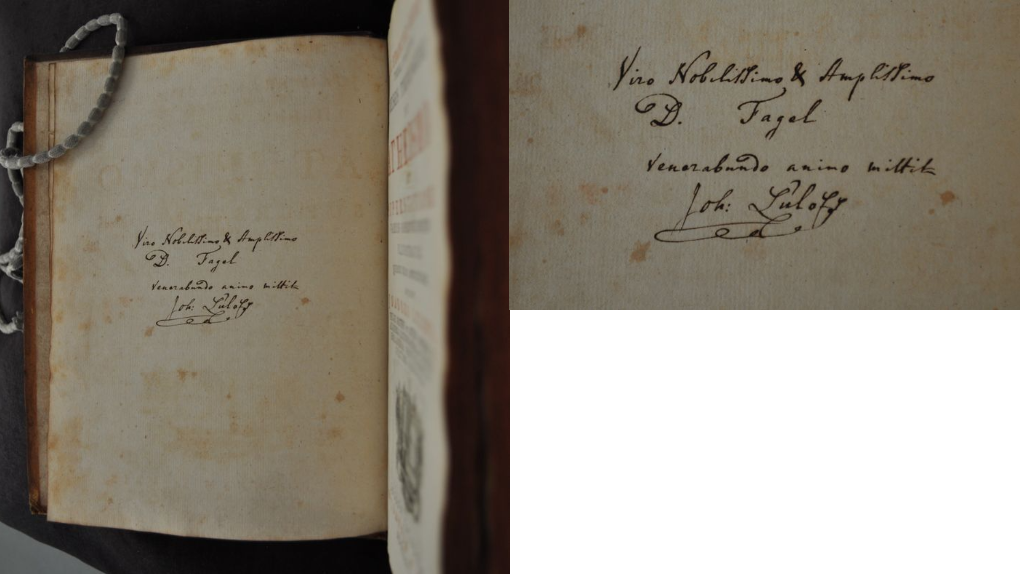
Fag.D.4.30 Inscribed dedication to D. Fagel by Johannes Lulofs (d. 1768), Dutch physicist and astronomer
I had training in medieval palaeography and the internship provided me with my first experience working on early modern palaeography. Despite some challenge in deciphering Dutch inscriptions, I very quickly became familiar with the handwriting styles that are found in the Fagel Collection. I thoroughly enjoyed the process of deciphering and interpreting the inscriptions, which prompted me to learn more about early modern palaeography and from the 25th of November to the 6th of December I will be taking an online course in English Early Modern Handwriting (1500-1700) with the Institute of Medieval and Early Modern Studies of Durham University.
Last, but not least, I am extremely grateful to have been able to connect with professionals from the library field. The Fagel team at TCD made me feel welcome and included from the very beginning. Their support and belief in my potential has made me more and more motivated and determined to pursue a career in this field
Final remarks from a PDA user
I first came across the CERL Provenance Digital Archive while researching digital tools for the study of manuscripts and early printed books during my master’s degree. However, the internship provided me with the opportunity to appreciate the PDA as a tool for promoting and enhancing research in this field all the more. The PDA is not just a database where ownership marks of printed books and manuscripts are collected, it also provides room for cooperation and interaction between libraries and scholars through its ‘Can you help?’ forum where unidentified marks are displayed waiting to be ‘reunited’ with their former owners.
Thus, creating a PDA record for a gilt stamp with wreath containing fleurs-de-lys and shamrocks at the centre of a number of leather bindings in the Fagel Collection and sharing it on the ‘Can you help?’ forum prompted Dr Marieke van Delft to send the link to the ownership mark to Jan Storm van Leeuwen, a well-known bookbinding specialist. He recognised this supralibros as the armorial design of the Dutch legal scholar and historian Hubert Loyens (1599-1684). The identification of the stamp owner was the more significant as it was not previously known that the Fagel Collection contains several volumes from the once famous Loyens Collection.
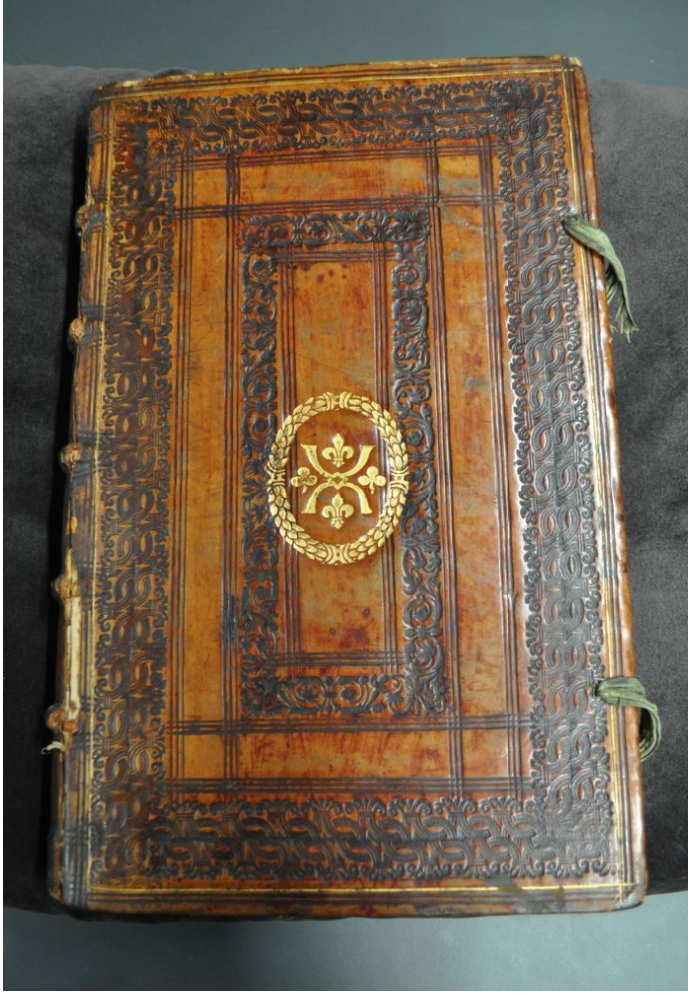
Left: Fag.D.1.17-18 – Right: Fag.R.1.75
Further, working on the Provenance Digital Archive, one soon realises how provenance marks are not just about identifying the former owner(s) and the history of a book. Sometimes they can also shed some light on and bring us closer to the individual(s) who owned them. Thus, the Greek motto adapted from James 1:19 that Gulielmus Martinus van Drogenbroek inscribed on some of the title pages of his collection of early 17th century pamphlets communicates to the reader the spiritual inclinations of a man with a willingness to listen for understanding, to speak with careful consideration and successfully control anger.
I found the CERL Provenance Digital Archive a very user-friendly database. What follows are a few remarks based on my experience as user and I hope they will be useful when editing the new guidelines.
- During my internship I came across cases of books or pamphlets where a single item contained more than one ownership mark from the same individual, such as inscriptions followed by the owner’s monogram or motto. As the system allows only for one type of ownership mark to be selected on the input form, it would be very useful if cases such as
these were mentioned in the guidelines and the CERL PDA editors advised on whether the user should create a record for each of the ownership marks (i.e. one for the inscription and one for the monogram or motto) or keep it to one single record. In the latter case the CERL
PDA editors could advise on which type of ownership marks would have priority over the other in being selected on the input form. - As regards the guidelines on transcription, it would be very useful to indicate whether abbreviation marks should or should not be expanded (i.e. whether the user is expected to provide a semi-diplomatic or diplomatic transcription)
- Being accustomed, in transcription, to indicate a line break with the vertical bar “|” I did not realise, at the beginning, that this was causing the text to show up as a hyperlink on the saved record. Hence, it would be useful if the guidelines on transcription also mentioned that line breaks should be indicated with a slash “/” and not with a vertical bar “|”.
- Finally, one of the types of ownership marks I encountered the most are owner’s inscriptions/signatures, signalled with ICONCLASS code 49L272. It may be useful to future users if the latter code was added to the list of examples in the search box that opens up when clicking the ICONCLASS button.
Related articles
November 9, 2026
by Markéta Kučerová and Vojtěch Šícha, Library of the Czech Academy of Sciences
November 9, 2026