CERL Internships 2024 – Utrecht University Library
by Martina Uvale, Master’s in Library and Archival Sciences from the Univ. of Bologna
Share this article
The CERL Internship and Placement Grant 2024 allowed me to work in the Special Collections Department of the University Library of Utrecht from 19 August to 15 September 2024, under the supervision of dr. Andrea van Leerdam, curator of printed works, and Coen van der Stappen, collection specialist.
The Utrecht University Library of the University Science Park was a great environment to work in: in addition to my supervisors, who followed my work closely and consistently, all the staff were always friendly and willing to clarify any doubts, thanks to their great competence and knowledge of the collection.
My task was to match incunabula holdings with ISTC numbers: as the library’s collection of incunabula is very large (over 900 exemplars), I mainly worked with Excel files containing the list of copies and the main cataloguing information, such as the title of the book, the name of the author, the year and place of printing, etc. It seemed reasonable to me, Andrea and Coen to use the provenance of the books as a working criterion: I gave priority to the collections from Utrecht, consisting mainly of those from the various religious chapters of the city, and then to all other provenances, again prioritising those from Dutch institutions and chapters. In this way my work, organized by provenance, will also be useful and more practical for further operations of digitisation and recataloguing in English of the library’s incunabula collection.
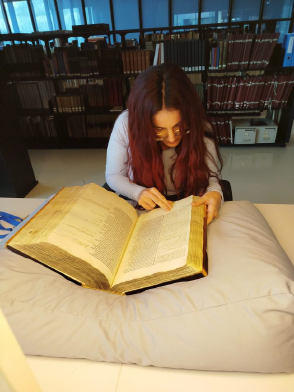
In most cases, the descriptive metadata searchable in the WorldCat cataloguing environment and present in the Excel spreadsheet were sufficient to identify each incunabulum holding and compare it to the description provided by the Incunabula Short Title Catalogue.
Therefore, once I determined that the copy matched the ISTC-described edition, I noted the ISTC number in a special column in the Excel spreadsheet. I have also added, in different columns, other information that might eventually improve the ISTC: whether and how the Utrecht University Library copy is referenced; whether there is a link to the digital copy of the item, if available; whether it has already been described in the MEI database.
Sometimes, due to insufficient information in the catalogues, or to dispel some doubts, it was necessary to verify the correspondence with the ISTC description by consulting the physical item: in all these cases, I was eventually able to verify the correspondence and assign the correct ISTC number.
In addition to gaining more knowledge about a new book type for me (having previously worked mainly with manuscripts), my time at the library also allowed me to become more familiar with MARC21 and the WorldCat catalogue, which I consider essential for a future librarian; I also pointed out some minor errors in WorldCat records, reporting them to the cataloguers.In addition to gaining more knowledge about a new book type for me (having previously worked mainly with manuscripts), my time at the library also allowed me to become more familiar with MARC21 and the WorldCat catalogue, which I consider essential for a future librarian; I also pointed out some minor errors in WorldCat records, reporting them to the cataloguers.In addition to gaining more knowledge about a new book type for me (having previously worked mainly with manuscripts), my time at the library also allowed me to become more familiar with MARC21 and the WorldCat catalogue, which I consider essential for a future librarian; I also pointed out some minor errors in WorldCat records, reporting them to the cataloguers.
Moreover, while working on the collection of incunabula, I found a book that caught my attention: it is a copy of Theorica musicae by Franchino Gaffurio, an important music theorist of the fifteenth century, printed in Naples in 1480 by the Florentine printer Francesco Di Dino. This book (whose call number is AA qu 95 Rariora) attracted my attention because it is the only Neapolitan edition I have come across in the library’s collection – since the other Italian incunabula are mainly from Venice, Rome and some other cities that developed a strong printing industry in the 15th century.
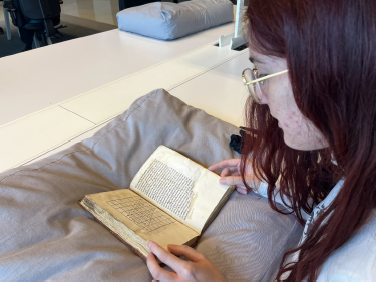
By consulting the ISTC, I found out that the Utrecht copy is the only copy of this incunabulum in the Netherlands, a fact that made me want to know more about how and when it got from Naples to the Chapter of St Mary in Utrecht. The available information is probably not sufficient to reconstruct the book’s journey, but Andrea agreed with me that it would be interesting to write a short article about it, describing the copy and presenting some hypotheses about its history: I am currentlyworking on it, trying to gather as much information as possible, also consulting the four copies of the same book held in Naples.
In conclusion, this one-month internship at the Utrecht University Library has not only allowed me to get to know a very pleasant and efficient working environment, but above all it has been an important professional experience and an opportunity to deepen my interests in the field of research on Neapolitan book production in the fifteenth century, introducing me to a new type of book to which I had not yet devoted myself, incunabula.
Related articles
November 9, 2026
by Markéta Kučerová and Vojtěch Šícha, Library of the Czech Academy of Sciences
November 9, 2026