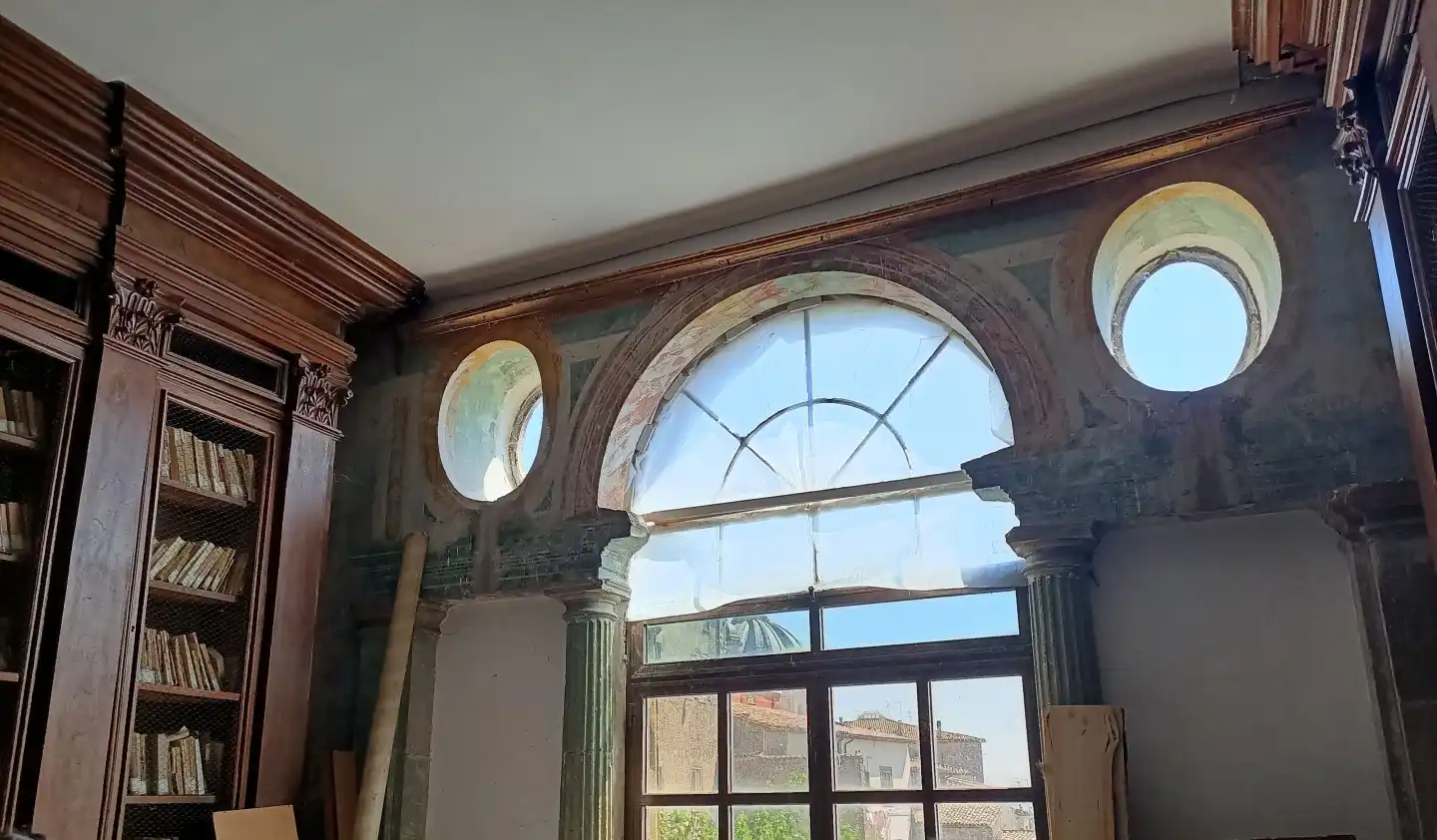
CERL Internships 2024 – University Library of Naples
by Valeria Cesaraccio, PhD student in Renaissance Studies at the University of Warwick
Share this article
I have been at the University Library of Naples for my CERL internship from the 10th of October to the 8th of November. The Naples UL owns about 450 incunables: during my stay I examined 40 of them. I created entries for the MEI database and the Owners of Incunabula database, for a total of 40 new entries in MEI and 41 in OOI; I have also updated 6 already existing records in OOI with new information.
My description of the incunables started from the information provided in the Catalogo degli incunaboli della Biblioteca Universitaria di Napoli, edited by Giancarlo Petrella (Rome 2022). The single entries in this catalogue were created by Petrella himself, together with some PhD students of the Scuola Superiore Meridionale and some students of the Scuola di Alta Formazione Alberto Varvaro. Some of the entries were very detailed and helpful, in particular for the physical description of the books and their bindings; others lacked some information or contained inaccuracies.
The library staff was kind and helpful. Unfortunately, the weekly opening times of the library were not ideal: the library was open until 6.30 pm only for two days a week and until 3.30 pm for the remaining three. Moreover, due both to a shortage of staff and difficulties related to the anti-theft alarm settings (not controlled by the library staff), the access to the books was possible only for an even more limited number of hours, particularly for some days.
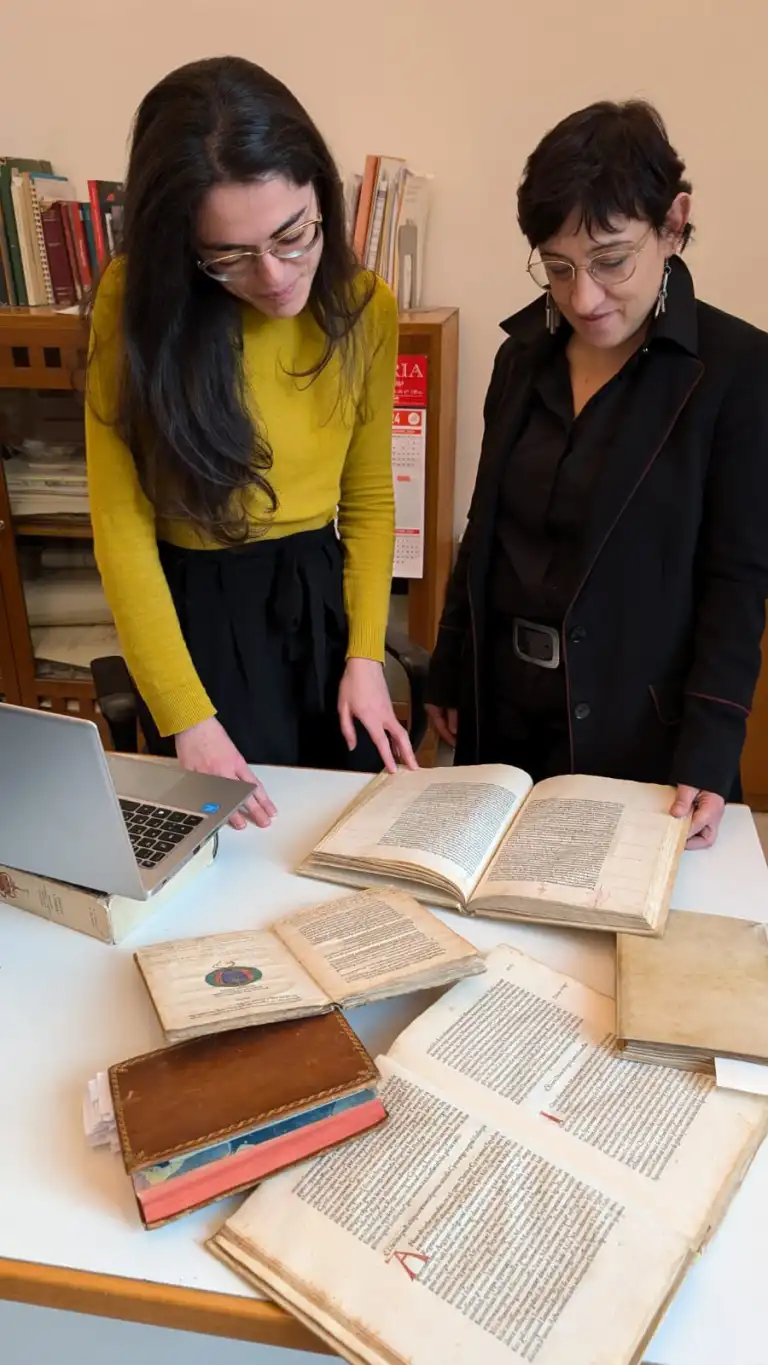
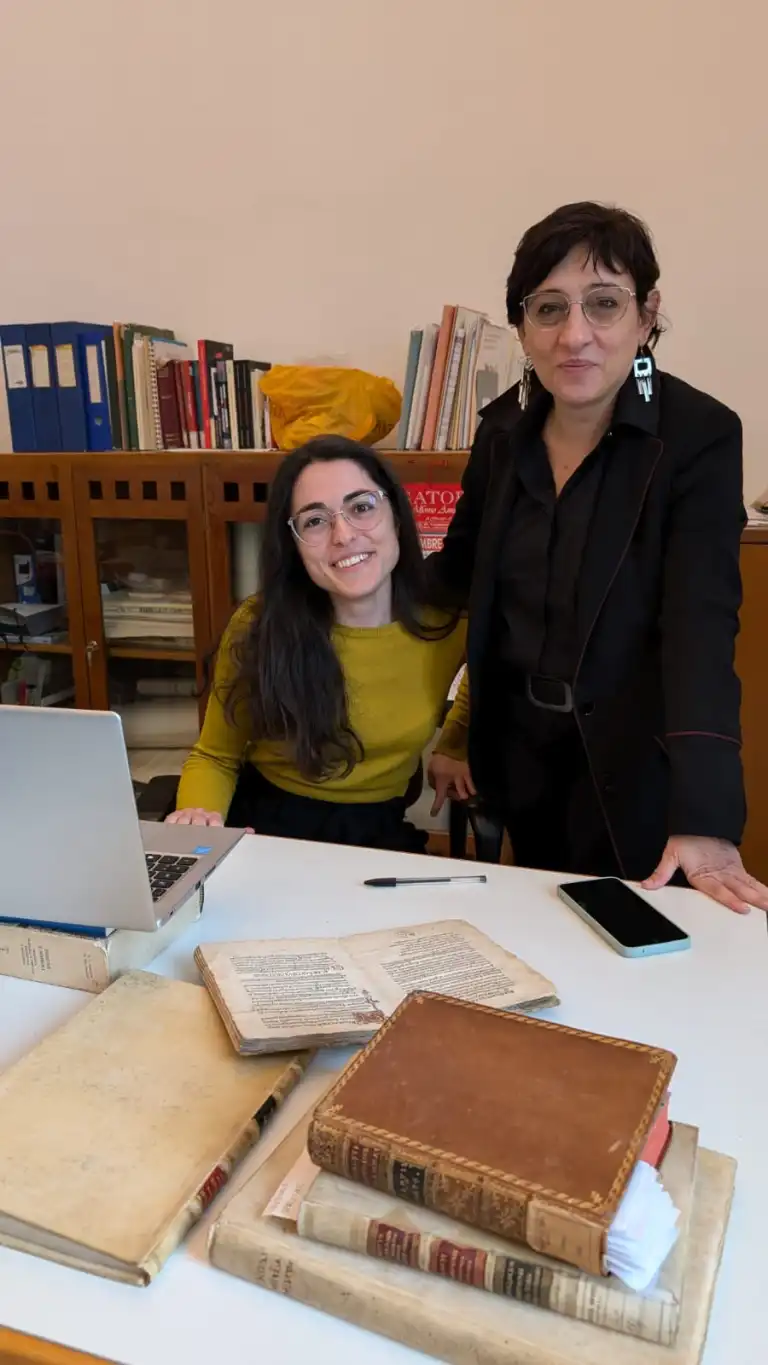
As for the incunables to insert in MEI, the library did not have any particular request, other than trying to correct any potential inaccuracies in the catalogue. Based on the descriptions provided in the catalogue, I chose some of the volumes that seemed more interesting in terms of annotations, owners, decoration or binding. Most of the volumes I examined were in Latin (including some Latin translations from Greek texts: 6), but there were also some incunables in Greek (2) and in Italian (3; 5 if we include two copies of the Hypnerotomachia Poliphili); one edition was bilingual (Latin and Italian). The incunables I inserted in MEI were mainly published in Italy; only one was published outside of Italy, in Augsburg. Many of them did not show any evidence of a passage outside of Italy.
Five of the incunables were rare, among which Accursius Bonus’s Compendium elegantiarum Laurentii Vallae (Naples, [Francesco di Dino, about 1480]) and a Vita Aesopi (Venice, Manfredus de Bonellis, 1493), both preserved in less than 10 copies.
Most of the bindings were from the eighteenth and nineteenth centuries, a few from the seventeenth century, and some had been made by restorers in the twentieth century.
In a few cases, the fifteenth-century binding was still preserved: for example, the Inc. 361 (Juvenal, Satyrae, Venice, Johannes Tacuinus, 1492) still had its wooden fifteenth-century binding, restored in the twentieth century.
The Inc. 149 too (Pomponio Leto, Grammaticae compendium, Venice, Baptista de Tortis, 1484) had a fifteenth-century vellum binding, in this case not well preserved.
In one case, we have information about the original binding of an incunable thanks to someone who annotated a description of it: the Inc. 122, a copy of Giovanni Tortelli’s De orthographia (Treviso, Hermannus Liechtenstein, 1477), a sixteenth-century hand described the leather binding, provided with chains, that the volume presumably had at that time (‘coopertus tabulis cum corio desuper albo vintus cathenis’).
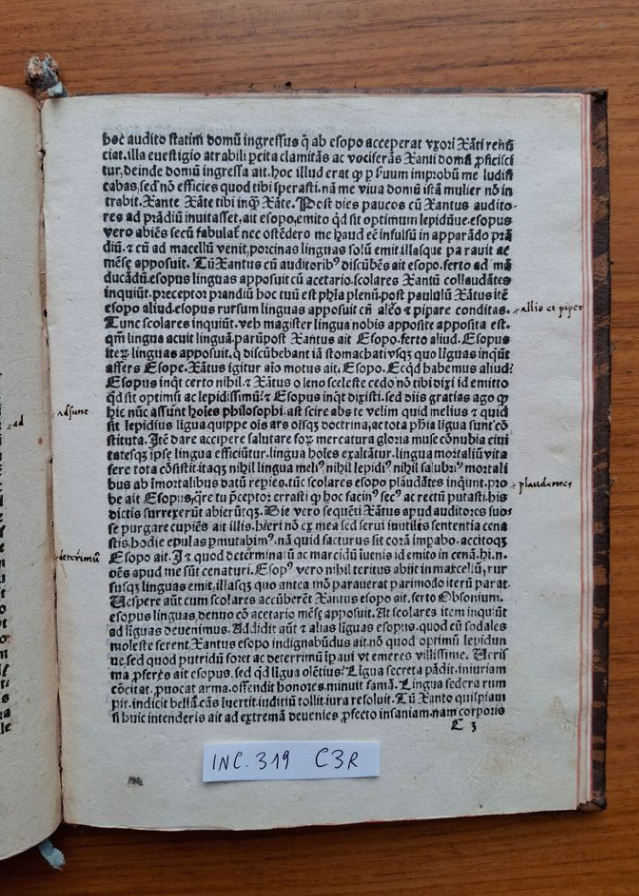
Vita Aesopi, Venice, Manfredus de Bonellis, 1493


Juvenal, Satyrae, Venice, Johannes Tacuinus, 1492
Pomponio Leto, Grammaticae compendium, Venice, Baptista de Tortis, 1484
Some of the volumes I examined came from the libraries of Francesco Taccone and Domenico Pilla, two among the donors who contributed the most to the collection of incunables at the Naples UL. Taccone’s books (4 examined) still showed his ex libris, evidence of his donation in 1812 to the public library of Monteoliveto. One volume I examined had the stamp of the Naples National Library, present in the incunables that had been transferred from the UL to the NL and again to the UL in the second decade of the nineteenth century. Other incunables showed provenance evidence from Neapolitan suppressed religious libraries, such as the library of the church of Santa Croce di Palazzo.
Some of the volumes contained coats of arms, evidence of their former owners: for example, the Inc. 10 belonged to the Rossi family of Bologna; several volumes belonged to Pope Pius VI, as testified by his coat of arms embossed on the cover (Inc. 9, Inc. 29, Rarissimi 51). Thanks to the collaboration of other MEI editors, through the CERL MEI mailing list, a coat of arms present in the Inc. 3 (Johannes Gallensis, Summa collationum, Augsburg, Anton Sorg, 1475), previously unidentified, has been assigned to the Welchser family by Caroline Zöhl of the Bayerische Staatsbibliothek. Other coat of arms found in the UL incunables are still unidentified.
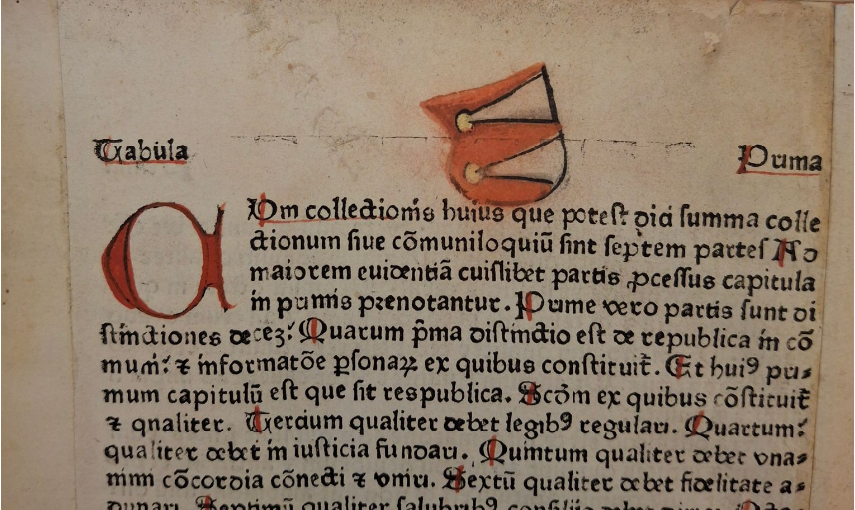
The Welchser family coat of arms
Some of the incunables belonged to well-known scholars and writers, such as Johannes Protzer, Pere Miquel Carbonell, Berardino Rota and Henri Dormal. In some cases, the books were heavily annotated by them. For example, Sigismondo Golfi della Pergola extensively annotated his copy of Dionysius of Halicarnassus’s Antiquitates romanae (tr.: Lampugnino Birago, Treviso, Bernardinus Celerius, 1480), often correcting the printed text.
Compared to the information on the catalogue, new owners have been identified: among them, Sigismondo Golfi for the Inc. 82, the Franciscans of Capestrano for the Inc. 149, Didaco Maria Arnone for the Inc. 2, Marzio Pacecco Carafa, Duke of Maddaloni for the Rarissimi 41.
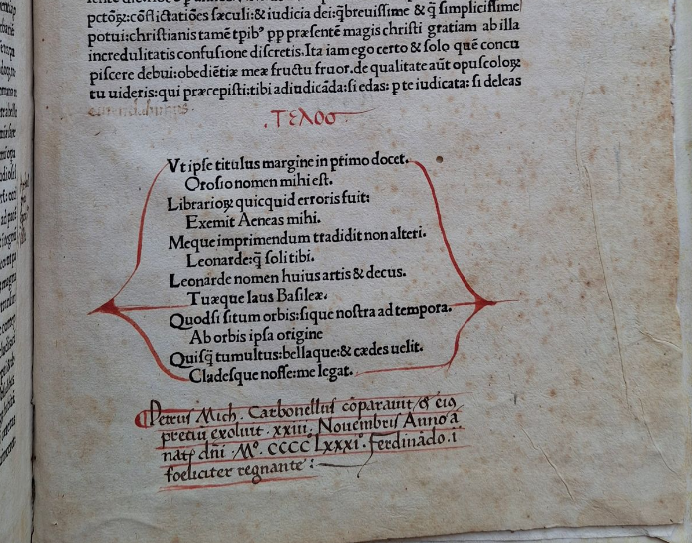
Inc 173. Acquisition note.
In a few cases, the volumes contained information related to the place of purchase and the price paid for it. For example, the Inc. 113 (Gabriel Barletta, Sermones quadragesimales, Brescia, Jacopus Britannicus, 1497-98) had a note by Giuseppe Bermudez from 16 October 1795, with an indication of the price he paid for it (30 baiocchi) and the place where he bought it in Naples, likely from a street bookseller, near to the convent of Santa Maria Maddalena delle Convertite Spagnole.
The Inc. 1 (Aristotle, De animalibus, Venice, Johannes de Colonia and Johannes Manthen, 1476) had a note by Angelo Tifernate, about his purchase from an anonymous bookseller in Pesaro, for the price of 50 bolognini. In one case (Inc. 173), a buyer’s note by Pere Miquel Carbonell from 23 November 1481 has been useful to limit the date of an edition of Paulus Orosius’s Historiae adversos paganos printed in Vicenza by Leonardus Achates de Basilea, previously dated on ISTC either to the 1482 or 1489.
During my stay in Naples, I also took some pictures of the most interesting features of the volumes, including several owner’s and buyer’s notes, marginal annotations and bindings. I uploaded them in the CERL Digital Provenance Archive and linked them to the MEI records. Finally, I reported a few mistakes on ISTC about the number of copies for each incunable at the UL.
The internship has been a great opportunity and a good methodological training. The collection of incunables at the Naples UL was rich and varied, and the study of the volumes was often challenging. The new entries made during this internship represent an acquisition for the CERL databases and can now be used for future research.
Related articles
November 9, 2026
by Markéta Kučerová and Vojtěch Šícha, Library of the Czech Academy of Sciences
November 9, 2026