
Printing Revolution exhibition online – a new website
by Cristina Dondi, CERL Secretary and Oakeshott Senior Research Fellow in the Humanities, Oxford
Share this article
Between September 2018 and April 2019 the exhibition Printing R-Evolution 1450-1500. Fifty Years that Changed Europe was held in Venice’s Museum Correr, in St Mark’s square. 200,000 visitors from all over the world left wonderful messages of appreciation and support to the question: ‘we have done 10% of the work, should we continue?’
The exhibition’s main goal was to share with the public the surprising results of five years of evidence-based research conducted by my team around Europe and the United States and funded by the European Research Council, the 15cBOOKTRADE Project.
The strength of the exhibition was, apart from its content, the extensive use of technology and graphic design to amplify communication. 15 videos, interactive maps, wall to wall projections, and graphs were created to explain fundamental concepts surrounding the European printing revolution, often misunderstood or completely unknown.
Today, all those digital products are available for anybody to consult and enjoy online.
Moreover, the flexible web environment is allowing us to supplement the original material with links to other digital outputs, for example an exhibition at Princeton University Library on the first twenty years of printing in Europe, and with new digital products on 15th-century printing created by other projects, such as the digitization of incunabula (= books printed before 1501) in Italian monastic libraries, or the illustrated copy-census of the 1481 Florence edition of Dante with engravings by Botticelli, both funded by the Polonsky Foundation.
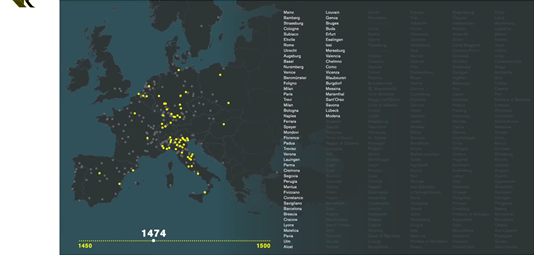
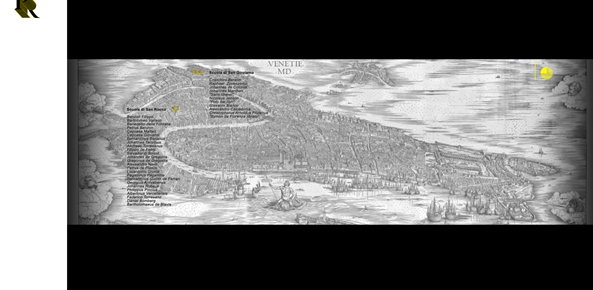
The exhibition is arranged into Why, Where, Who, What, How, Movement, and Past & present sections. Videos include images of 15th-century manuscripts from Venetian collections, to explain that Europe was already consuming large quantities of books of various kind and value, and this represents the demand factor in the success of the new invention. All printing places in Europe pop up on a map of Europe according to the date of their first printing activity. In another map, of Venice in 1500, we locate the printing offices of the hundreds of typographers which established themselves in the city from all over Europe, and their affiliation to local confraternities.
We show examples of the great variety of books and we compare their prices to the contemporary cost of living. We show the evidence of international trade, what made Venice not only the leading printing place in Europe, but also the largest exporter.
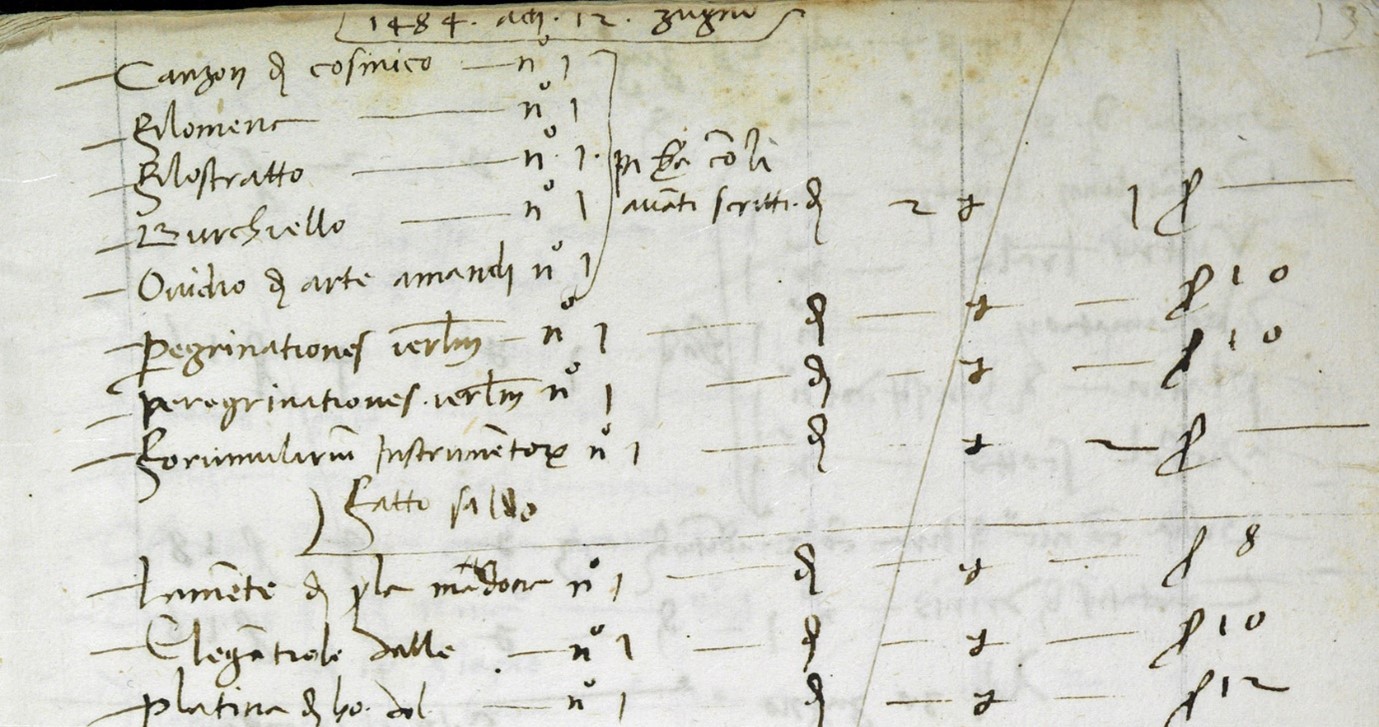
The account book of Venetian bookseller Francesco de Madiis, 1484-88. Venice, Biblioteca Nazionale Marciana, Ital. XI, 45 (7439)
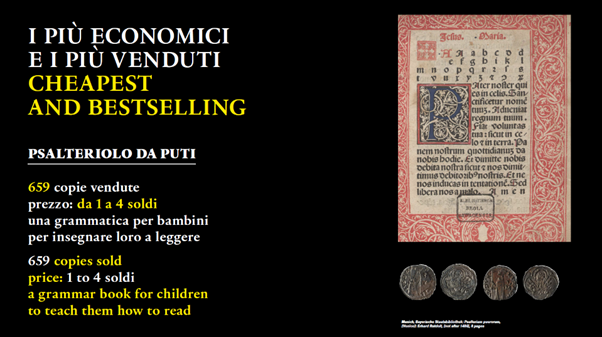
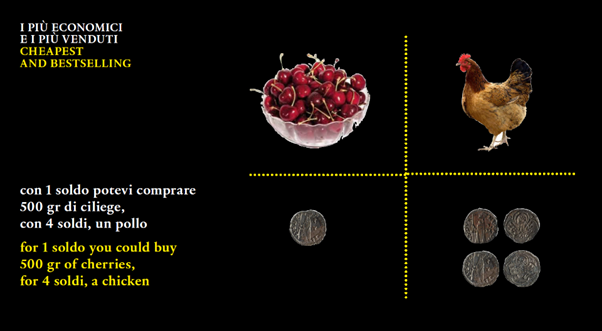
Other videos tackle literacy (grammar books were the most printed and purchased), the bible in translation – 50 years before Luther – women as authors, printers, and readers, and the printed books in Leonardo’s library. We look at the evolution in the decoration of books, from manuscript illumination to illustration. We explain the dispersal of the Library of San Giorgio Maggiore of Venice, and how Material Evidence in Incunabula (MEI), is allowing us to virtually reconstructing thousands of dispersed collections.
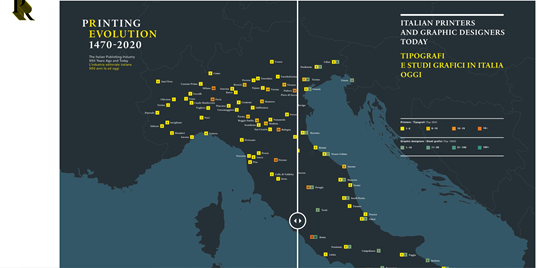
In the Past & Present section an interactive map allows us to compare the location and number of printing offices in Italy 550 years ago and today. For this analysis we teamed up with the Fedrigoni Group, one of the largest paper manufacturers in the world, and the heirs to Italy’s first paper mill in Fabriano (Marche).
The website provides the latest research on the printing revolution in an accessible and attractive way, and at the same time promotes the relevance of book heritage collections and the opportunity of their inclusion in widely accessible digital projects and outputs.
Related articles
November 9, 2026
by Markéta Kučerová and Vojtěch Šícha, Library of the Czech Academy of Sciences
November 9, 2026
by Konrad K. Szymański (Ossolineum National Library, Wrocław)
November 9, 2026