Rare Books on the Move: Trade, Transfer, and the Law
by Dr Agnieszka Franczyk-Cegła, CERL Provenance Working Group, Ossolineum National Library (PL)
Share this article
Being a rare book librarian involves a wide range of tasks. You might spend one moment deciphering a Latin inscription from the fifteenth century, and the next, dusting display cases, presenting a research paper at a conference, or explaining to a child what half a century means. In between, you also face the challenge of dealing with the legal and regulatory complexities of acquiring rare books from abroad. And even if you often do it through an intermediary (antique bookstore, auction house), who is often responsible for fulfilling legal obligations, it is worth having at least a little knowledge of the world of rare book trade and transfer, and the main regulations and laws governing it. So, let’s unpack the legal and regulatory aspects in a brief and practical way.
These legal instruments generally fall into two main groups. The first one includes cultural heritage protection tools, such as the UNESCO Convention on the Means of Prohibiting and Preventing the Illicit Import, Export and Transfer of Ownership of Cultural Property (1970), the UNIDROIT Convention on Stolen and Illegally Exported Cultural Objects (1995), and the European Council Directive 93/7/EEC on returning cultural objects taken unlawfully from a Member State (1993). The second group covers market or regulatory compliance rules, like anti-money laundering regulations (AML), the General Agreement on Tariffs & Trade (GATT), and national export and import controls.
Cultural heritage protection instruments
One of the most important international instruments protecting cultural heritage is the UNESCO Convention on the Means of Prohibiting and Preventing the Illicit Import, Export and Transfer of Ownership of Cultural Property. Adopted by the UNESCO General Conference in 1970 and entering into force in 1972, it was the first international convention addressing illicit trade and transfer during peacetime. States Parties commit, among others, to introducing national laws restricting illicit trade in cultural property, creating registers of protected property, and cooperating in the identification, confiscation, and return of stolen objects. In practice, there are different approaches to the implementation of the convention – some countries, such as Canada and Australia, have strict controls, while others (e.g. the USA, UK) have more limited regulations. And does this most important international instrument mention rare books? Yes! Article 1 of the 1970 UNESCO Convention, while explaining the term ‘cultural property’, explicitly lists as one of its categories ‘rare manuscripts and incunabula, old books, documents and publications of special interest (historical, artistic, scientific, literary, etc.) singly or in collections’.
The 1970 UNESCO Convention marked a major step in protecting cultural heritage around the world, but it had some important shortcomings. It mostly worked at the state level, did not strongly regulate good-faith buyers, and lacked effective ways to enforce restitution. These issues led to the creation of the UNIDROIT Convention (1995) on Stolen or Illegally Exported Cultural Objects. What did this new convention change? Unlike the UNESCO Convention, which mainly involves states, UNIDROIT lets private individuals as well as states make claims to recover stolen cultural objects. It also addresses the issue of good-faith purchases. Under the UNESCO Convention, someone could legally buy an item that was trafficked if they did so in good faith. The UNIDROIT Convention requires anyone holding stolen cultural objects to return them (Art. 3). Even if the buyer acted in good faith and can prove it, they must return the object but can receive compensation (Art. 4). Claims must be made within three years of discovering the object’s location and the possessor’s identity, and up to 50 years after the theft. There is no time limit if the item was stolen from a public collection. The UNIDROIT Convention only applies to claims after a country has ratified it. As of 2020, 48 countries had joined, but neither the UK nor the USA—both considered ‘market states’—have ratified it. A market state is a country whose laws make it easier to trade art, with fewer export controls and more protection for buyers, compared to source states, which have strict export laws and claim national ownership of antiquities. The United States, the United Kingdom, and Switzerland are often called market states in art law. The main legal issues between market and source states are good-faith purchase, provenance, and restitution or repatriation claims.
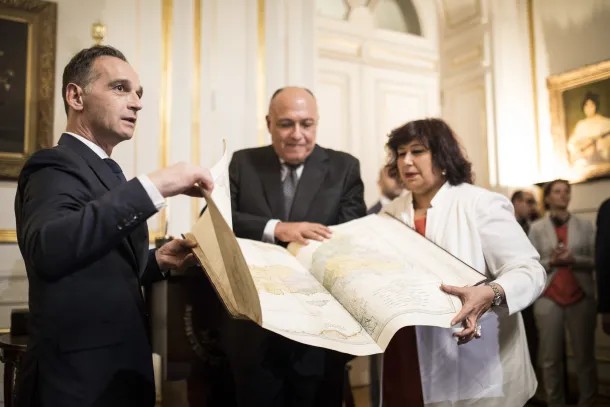
Fig. 1. Egyptian Foreign Minister Sameh Shoukri and German Foreign Minister Heiko Maas with a recovered historical atlas, 2019. © Photothek.de / Florian Gärtner via UNESCO
Cases of return and restitution carried out under the framework of the 1970 Convention and its implementing national laws include the 2019 repatriation from Germany to Egypt of a rare atlas printed in 1803.
The atlas, originally part of the National Library of Egypt’s collection, was illicitly removed from the country at an unknown date and resurfaced on the German market in 2018.
In the European Union, the return of cultural objects that were unlawfully taken from one Member State to another was first regulated by Council Directive 93/7/EEC, known as the 1993 Restitution Directive.
This directive set up a process for Member States to cooperate, share information, identify objects, and use a legal return system. It applied to items considered ‘national treasures’ by each country.
If a Member State claimed an object was unlawfully removed, it had to request its return from the country holding it. If the object was found to be an unlawfully removed national treasure, it had to be returned, and if the current holder bought it in good faith, they might get compensation. All legal actions had to start within a year of discovering the object’s location. The 2014 Directive (2014/60/EU) replaced the 1993 version, but its main goal stayed the same. Member States had to include it in their national laws by December 2015. Compared to the 1993 Directive, the 2014 version has a wider scope (it removed financial limits and applies to any cultural object classified as a national treasure under Article 36 TFEU), longer deadlines (three years instead of one to start return proceedings, and up to 30 years or more for some objects), and stronger cooperation between authorities through the Internal Market Information System (IMI). It also added due diligence requirements.
Trade regulations
Among trade and financial crime regulations that can be applied to rare book protection are anti-money laundering (AML) regulations. International efforts to combat money laundering began with the Financial Action Task Force (FATF), created at the 1989 G7 summit in Paris. In 1990, FATF introduced the “Forty Recommendations”, which among others criminalised money laundering and introduced customer due diligence requirements. The European Union developed harmonised standards through the First Anti‑Money Laundering Directive (1991) and later strengthened them in the Fifth Anti‑Money Laundering Directive (2020), which explicitly extends AML obligations to auction houses and art dealers and imposes stricter due diligence requirements, which is carried out through Know Your Customer (KYC) procedures. This means that dealers, galleries, and auction houses are required to check their clients’ identities, make sure the funds are legitimate, and watch for any suspicious transactions. So, in short, due diligence includes provenance research. Similar frameworks exist in other jurisdictions, for example, in China (party to UN conventions on AML and a member of FATF) through provisions of the Anti‑Money Laundering Law of the People’s Republic of China (2006) and earlier related banking and criminal regulations.
The first global trade agreement to clearly protect cultural goods within a free-trade system was the General Agreement on Tariffs & Trade (GATT), which started in 1948. Article XX (f) of GATT lets countries restrict trade to protect ‘national treasures.’ In practice, this means countries can ban the export of important artworks, block sales to other countries, or require export permits.
The main EU laws for exporting and importing cultural property are Council Regulation (EC) No 116/2009 for exports and Regulation (EU) 2019/880 for imports. These laws cover books based on their age and value. Under Regulation (EC) No 116/2009, exporting certain cultural goods outside the EU needs an export licence. For books, a licence is needed if they are over 100 years old and worth more than €50,000. For imports, Regulation (EU) 2019/880 says that if a book is over 200 years old and worth more than €18,000 (Category C cultural goods), the importer must provide a statement to EU customs confirming the book was legally exported from its country of origin.
In the UK, the Export Control Act 2002 and the Export of Objects of Cultural Interest Order 2003 require an export licence for cultural objects that are over 50 years old and above certain value limits, which vary according to their category. In the case of incunabula, an export licence is required regardless of value. For books, the relevant criteria generally apply to items over 100 years old, with a value threshold of approximately £40,000. If an item was imported legally into the UK within the last 50 years, it usually gets a licence automatically. Items that have been in the UK for 50 years or more are checked using three Waverley Criteria to see if they are national treasures. An item qualifies if it is closely linked to British history, has outstanding artistic value, or is very important for the study of art, learning, or history. If it meets any of these, the UK can temporarily stop the export, but must pay the fair market price to keep the object. If not, the export licence is granted. The criteria do not apply to items brought into the UK solely for transit, with the intention of being exported.

Fig. 2. Page from The Natural History of Carolina, Florida and the Bahama Islands, reproduced from RCEWA Annual Report 2019–20, p. 90
One of the clearest documented cases involving rare books concerns two volumes of natural history by Mark Catesby, The Natural History of Carolina, Florida and the Bahama Islands (1731, 1743). The works were recognised as a national treasure under the first and third Waverley Criteria, partly due to their provenance and scholarly importance. However, by the end of the initial deferral period, no institution had made an offer to acquire them, and there was no clear sign that funding would be secured. As a result, an export licence was granted.
In the United States, export controls on cultural objects are fairly limited. Most artworks can be exported freely as long as they are not stolen. There are exceptions for Native American artefacts and protected wildlife, which can include parts of artworks made from protected materials, such as frames or jewellery.
Other laws, like the National Stolen Property Act (1948) and the Protect and Preserve International Cultural Property Act (2016), deal with trafficking in stolen goods and help with international efforts to protect cultural heritage.
The primary legal framework governing the preservation and management of cultural heritage in the People’s Republic of China is the Law on the Protection of Cultural Relics (1982). Under the law, the export of all cultural relics is strictly controlled, requiring state approval, while objects of significant historical, artistic, or scientific value cannot be exported at all (Articles 27–28). In the first case, the law also regulates the trade and transfer of such objects, allowing transactions only through approved and licensed entities (Articles 23–25). Furthermore, it establishes strict state control over the art market by prohibiting unauthorised dealing and penalising illegal trade in cultural relics (Articles 50–53). In the Chinese system, rare books are designated as “precious ancient books” and defined through state-led classification under the Regulations on the Protection of Ancient Books (2007). The term “ancient books” generally refers to works produced before 1911/1912, marking the end of the imperial period, although only those of significant rarity or value are further classified as “precious ancient books” and subject to the strictest protection. In Hong Kong, rare books are classified under the term ‘relic’, defined as a movable object made, shaped, painted, carved, inscribed or otherwise created, manufactured, produced or modified by human agency before the year 1800 (Antiquities and Monuments Ordinance 1976, Art. 2), and are generally freely tradable unless they may have been stolen. Buyers must complete and submit an export declaration in accordance with the Import and Export Registration Regulations (1966) and pay a fee based on the value of the exported item.
This short overview of legal tools that can be applied to rare book trade show how complex and extensive the regulatory landscape is. On the other hand, it also shows that the term ‘rare book’ does not have a single universal legal definition. Its meaning depends on a country’s laws and the regulatory context (heritage protection, export controls, libraries, taxation, etc.). However, most legal systems treat a rare book as cultural property or an antiquarian object with special value because of its age (older than a specific number of years, e.g. 50+ years old, 100+ years old, printed before WWII), scarcity, historical or cultural importance, or artistic value. As such, they require special protection including, e.g. special preservation, restricted access, or conservation measures, and also – as shown above – special trade and transfer regulations.

This article results from a project co-funded by the National Recovery and Resilience Plan (KPO) of Poland.
Related articles
November 9, 2026

by Markéta Kučerová and Vojtěch Šícha, Library of the Czech Academy of Sciences
November 9, 2026