
Special collections reading rooms from a user’s perspective: equipment and online information provision
by By Janna Freiling, Information Management, Hanover University of Applied Sciences and Arts
Share this article
Anyone who has worked in a special collections reading room may have noticed that their use often raises practical questions. Researchers may wonder whether an appointment is required, how materials can be ordered, how long it takes for them to arrive, or whether photography is allowed. These questions often arise even before a visit, for example in enquiries to the library. Working in a special collections reading room myself, I noticed that such questions came up regularly. In many cases the relevant information existed somewhere on the library website, but it was not always easy to find.
This observation led to a broader question: which information do users actually need in order to prepare a visit to a special collections reading room, and how well is this information currently provided on library websites? At the same time, I also became interested in another aspect of reading room use: the equipment available to researchers. While this is rarely the subject of enquiries, it raises the question of whether the equipment provided in special collections reading rooms actually reflects users’ needs.
These questions became the starting point for my bachelor’s thesis. My name is Janna Freiling, and I completed a part-time bachelor’s degree in Information Management at Hanover University of Applied Sciences and Arts while working in special collections, both in a special collections reading room and in the cataloguing of historical collections.
At the end of 2025, my online survey on the use of special collections reading rooms was distributed via the CERL network, among others. A total of 92 people from several countries took part, mainly from Germany, the United Kingdom and the USA. The survey formed part of a bachelor’s thesis, the key findings of which are presented below.
The thesis explores whether the requirements for the equipment of special collections reading rooms and the online information provided by German academic libraries correspond to the needs of users. The study combines specialist literature, a systematic analysis of 20 German academic library websites, and an international online survey of special collections reading room users.
Special collections reading rooms are central locations for the use of particularly sensitive collections such as manuscripts, old prints, or estates. Their design is influenced by conservation requirements, but at the same time they are workspaces where research takes place under specific time and organisational conditions.
The results show differences in emphasis between the technical descriptions in the literature and the priorities expressed in the survey, but no fundamental contradictions between them. The survey results place greater emphasis on practical working conditions.
Analysis of German websites: structure, terminology and findability
The website analysis covers 20 academic libraries in Germany and examines their German-language pages on special collections reading rooms. Basic organisational information such as ordering procedures, opening hours and contact details is generally available. However, the analysis also shows differences regarding English-language information. 40% of the libraries examined do not provide English-language information about their special collections reading rooms at all. Where English-language pages exist, their content does not always correspond fully to the German version. For international researchers, this can make the preparation of a visit more difficult. At the same time, there is considerable variation in terms of terminology and structure. Numerous different German terms are used for special collections reading rooms, such as ‘Handschriftenlesesaal’ (manuscript reading room) or ‘Forschungsleseraum’ (research reading room). This diversity can make targeted searches difficult. In addition, the relevant information is often not immediately accessible from the home page. There is a general lack of information on how often the content is updated. Information on reproductions, technical equipment or organisational conditions is often available, but it is not always bundled or centrally located; instead, it is sometimes outsourced to subpages or linked documents.
Information requirements from the user’s perspective
The online survey systematically records the importance of various types of information. Information on access and organisation, on making appointments and lead times, and on regulations regarding photography and reproductions are rated particularly highly. Information on equipment is also considered important. The five highest-ranked types of information are opening hours, whether registration or an appointment is necessary, rules for photography with personal cameras, the ordering procedure, and contact details. The ranking of the most important information and equipment needs is summarised in Figure 1.
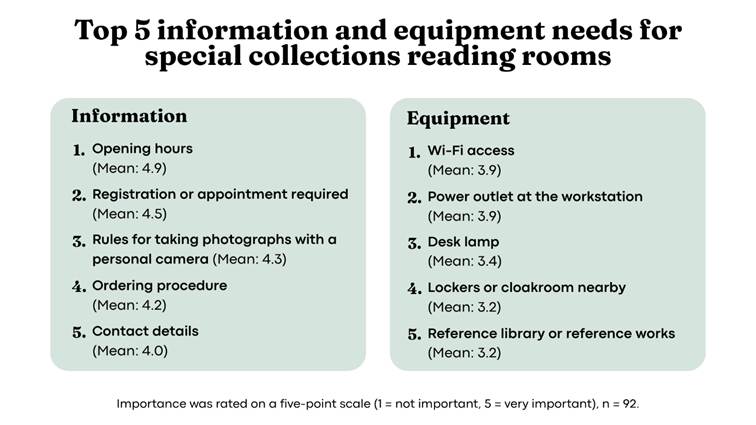
Figure 1. Top 5 information and equipment needs for special collections reading rooms
identified in an online survey of special collections reading room users.
The free-text responses illustrate why these types of information are considered important. As one respondent emphasised, “predictability is key; a library should announce as much as possible on their website so that researchers can plan ahead.” In particular, information on access requirements, appointment procedures, provision times, photography and reproductions is justified by the need to plan a visit to the special collections reading room in advance and to be able to structure the available working time on site. Information on the technical infrastructure is also mentioned in connection with specific work processes.
The results thus show the central importance of planning-relevant information for the preparation and organisation of a visit. Respondents also stressed the importance of clear advance guidance, including access requirements, turn-around times and procedures for ordering materials.
User experiences
The open questions about positive and negative experiences also show that transparent processes, reliable organisation and supportive staff are perceived as conducive to work. As one respondent put it, special collections reading rooms “tend to be quiet places with dedicated staff.” Another participant summarised the importance of library staff even more succinctly: “Librarians are the scholar’s best friends. Treat them well.” Negative experiences, on the other hand, relate primarily to organisational uncertainties, unclear regulations or restrictions on reproductions. Some respondents also mentioned disturbances in the reading room environment, such as noise from conversations between staff or other researchers, which can affect concentration and the overall working atmosphere. Positive and negative assessments are therefore often linked to the predictability of procedures and the overall working conditions on site.
Structure of a user-oriented special collections reading room website
Based on the online survey, a website structure can be derived that follows the typical sequence of events during a visit. The special collections reading room page can be understood as a kind of instruction manual that guides users through preparation, arrival and use.
The following information should be immediately visible at the top of the page: a brief description of the special collections reading room as a special workspace, a reference to the applicable rules with a link to the terms of use, opening hours, information on the appointment requirement and clear contact details. This information allows users to make an initial assessment of the terms of use without additional navigation.
A separate section should summarise all the steps that need to be clarified before arrival. This includes information on making appointments, the ordering process including links to catalogues, the necessary documentation, the maximum number of items that can be ordered, and lead times and delivery times. This makes it clear what organisational requirements must be met before the visit.
For arrival on site, information on the location within the building, documents to be presented, permitted and prohibited items, and cloakrooms or lockers is relevant.
Another area should cover the specific working conditions: workplace equipment, electricity and Wi-Fi availability, existing reference libraries or technical aids, and, where applicable, information on break options or climatic conditions.
Regulations on photography, reproductions and further use should be presented clearly and concisely, as they have a direct influence on the scope of work and length of stay. This includes conditions for taking your own photographs, use of existing equipment, reproduction services, publication requirements and copyright notices.
In addition to the structure of the content, findability, language and timeliness must also be taken into account. The diversity of German terms can make searching difficult. Consistent use of the term ‘Sonderlesesaal’ (special collections reading room), at least in metadata, can improve findability. In view of an international user base, an English-language version with equivalent content is also useful. Indicating the update status can help to assess reliability.
Conclusion
The results show that information relevant to planning and practical working conditions play a particularly important role from the users‘ perspective. While the specialist literature describes equipment requirements primarily from a conservation perspective, the survey focuses more on aspects of workability and organisation, without giving rise to any fundamental contradictions.
For the design of special collections reading room websites, this means that information must be provided in a structured, transparent and user-oriented manner.
My bachelor’s thesis (in German) is available online at: https://doi.org/10.25968/opus-3845
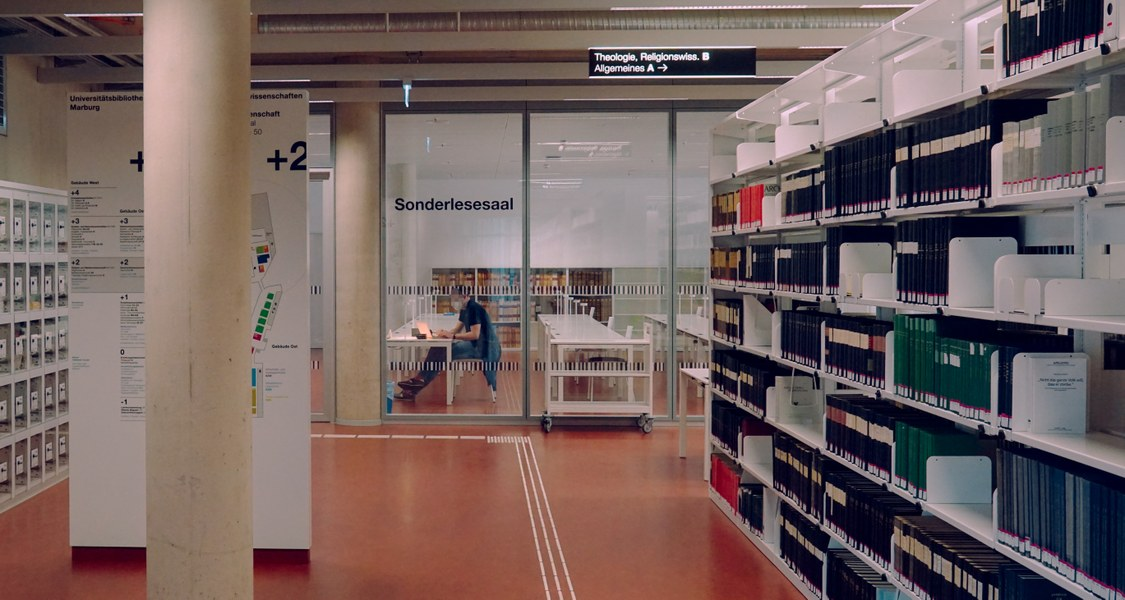
Figure 2. Sonderlesesaal, Universitätsbibliothek Marburg
Related articles
by Markéta Kučerová and Vojtěch Šícha, Library of the Czech Academy of Sciences
November 9, 2026
by Caroline Duroselle-Melish, Angela Dressen and Attilio Bottegal, I Tatti, Harvard
November 9, 2026