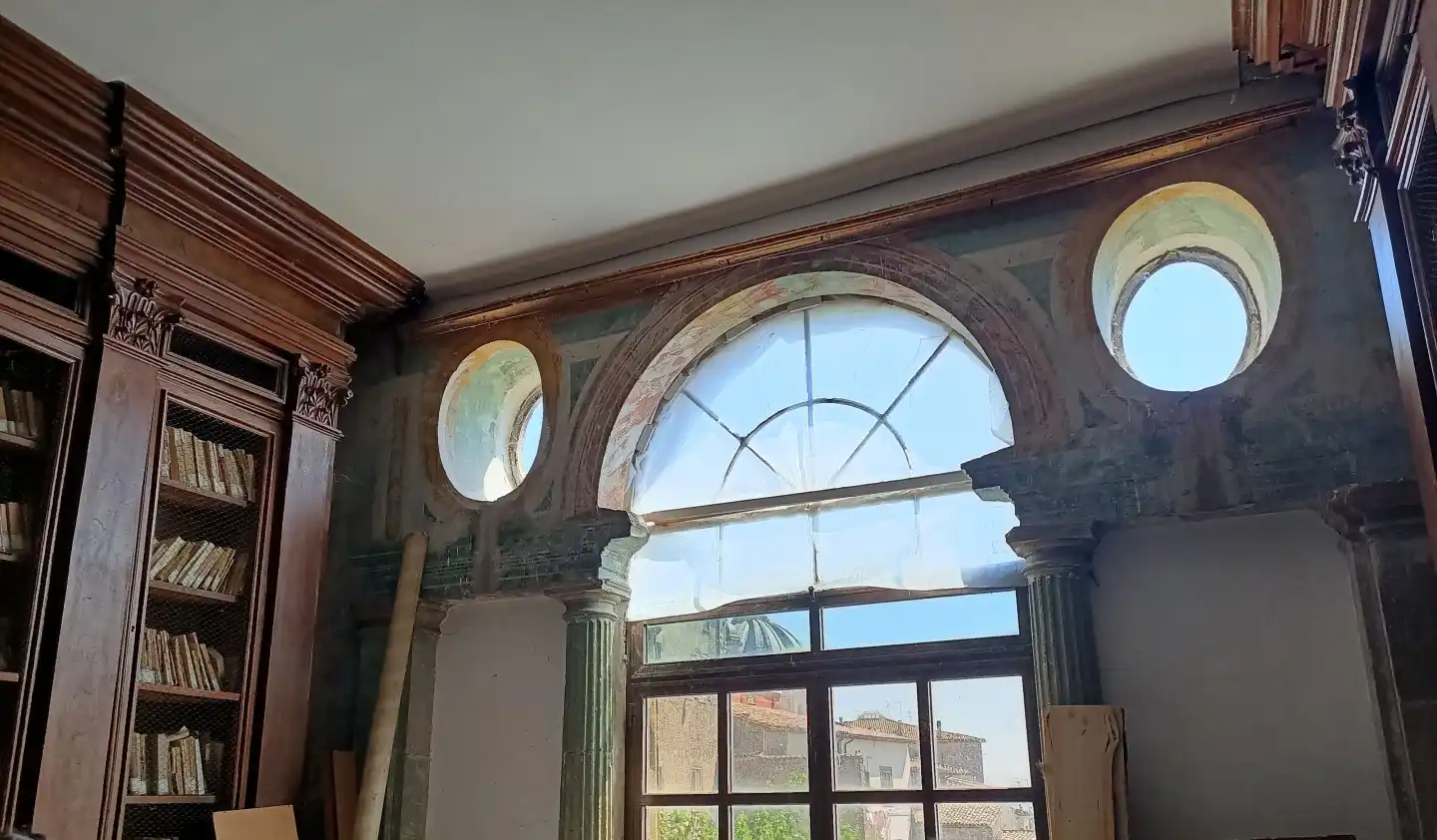
The Rare Book Collection of Ioannis Pezaros at the National Bank of Greece Cultural Foundation (MIET)
by Dr. Venetia Chatzopoulou, Historical and Palaeographical Archive of the National Bank of Greece Cultural Foundation
Share this article
The Rare Book Collection of Ioannis Pezaros and his heirs was acquired by the National Bank of Greece Cultural Foundation in 1976 and is housed at the Historical and Palaeographical Archive (Istoriko kai Palaeografiko Archeio) of the Foundation in Athens.
Ioannis Pezaros (1749-1806), cleric and scholar from the city of Tyrnavos in Thessalia, pursued an ecclesiastical as well as a secular education and taught at the schools of Thessalia during the second half of the 18th century but also at the Athoniada School in Mount Athos (1770-1771) [1]. His book collection was enriched by the acquisitions of his sons (Dimitrios and Alexandros) and of Dimitrios Konstantinou, who was also a teacher in Tyrnavos at a later time. The Pezarou Rare Book collection consists of 222 Greek and foreign titles (247 printed volumes in all) that date from as early as the 15th century to the beginning of the 20th century.
The oldest item in the collection is the Aldine incunable edition Scriptores astronomici veteres which was published in Venice (Oct. 1499; Pezarou 110; fig. 1) and contained the works of Greek and Latin ancient authors in a volume. The copy of the Pezarou Collection , however, includes only the works of the Greek authors [quires N-S], i.e. a short treatise on the construction of Aratus’ Sphere by Leontius Mechanicus, the Greek text of Aratus’ Phaenomena with the commentaries of Theon of Alexandria and, finally, the Sphaera of Ps.-Proclus, a text which constitutes a collection of excerpts from the work of the Rhodian astronomer Geminus Introduction to Astronomy, without the Latin translation by the English physician Thomas Linacre, which the complete Aldine edition includes.
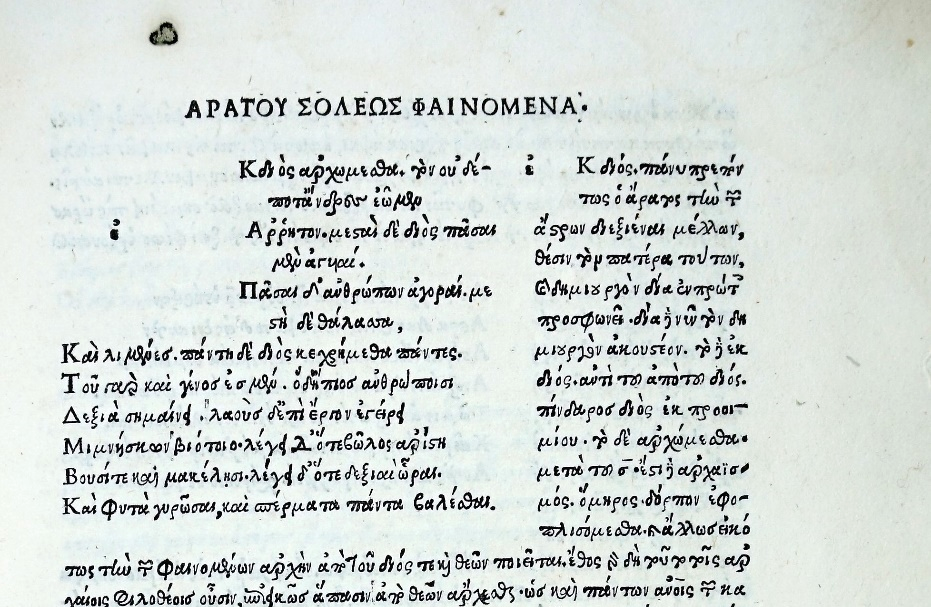
Fig. 1
The copy was donated to Ioannis Pezaros in 1771 by Dimitrios Chatzi-Spandonis, one of his students in Mount Athos and represents evidence of the favour shown by the teacher to the student, as the manuscript note of donation on the second folio of the book indicates (fig. 2) [2].
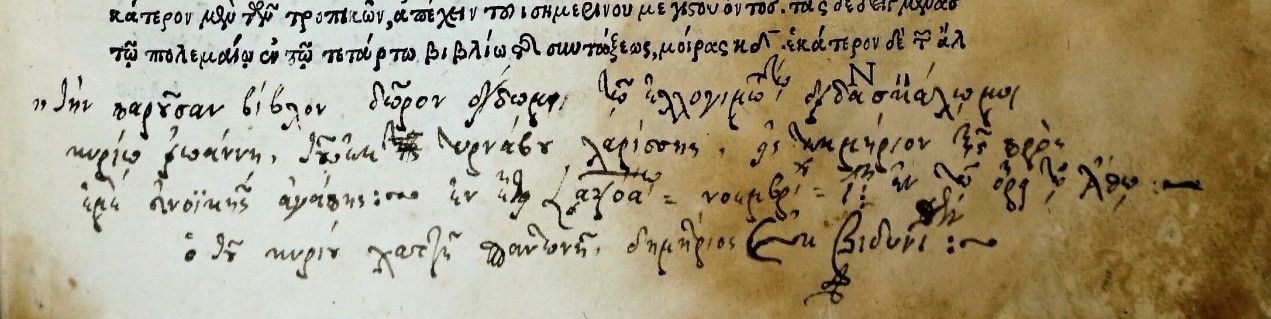
Fig. 2: τὴν παροῦσαν βίβλον δῶρον δίδωμι …
A second Aldine edition of the Pezarou collection is the editio princeps of Sophocles’ works (Venice, 1502; Pezarou 114; fig. 3) that was published with the collaboration of the Cretan scholar Ioannis Grigoropoulos.
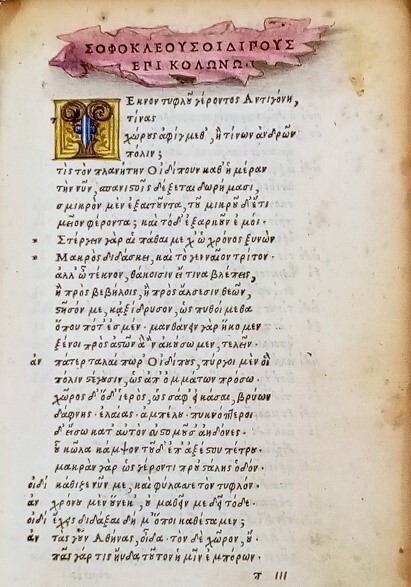
Fig. 3
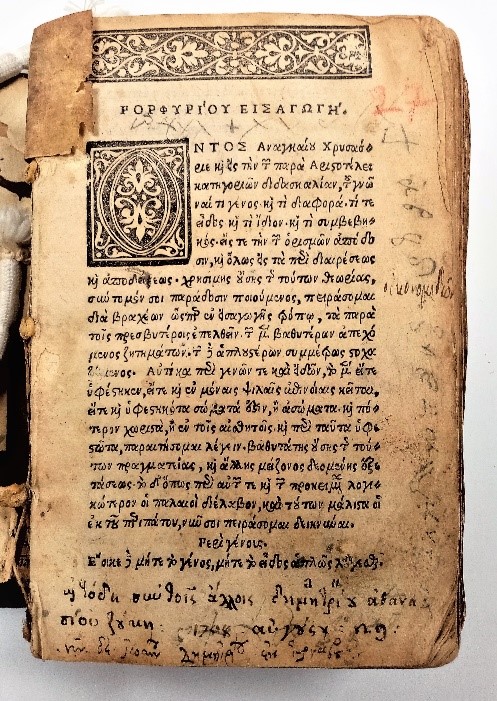
Fig. 4
Among the rest of the rare 16th century editions, Aristotle’s Organon stands out (Pezarou 113; fig. 4). This copy, with missing first leaves, has recently been identified as the edition printed in Venice in 1536 by the printing office of Bartolomeo Zanetti with the financial support of Gian Francesco Trincavelli, the son of Vittore Trincavelli, who was a physician and the editor of the Zanetti editions in 1535-1536. [3]
The primary strength of the collection lies in the area of religious books: Ioannis Pezaros being a priest, the presence of liturgical books of the Orthodox East does not surprise. Most of them were produced in Venice, the traditional center for the printing of Greek liturgical books over the centuries, but some came also from other 18th century European printing centers, like Bucharest, Moschopolis and Tirgoviste. Among the liturgical editions a few include church services, such as the Euchologion printed by Christoforo Zanetti (a. 1553; Pezarou 43; fig. 5), while others include Akolouthies dedicated to various saints like Saint Dionysios of Olympos (Venice 1728; Pezarou 13; fig. 6), Saint Catherine (Tirgoviste, 1710; Pezarou 7) and Saint Bessarion (Bucharest 1759; Pezarou 130; fig. 7).
Among the rest of the theological works, only a few represent editions prepared by Westerners, such as the rare edition of the New Testament printed in Basel (a. 1540; Pezarou 118; fig. 8) by the Swiss humanist Thomas Platter (1499-1582). The vast majority is represented by original works or by translations of representatives of the Orthodox Church, as for example Evgenios Voulgaris (1716-1806), a clergyman from Corfu and one of the leading figures of the Neohellenic Enlightenment, who translated into Greek Voltaire’s work A historical and critical essay on the dissensions of the Churches in Poland [Peri ton dichonoion en tais ekklisiais tis Polonias], that was accompanied by notes on religious tolerance and the toleration of other religions (Schediasma peri tis anexithriskeias) (Leipzig 1768; Pezarou 3) composed by Voulgaris himself; or, the treatise A Reply by a Certain Orthodox Christian to an Orthodox Brother on the Catholic Dynastic Rule (Apokrisis orthodoxou …) (Pezarou 10; fig. 9), an anti-catholic work which circulated anonymously in 1775 in Halle and was attributed to the prominent cleric Nikiphoros Theotokis (1731-1800) but was recently considered as being probably a primary conception of Evgenios Voulgaris [4].
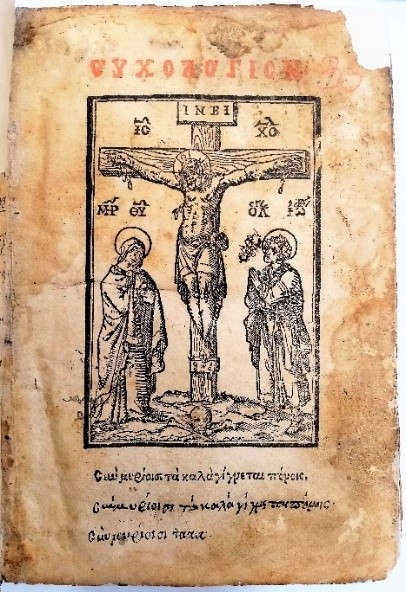
Fig. 5
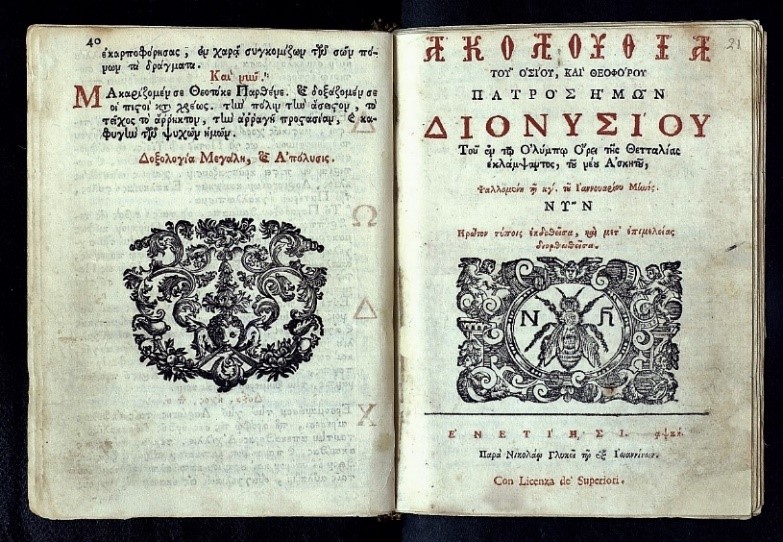
Fig. 6
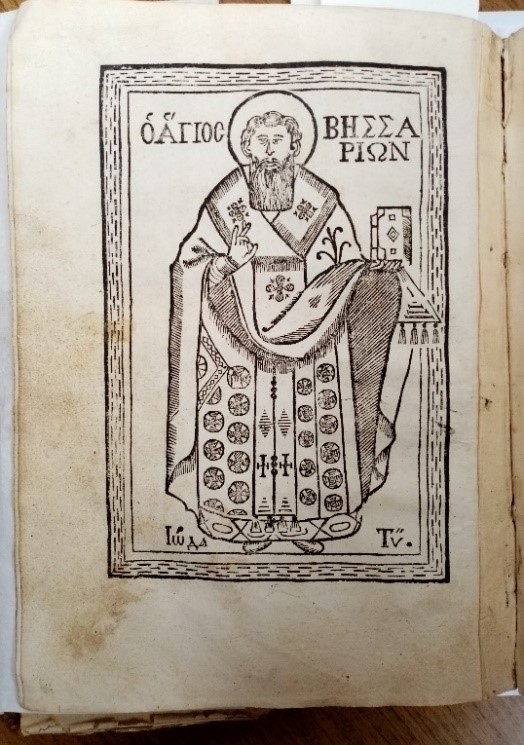
Fig. 7
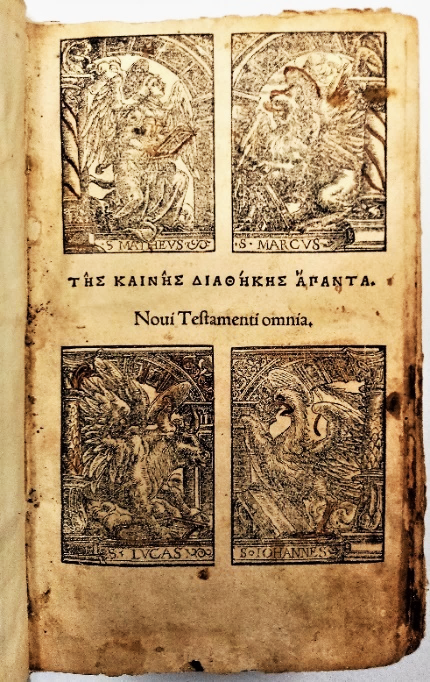
Fig. 8
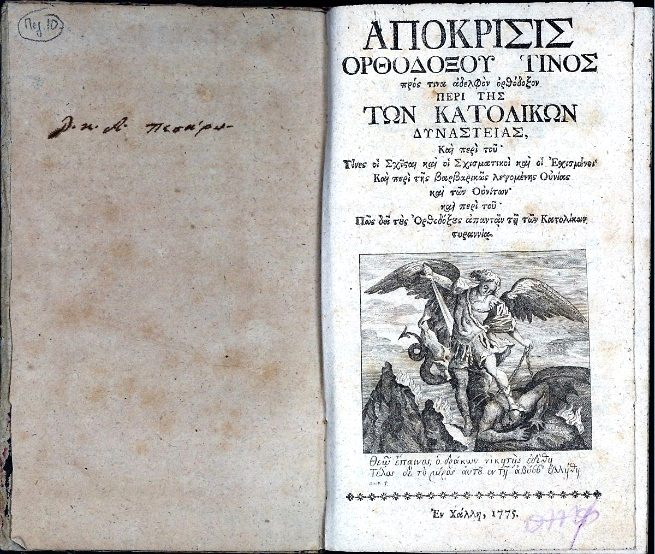
Fig. 9
The Pezaros rare book collection also includes a number of philosophical treatises: only a few of them regard the ancient Greek philosophy, like The Platonic Doctrines of Albinus [Eisagogi ton dogmaton Platonos; Pezarou 106], that was printed by Antonio Bortoli in Venice (a. 1748), while others are contemporary works such as the Syngramma peri ton aoraton dia ton oraton (Leipzig 1760; Pezarou 37), by Thomas Mandakassis (1709-1796), scholar of the Greek diaspora in Germany, who composed this philosophical/theological treatise on the acquisition of knowledge. [5]
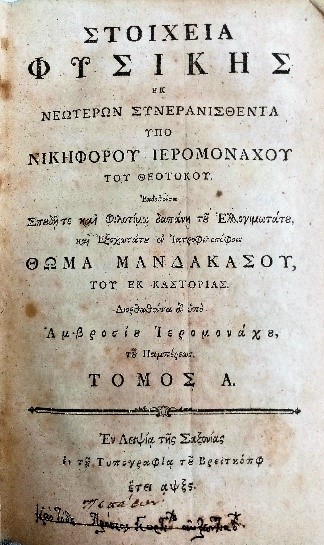
Fig. 10
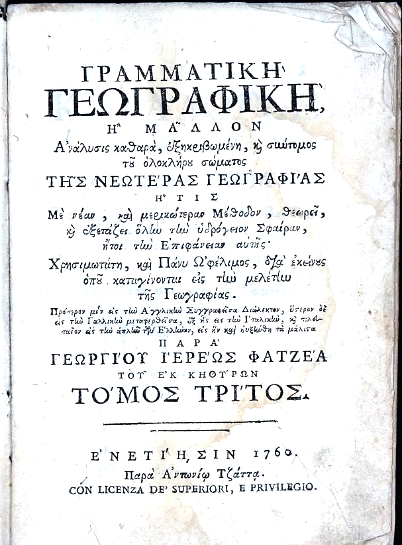
Fig. 11
From a considerable number of scientific works destined for the education of the youth, we highlight here the Elements of Physics (Stoicheia Physikis, Leipzig 1766, 1st vol.; Pezarou 90; fig. 10) that was composed by Nikiphoros Theotokis, a fellow intellectual of Voulgaris, who had studied mathematics and natural science and, in parallel with theological treatises, occupied himself with the writing of scientific works. He is considered to be one of the major contributors to the introduction of scientific thought in the Greek education of the 18th century. [6] Earlier, Georgios Fatzeas published his Geographical Grammar (Grammatiki Geografiki, Venice 1760; Pezarou 91; fig. 11), which adopts a 17th c. English treatise [7] that was translated by Fatzeas through the Italian median and, as it was common during this period, the author arranged the foreign text and added explanations in the parts that concerned the Greek lands. [8]
Some grammatical and linguistic works are included in the Collection, as for example the Introduction to the Greek Language (Eisagogi eis tin ellinikin glossan; Venice 1805, 2nd ed ; Pezarou 17; fig. 12) by Dimitrios Darvaris (1757-1823), member of a merchant family in Vienna, to whom we owe several works for children and young people and who aimed at the Greek language cultivation and the promotion of the education of Greek in the communities of the diaspora. [9]
Among the literary works, we note the Greek translations of Vergil’s Georgics (Saint Petersburg 1786; Pezarou 35; fig. 13) and Aeneid (Saint Petersburg 1791; Pezarou 86), prepared by Evgenios Voulgaris in Russia, at the court of Catherine II [10].
These are the first complete translations of Vergil’s work in Greek written in Homeric hexameter and in Homeric Greek language chosen for educational reasons, since the translations were addressed to those interested in studying the ancient Greek language and would guarantee to the readers the approach to the honorable past of the ancients.
The translation of Georgics was dedicated to the Prince Potemkin while Aeneid, printed in 3 volumes, was dedicated to the Empress Catherine. The works were published by the Russian Academy of Sciences.
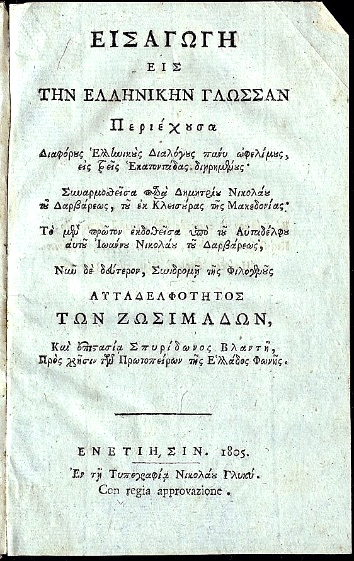
Fig. 12
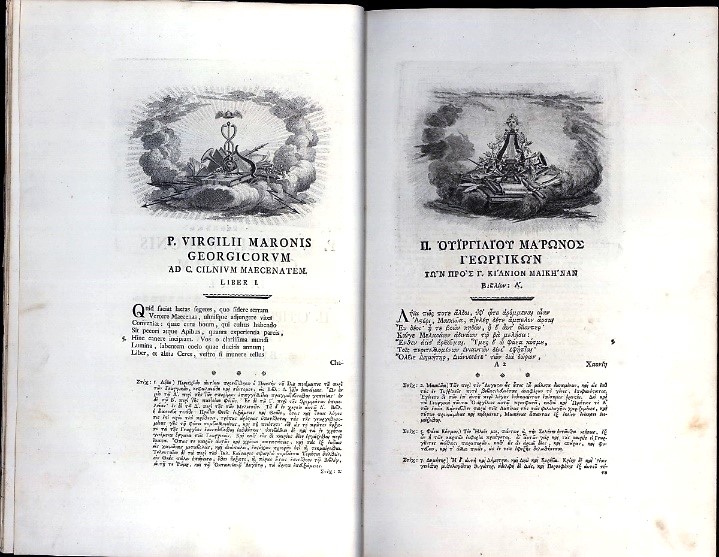
Fig. 13
Among the foreign titles a few are in Latin, like a Selection from Cicero’s Letters [Treviso, 1719; Pezarou 230], which bears on the title page a note of possession of Ioannis Pezaros’s sons (Οἰκονομιδῶν) (fig. 14). The vast majority of the rest of the titles are printed in modern European languages, mostly in German, Italian and French, and include mainly literate works, dictionaries, catalogues of antiquities but also editions of a more practical content like the La scrittura doppia, a text prepared for accounting reasons that was useful to merchants (Venice 1803; Pezarou 112; fig. 15). [11]


Fig. 14
Fig. 15
The Pezaros’ Rare Book collection at the Historical and Palaeographical Archive of MIET represents a wide range of subjects and languages. Predominant are religious texts augmented by various secular works, mostly scientific and linguistic treatises. At this point, especially it should be pointed out that Ioannis Pezaros was a man of the Orthodox Church who was simultaneously receptive to the novel Enlightenment ideas. He himself introduced modern texts into the teaching of the philosophical and scientific courses he taught to his students of the last grade of school in Thessalia.
Bibliography
[1] Michalis Lafazanis, Ιωάννης Πέζαρος (1749-1806): η εποχή, το έργο, η αλληλογραφία του: η συμβολή της σχολής του Τυρνάβου στον Nεοελληνικό Διαφωτισμό, Tyrnavos 2009.
[2] Venetia Chatzopoulou, «Από την Αναγέννηση στον ελληνικό 18ο αιώνα: αστρονομική παράδοση στην αλδινή έκδοση Scriptores astronomici veteres (1499) της συλλογής ΙΠΑ/ΜΙΕΤ», in: Vera Andriopoulou, Kleopatra Kyrtata, Aggeliki Papadopoulou (eds.), Ένα βιβλίο, έξι αιώνες ιστορίας. Εκδόσεις από την αυγή της τυπογραφίας στις βιβλιοθήκες της Αθήνας, Piraeus 2020, p. 213-228.
[3] Annaclara Cataldi Palau, «Bartolomeo Zanetti stampatore e copista di manoscritti Greci», in The Greek Script in the 15th and 16th Centuries, ed. S. Patoura [National Hellenic Research Foundation – Institute for Byzantine Research, International Symposium 7], Athens 2000, p. 83-144.
[4] Vasilios Makrides, «Ἀπόκρισις Ὀρθοδόξου τινὸς πρός τινα ἀδελφὸν ὀρθόδοξον περὶ τῆς τῶν Κατολίκων δυναστείας […] (Χάλλη 1775): Ἔργο τοῦ Νικηφόρου Θεοτόκη ἢ τοῦ Εὐγενίου Βούλγαρη; Στοιχεῖα, ἑρμηνεῖες καὶ ὑποθέσεις», in Chariton Karanasios (ed.), Εὐγένιος Βούλγαρης. Ὁ homo universalis τοῦ Νέου Ἑλληνισμοῦ. 300 χρόνια ἀπὸ τὴ γέννησή του (1716-2016), Athens 2018, p. 463-522.
[5] Elias Tempelis, «Τα απάνθρωπα ξυλίσματα και υβρίσματα: Θωμάς Μανδακάσης, ο πρώτος παιδαγωγός του Νεοελληνικού Διαφωτισμού », Xenophon 3 (Oct. 2018), p. 100-112.
[6] Paschalis Kitromilides, Νεοελληνικὸς Διαφωτισμός. Οἱ πολιτικὲς καὶ κοινωνικὲς ἰδέες,[ΜΙΕΤ], Athens 1995 [32000], p. 66-70.
[7] Patrick Gordon, Geography anatomized, London 1693.
[8] Alexandra Sfoini, Ξένοι συγγραφείς μεταφρασμένοι ελληνικά (1700-1832). Ιστορική προσέγγιση του ελληνικού μεταφραστικού φαινομένου, Athens 2019, p. 209 ; Stratos Myrogiannis, The Emergence of a Greek Identity (1700-1821), Newcastle 2012, p. 86.
[9] Vaso Seirinidou, Το Εργαστήριο του Λογίου. Αναγνώσεις, λόγια παραγωγή και επικοινωνία στην εποχή του Διαφωτισμού μέσα από την ιστορία της βιβλιοθήκης του Δημητρίου Ν. Δάρβαρη (1757-1823), Athens 2013.
[10] Sophia Papaioannou, « Το ‘Ελληνικό Σχέδιο’ της Αικατερίνης Β΄ και οι μεταφράσεις του Βιργιλίου από τον Ευγένιο Βούλγαρι », in Eleni Aggelomati-Tsougaraki (ed.), Εὐγένιος Βούλγαρης ‘ὁ ὕπατος τῶν φιλοσόφων τοῦ Νέου Ἑλληνισμοῦ’. Τρεῖς αἰῶνες ἀπὸ τὴ γέννησή του, Corfu 2018, p. 213-234 ; eadem, «Eugenios Voulgaris’ translation of the Georgics: an introduction to the first modern Greek translation of Vergil», Vergilius 54 (2009), p. 97-123.
[11] Sfoini, op. cit., p. 233.
Related articles
November 9, 2026
by Markéta Kučerová and Vojtěch Šícha, Library of the Czech Academy of Sciences
November 9, 2026