The Dante project and the Divine Comedy in Emilia-Romagna
by Federica Fabbri, PhD Student in Library Science, Bologna
Share this article
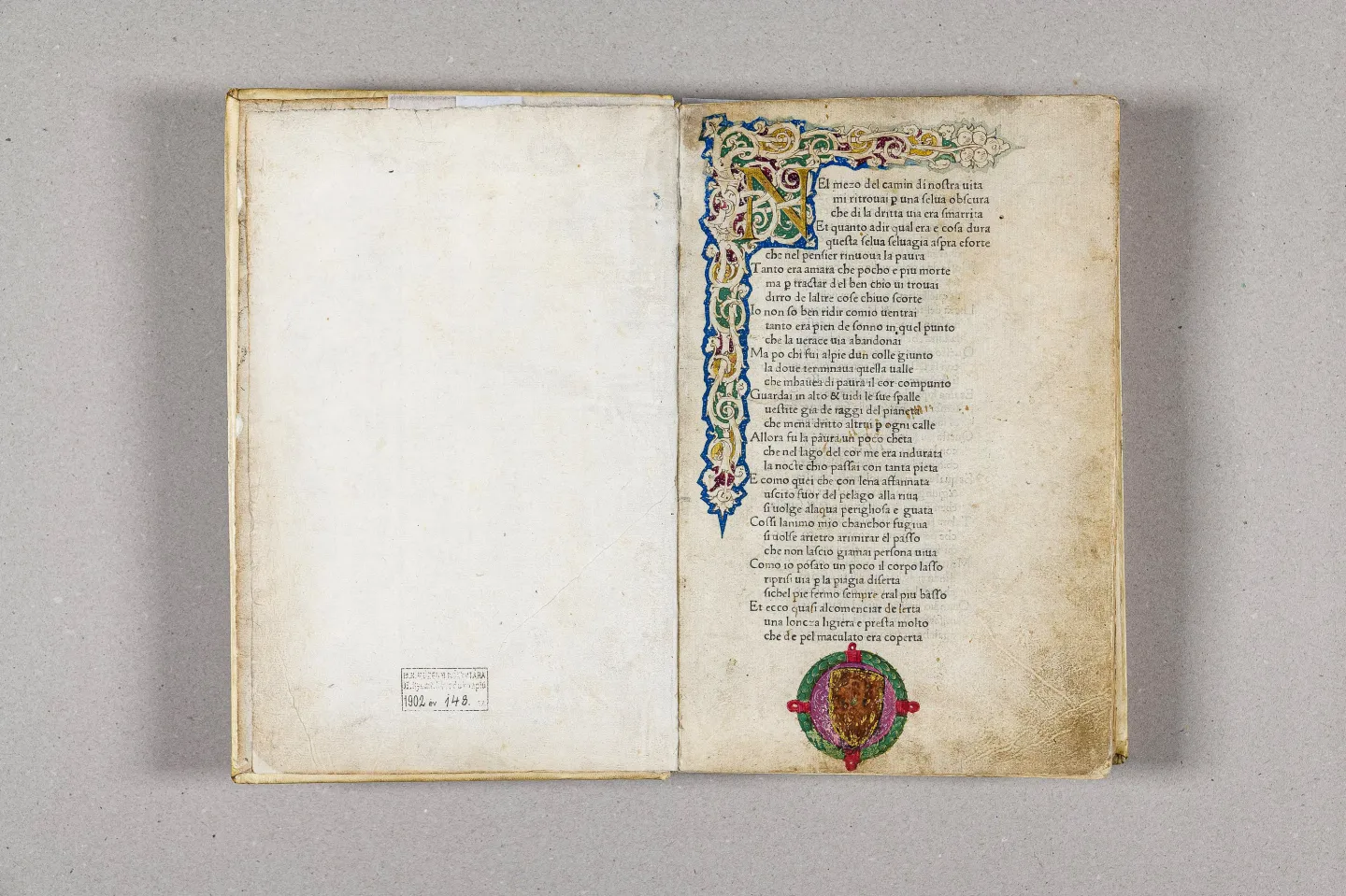
Ravenna, Centro Dantesco. Photographs by Luca Bacciocchi for Servizio Patrimonio culturale della Regione Emilia-Romagna, 2020-2021.
On the seventh centenary of Dante Alighieri’s death (1321-2021), the Servizio Patrimonio Culturale of the Emilia-Romagna Region, in collaboration with the Italian Dante Society, promoted a widespread exhibition itinerary with the aim of enhancing the handwritten and printed testimonies of the Comedy kept in the libraries and archives of the Region.
Conceived by Alberto Casadei, coordinated by Claudio Leombroni, and curated by Gabriella Albanese (University of Pisa), Sandro Bertelli (University of Ferrara) and Paolo Pontari (University of Pisa), the project consisted in the census and exhibition to the public of manuscripts, incunabula, sixteenth-century books of the Comedy and copies of editiones principes of other Dante works preserved in the fourteen institutes of the Region involved. The single catalog, published by Silvana Editoriale, which accompanies the exhibitions set up at the participating institutes, with introductory essays by specialist scholars from the academic world and experts in the ancient book heritage and with specific sections dedicated to Dante’s collections owned by each institution, reports over two hundred descriptions relating to the material studied and cataloged.
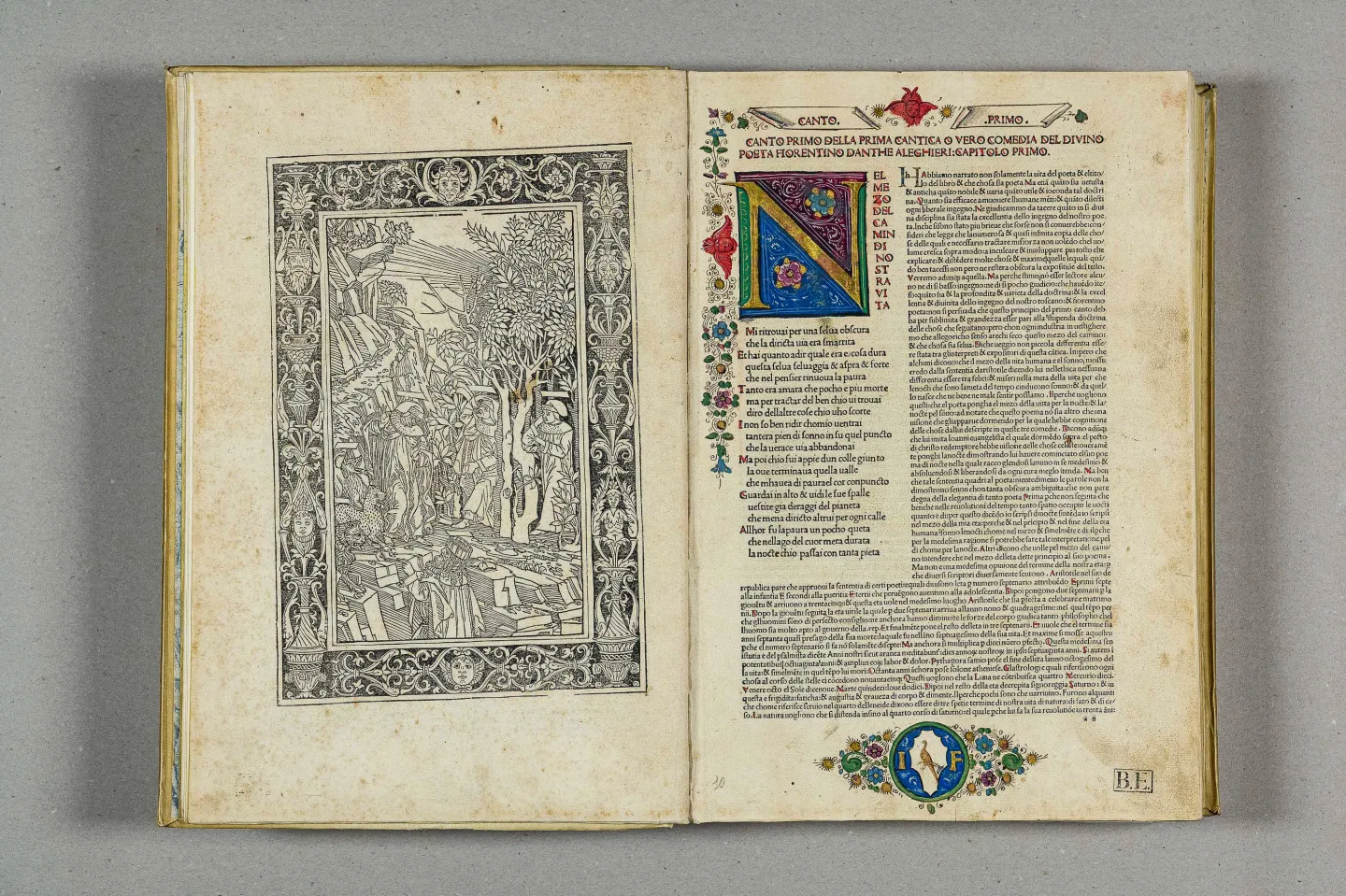
Modena, Biblioteca Estense Universitaria.
To launch the exhibition project, the Servizio Patrimonio Culturale of the Emilia-Romagna Region has created a thematic section that is constantly updated on the project within its website and also a video (with English subtitles) with the collaboration of WildLab, which was launched on the occasion of the DantdMonday 2021. The video, edited by Alberto Casadei and Claudia Collina, traces the close relationship between Dante, Romagna and the Emilian territory from the early years of his exile to the last Ravenna refuge:
“It is a monologue by Dante himself – says Alberto Casadei – which recalls some of his stops in Emilia-Romagna, citing known and lesser-known facts (for example the fact that he wrote a joking sonnet in Bologna on the two towers, preserved in the Archive di Stato): this allows the listener to enter from the inside into Dante’s biography, which is still very uncertain; Then there are landscapes and cities mentioned in the Divine Comedy or in any case related to Dante’s travels in these territories, and the suggestions that have emerged, even at the level of inspiration. There remain the many manuscripts and prints that his works and in particular the Divine Comedy hand down to us, and here is the importance of the libraries and archives involved from all over Emilia-Romagna in the exhibition project. The third part of the video is dedicated to these places which preserve the testimonies of Dante’s great fortune starting from the fourteenth century and up to the entire humanistic era: although not even an autographed line of this great author has arrived, his texts, and in particular the Divine Comedy, they traveled everywhere, and they arrived there precisely because it was considered that they were worthy of being handed down even in splendid manuscripts.”
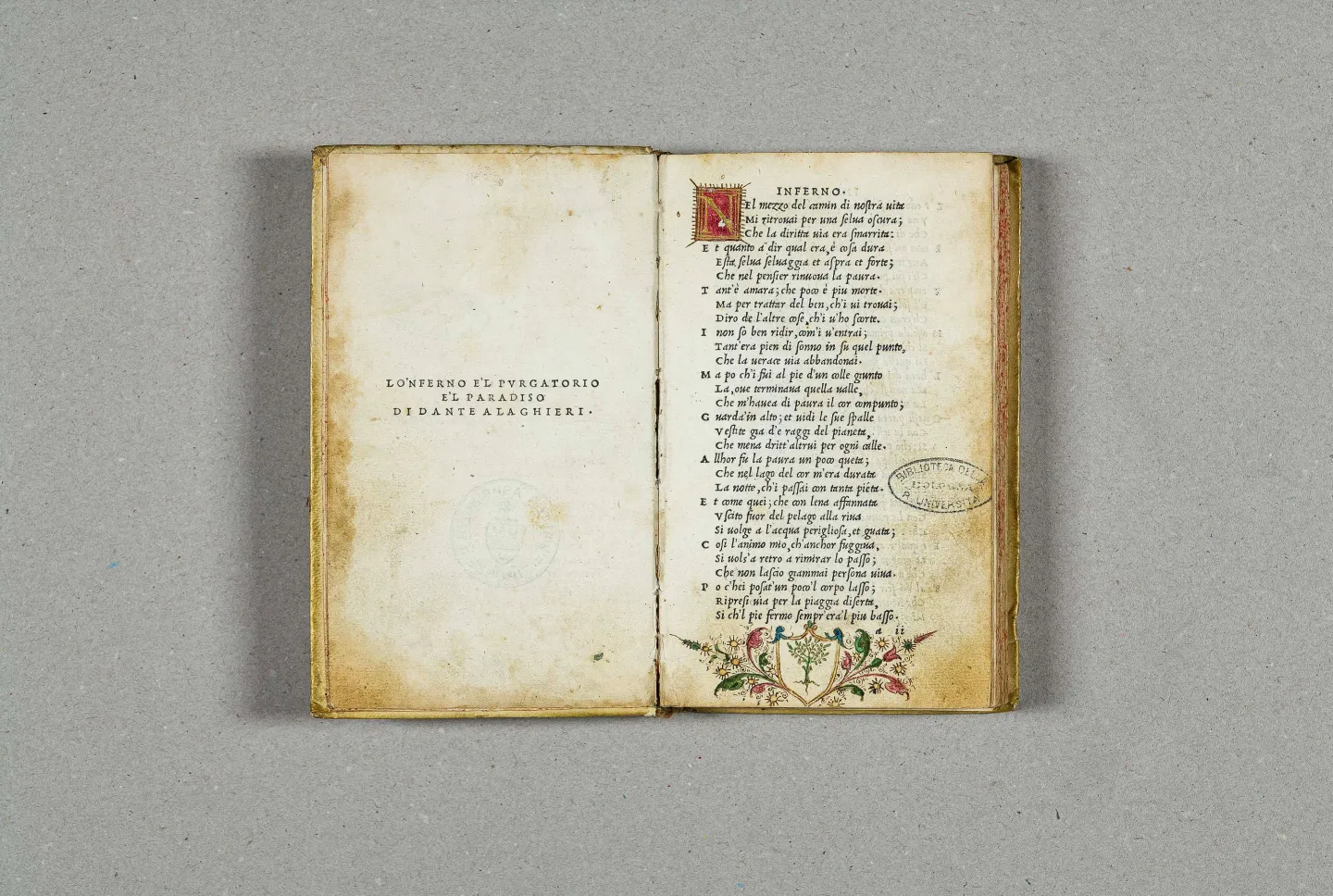
Bologna, Biblioteca Universitaria.
Institutes involved in the project:
- Biblioteca Passerini-Landi di Piacenza – Tesori danteschi a Piacenza: il Landiano 190, frammenti, incunaboli e cinquecentine (23 ottobre 2021-31 gennaio 2022)
- Biblioteca Palatina di Parma – Un splendor mi squarciò ’l velo (20 novembre 2021-12 febbraio 2022)
- Archivio di Stato di Modena – Dante e gli Este. Riflessi della Commedia fra Modena e Ferrara (3 settembre 2021-21 marzo 2022)
- Biblioteca Estense Universitaria di Modena – Dante illustrato nei secoli. Testimonianze figurate nelle raccolte della Biblioteca Estense Universitaria (17 settembre 2021-8 gennaio 2022)
- Archivio di Stato di Bologna – La fortuna di Dante e i suoi primi cultori nei documenti dell’Archivio di Stato di Bologna (25-29 ottobre 2021)
- Biblioteca Comunale dell’Archiginnasio di Bologna – Cercar lo tuo volume. Documenti danteschi in Archiginnasio (24 marzo-27 giugno)
- Biblioteca Universitaria di Bologna – Spiegare Dante. Testimonianze e commenti della Divina Commedia nelle raccolte della Biblioteca Universitaria di Bologna (25 ottobre-17 dicembre 2021)
- Biblioteca Comunale di Imola – La Commedia nella città di “Santerno”. Testimonianze dantesche nella Biblioteca comunale di Imola (10 settembre 2021-12 febbraio 2022)
- Biblioteca Comunale Ariostea di Ferrara – Manoscritti, antiche edizioni e opere artistiche del “viaggio” dantesco alla Biblioteca Comunale Ariostea di Ferrara (2 settembre 2021-2 febbraio 2022)
- Centro Dantesco dei Frati Minori Conventuali di Ravenna – In su ‘l lito di Chiassi. Tesori danteschi nelle biblioteche e negli archivi di Ravenna (21 agosto-6 novembre 2021)
- Istituzione Biblioteca Classense di Ravenna – In su ‘l lito di Chiassi. Tesori danteschi nelle biblioteche e negli archivi di Ravenna (21 agosto-6 novembre 2021)
- Biblioteca Civica «Aurelio Saffi» di Forlì – Alla scoperta di Dante. Il patrimonio dantesco alla Biblioteca «Aurelio Saffi» di Forlì (18 settembre-18 dicembre 2021)
- Biblioteca Malatestiana di Cesena – Per Dante Alighieri: testi, commenti, imitazioni e difese (5 giugno-14 novembre 2021)
- Biblioteca Civica Gambalunga di Rimini – Le opere di Dante nella storia della Gambalunga (10 settembre 2021-8 gennaio 2022)
The catalog published by Silvana Editoriale also includes the descriptions of the single 15th-century copy owned by the Diocesan Library «San Pier Crisologo» in Ravenna (http://www.diocesiravennacervia.it/wd-annuario-enti/bibmingham-diocesana-10589/) and of the papers kept in the State Archive in Ravenna (https://asravenna.beniculturali.it/) not showed to the public.
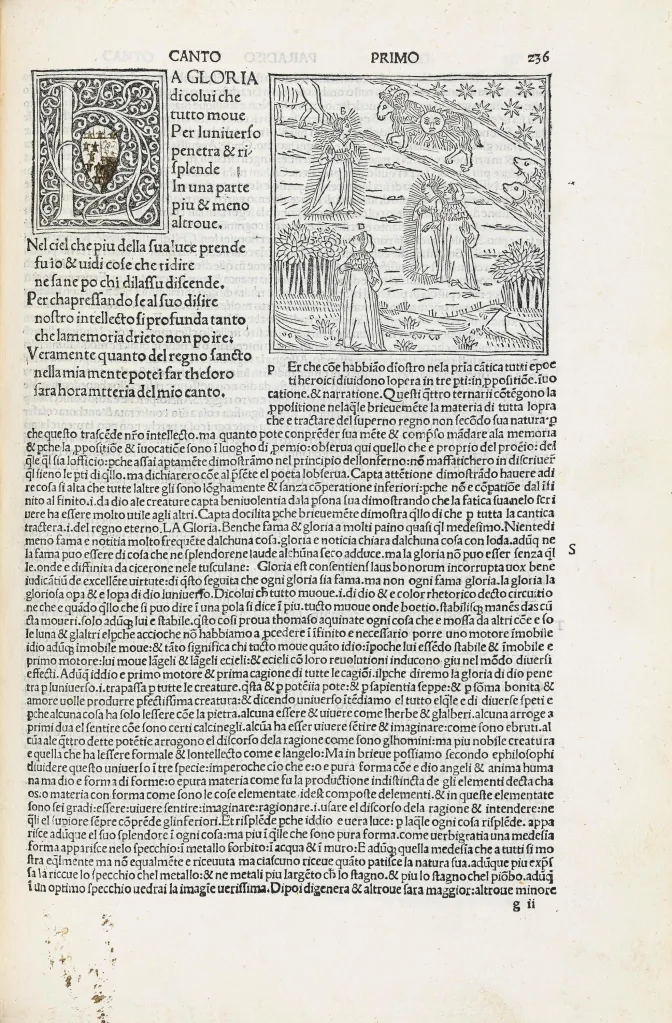
Bologna, Biblioteca comunale dell’Archiginnasio.
The contribution of the Research Center in Bibliography of the University of Bologna
The Research Center in Bibliography (Centro di Ricerca in Bibliografia, CERB) of the University of Bologna also collaborated in the census, study and description of the printed copies of the 15th and 16th centuries kept by the libraries and archives of the Region: https://centri.unibo.it/cerb/en. Prof. Paolo Tinti, head of the Center since November 2019, has been entrusted in particular with the scientific coordination of the cataloguing project, as well as with the description of the 15th-century book of the Estense University Library of Modena; Federica Fabbri was entrusted with the incunabula of the Classense Library, of the Dante Center of the Conventual Friars Minor, of the Diocesan Library of «San Pier Crisologo» in Ravenna, of the Manfrediana Municipal Library in Faenza and of the Municipal Library of the Archiginnasio in Bologna.
CERB’s involvement also has extended to the exhibition In su ‘lito exhibition in Chiassi. Tesori danteschi nelle biblioteche e negli archivi di Ravenna (21st August-6th November 2021), curated by Federica Fabbri for the Dante Center of Ravenna.
The descriptions prepared by the members of CERB in relation to the copies of the edition of Dante’s Comedy of 1481 (Florence: Nicolaus Laurentii, Alamanus, ISTC id00029000), partially transferred to the Material Evidence in Incunabula (Ravenna, Biblioteca Classense, id. 02126770; Ravenna, Dante Center of the Conventual Friars Minor, id.02141029), were used in The Polonsky Dante Project: An Illustrated Copy-census of Dante, Comedia, Florence, 1481 with engravings by Botticelli, promoted by the Polonsky Foundation and coordinated by CERL, aimed at the census of all the specimens of the only Florentine edition of the Comedy, embellished with engravings on copper-plate with a burin made by Baccio Baldini on drawings by Sandro Botticelli.
 The collaboration given by the CERB of Bologna to the project of the Emilia-Romagna Region and the Polonsky Foundation is part of the PRIN17 The Dawn of Italian Publishing activities. Technology, Texts and Books in Central and Northern Italy in the Fifteenth and Sixteenth Centuries (Unit of Bologna).
Related articles
by Konrad K. Szymański (Ossolineum National Library, Wrocław)
November 9, 2026
by Caroline Duroselle-Melish, Angela Dressen and Attilio Bottegal, I Tatti, Harvard
November 9, 2026