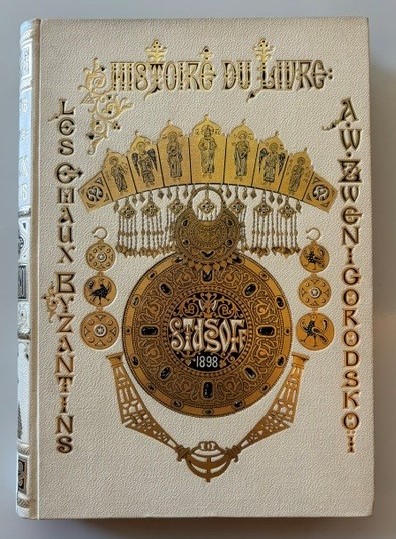
CERL Internships 2022 – Incunabula from the database ‘Medieval Libraries of Great Britain’ (MLGB3)
by Vanessa Rossi, Bruno Kessler Foundation, Trento
Share this article
They that shall live in future ages, may possibly value such old editions, as much as we do manuscripts now. The curious have a value for them already”, Thomas Baker noted back in the eighteenth century on a copy of Augustinus de Ancona’s Summa de potestate ecclesiastica (Cologne : Arnold Ther Hoernen, 1475; now at St John’s College, Cambridge).
I think that curiosity is indeed the key that guides those who deal with ancient books and their history in their research; it is also what led me to apply for the CERL 2022 Grant to support a remote internship to create records in MEI from MLGB3 – the online database created by Richard Sharpe (+2020) with data extracted from the 8,000 file-cards on which Neil Ker (author of Medieval Libraries of Great Britain) recorded the evidence for provenance from the extant medieval books (source: MLGB3 website).
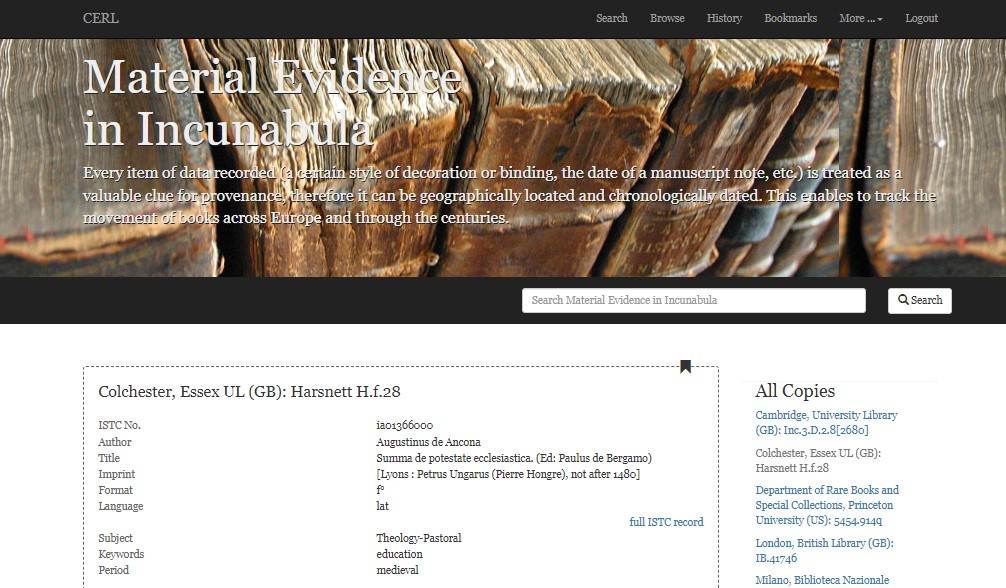
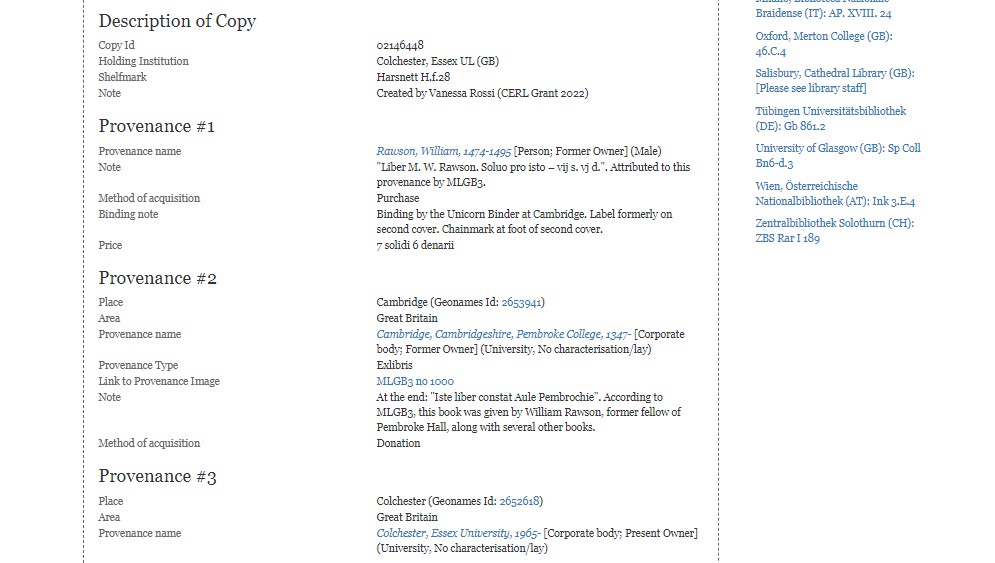
My project required me to add on MEI those incunabula that had belonged (or still belong) to British monasteries, convents and other institutions around the time of Henry VIII’s Dissolution (about 400 copies, as the list would be longer if we considered manuscripts and sixteenth century prints), along with the pieces of evidence for their provenance. For the purpose Cristina Dondi, my supervisor, trained me in the understanding of MLGB3 records and in the creation of MEI records, which also required the use of other CERL databases (namely ISTC, EBOB and Owners of Incunabula).
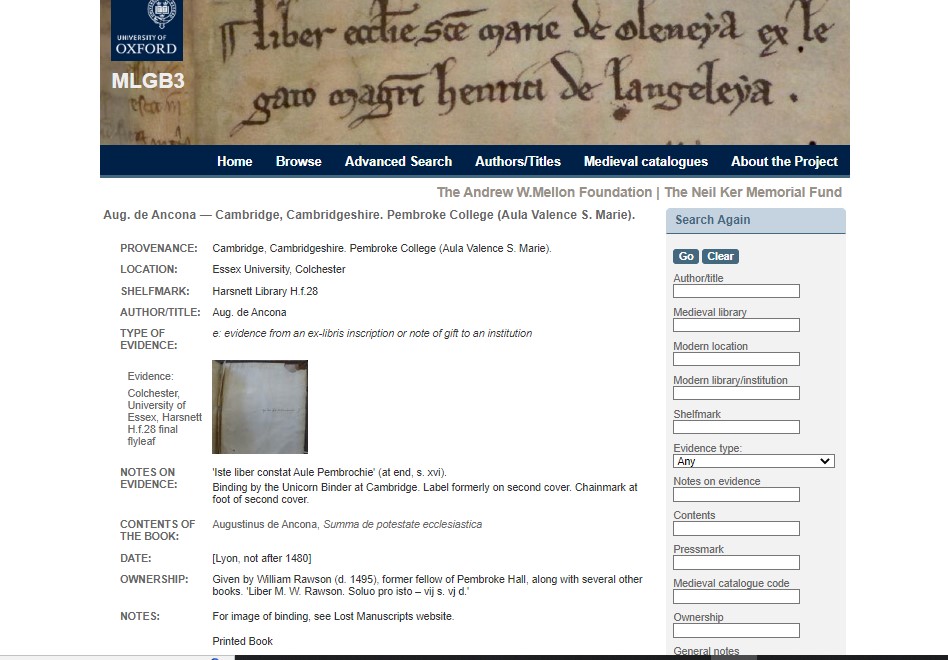
It was a challenging work – as the primary source, books, were not on my desk to compare whenever I had doubts and I had to rely on and sometimes interpret the pieces of information I would find on MLGB3 – but it proved to be also an extraordinary and enriching experience that gave me the possibility to look for contemporary and modern provenances and to reconstruct (whenever possible) their existence in order to locate them, and hence the books, in space and time.
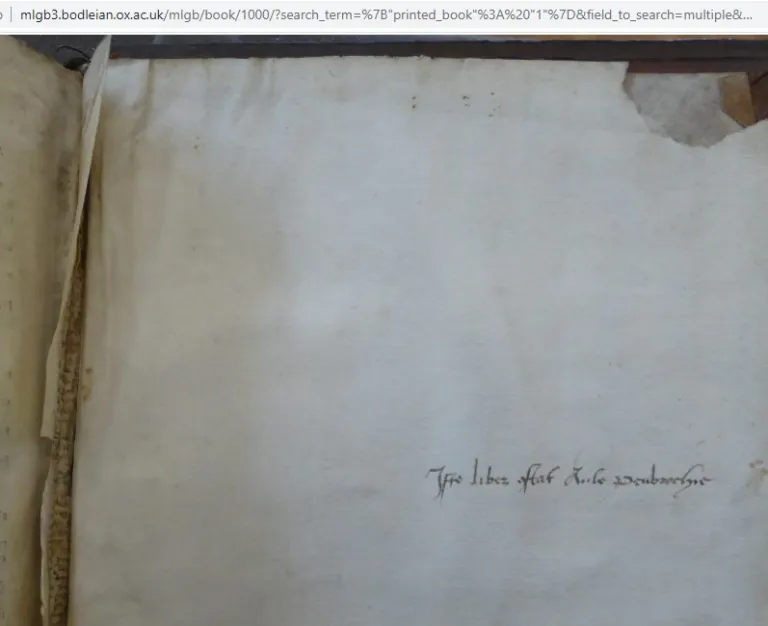
It is the hope that the data and the descriptions now available in MEI (which cross-refer to MLGB3) will prove to be useful for the ongoing studies on the book trade and book provenance; and maybe, one day, MEI records will be further completed (or revised) with the details that only the material book in hand can tell and, conversely, MLGB3 records will be all integrated with images of the respective pieces of evidence for provenance (as the website itself states, image coverage is partial), and links to MEI.
Related articles
November 9, 2026
by Konrad K. Szymański (Ossolineum National Library, Wrocław)
November 9, 2026