
Provenances from Brazil
by Fabiano Cataldo de Azevedo, Ph.D. (UNIRIO/CERL) with the collaboration of Nathalia Henrich, Ph.D. (The Oliveira Lima Library/ The Catholic University of America)
Share this article
Since March 2019, I have coordinated with professor Stefanie Cavalcanti Freire the research project A Eloquencia dos Livros: Marcas de Proveniencia (‘The Eloquence of Books’: Provenance) as professor at the Department of Librarianship of the Universidade Federal do Estado do Rio de Janeiro (Federal University of the State of Rio de Janeiro – UNIRIO).
In doing so, I decided to create this project with one very straightforward objective in mind: to identify other activities within this subject in Brazil and to map the scientific production on the subject. Despite expecting that there were people interested in this subject and knowing about single activities, the results have been beyond what I could have imagined.
It is important to contextualize this project within my own research agenda.
For six years I have taught a course on the formation and management of special collections, an area in which there is as much demand as there are doubts. Especially because there is still some confusion regarding the concepts of what is a “rare book”, “old book” and even “heritage in libraries” (although this may actually be a theme for another text).
Finally, during this period teaching about special collections, it was clear that some topics were always included in the class program, that is, “private” libraries (of an individual) and “institutional” (whose creation nucleus was at the beginning of an institution).The subject of provenance always appeared in these discussions, and always generated many questions. Of course, the biggest were “how to describe” and “how to catalog”. However, throughout this period, I began to notice that doubts about provenance were not specifically about them. Rather many doubts stemmed from the absolute lack of training in History of the Book and Analytical Bibliography. Unfortunately, this content was eliminated from the curricula of Librarianship courses over the decades in the 20th century, due to the claim that they were no longer needed and consequently outdated.
I am a graduate and I teach at the first School of Library Science in Latin America. These are courses that try to remain within a humanist tradition, even though many believe that this means “not to modernize”. Therefore, in the last 50 years, Library Science courses in Brazil and other Latin American countries, such as Argentina, for example, have assumed a more technical approach.
Our theoretical guides are David Pearson’s Provenance Research in Book History and his Books As History. The study of provenances is a field within the History of the Book and Libraries. As such, the form of analysis and description requires knowledge of what Dominique Varry calls “Archeologie du Livre”, that is, that of Analytical Bibliography. Without it, even projects involving digitization and digital humanities with provenances are baseless: they are not supported as a method.
In activities where provenance is used to reconstruct the historical narrative of an institution or an individual, we have guided the association with the method of “evidential paradigm”, coined by Carlo Ginzburg. Because, as we know, by this method the provenances work as “clues” that together, as in a police investigation, can reveal some history.
Therefore, we are not working from the researcher’s perspective, or the other end. In dialogues with Librarian Ana Clara Brandão, curator of a special collection in the area of Law, at the Universidade do Estado do Rio de Janeiro (University of Rio de Janeiro), we have established a reflection that the identification and cataloging of sources can be a very important strategic action in a library.
Librarian Frederick Wilfrid Lancaster (1933-2013) said that when indexing, it was necessary to think about the real and potential researcher. In other words, the first is the one who naturally seeks the library, while the second is not. An example: we live in a field of collections pasteurized by digitization and indexing that are practically identical and often superficial. In the case of a special collection, a type of library that finds itself constantly needing to justify its existence, cataloging beyond the content (which can eventually be found in any other library) can be crucial. This gives the book a different status and attracts the potential researcher. As a strategy, it can also show that a collection is not isolated, and that it can be connected to and complete others.
In this perspective, the project is justified and has developed its activities. Currently, the research team is composed of curators with different backgrounds, ranging from Social Sciences, Anthropology, History, Librarianship, and teachers in areas such as Paleography and Latin, Archivists, Museologists and Restorers from 10 states in Brazil, in addition to the United States, Peru and Argentina.
The project also includes the participation of a Latin expert, Professor Fábio Frohwein, Ph.D. from Universidade Federal do Rio de Janeiro (Federal University of Rio de Janeiro); and recently with the participation of a specialist in Palaeography, Professor Alícia Duhá Lose, Ph.D. from Universidade da Bahia (Federal University of Bahia) and Professor Vanilda Mazzoni, Ph.D. from Memória e Arte (Memory and Art).
The participation of these professionals in the project has been even more positive because what we have discussed and researched has reverberated in actions in the libraries where they work. Many have improved existing projects and others have created new ones.
I would like to mention some examples of researchers from the project and their work. The first is being developed by the team of the rare books collections of the Biblioteca de Manguinhos/Fundação Oswaldo Cruz (Manguinhos Library/Oswaldo Cruz Foundation), one of our most important scientific institutions. The rare books section is developing an illustrated glossary to support the cataloging of some note fields.
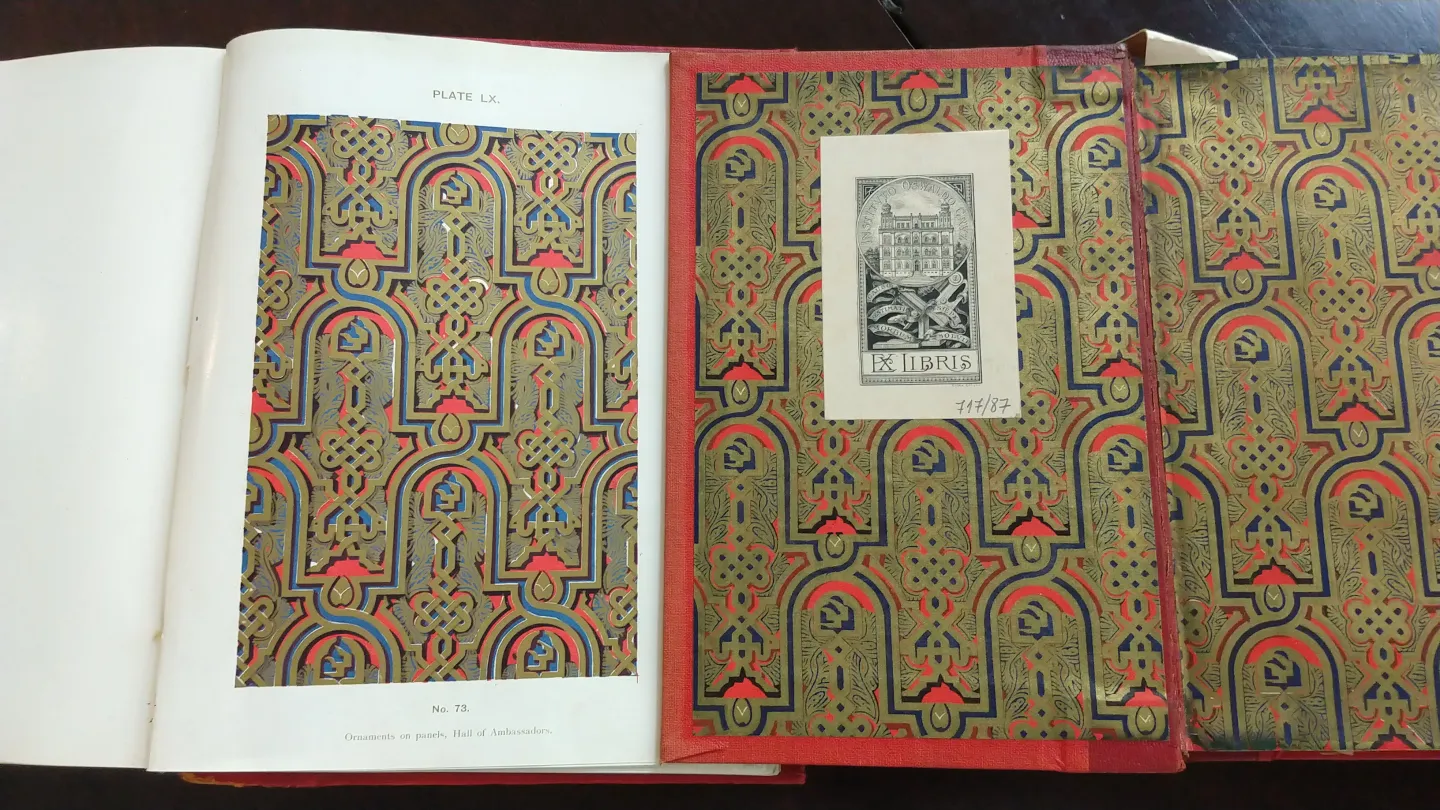
Bookplate and endleaf of Biblioteca de Manguinhos (Rare book collection from the Library of Manguinhos).
The endleaf was created to identify all the bindings made by the Library at the beginning
of the 20th century as a reproduction of Plate 60 of the book “The Alhambra“, by Albert Frederick Calvert.
Photograph by Fatima Duarte.
The production of this glossary aims to approximate the technical vocabulary and the catalogers. The goal is to improve their bibliographic description work by adding technical scientific vocabulary, minimizing generic or subjective descriptions, and even avoiding errors. For the provenance project by the library of Manguinhos, they are creating specific terms / expressions and also including them in the Glossary. At the National Library of Brazil, there is a group, composed by the restorers Thaís Helena and Jandia Flaeschen, whose objective is to identify the stamps used by the institution throughout its 200 years, as well as some more historic collections, such as the well-known Thereza Cristina Collection (named after the last empress of Brazil). Another group uses provenance to combat illicit book trafficking. Finally, there is the controlled vocabulary developed by by librarians Rosângela Von Helde and Silvia Fernandes, from the Plano Nacional de Recuperação de Obras Raras (National Plan for the Identification of Rare Books), responsible for the Catálogo do Patrimônio Bibliográfico Nacional (Catálogo National Bibliographic Heritage Catalog).
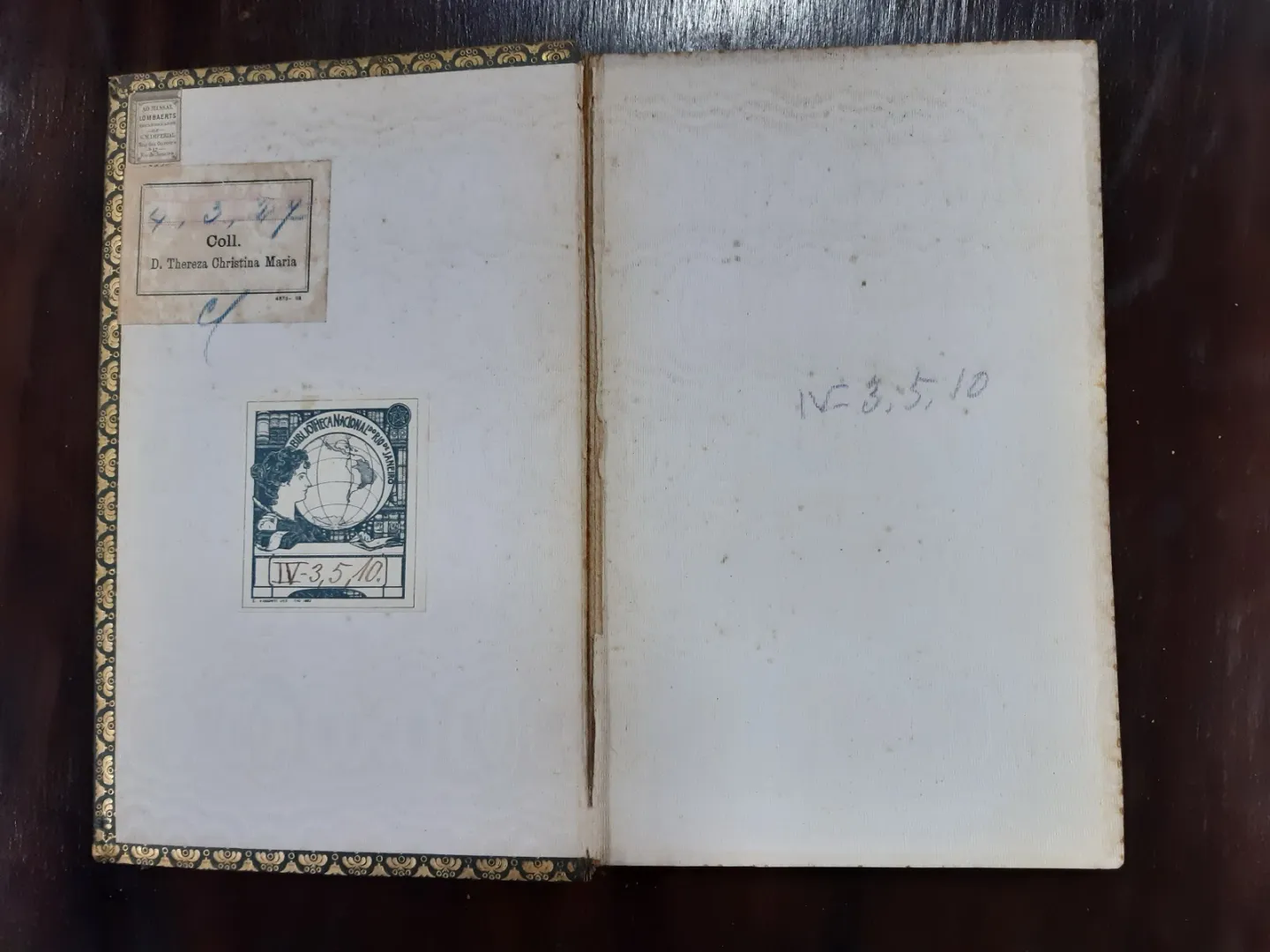
Provenances from Biblioteca Nacional do Brasil Collection. Photography by Jandira Flaeschen.
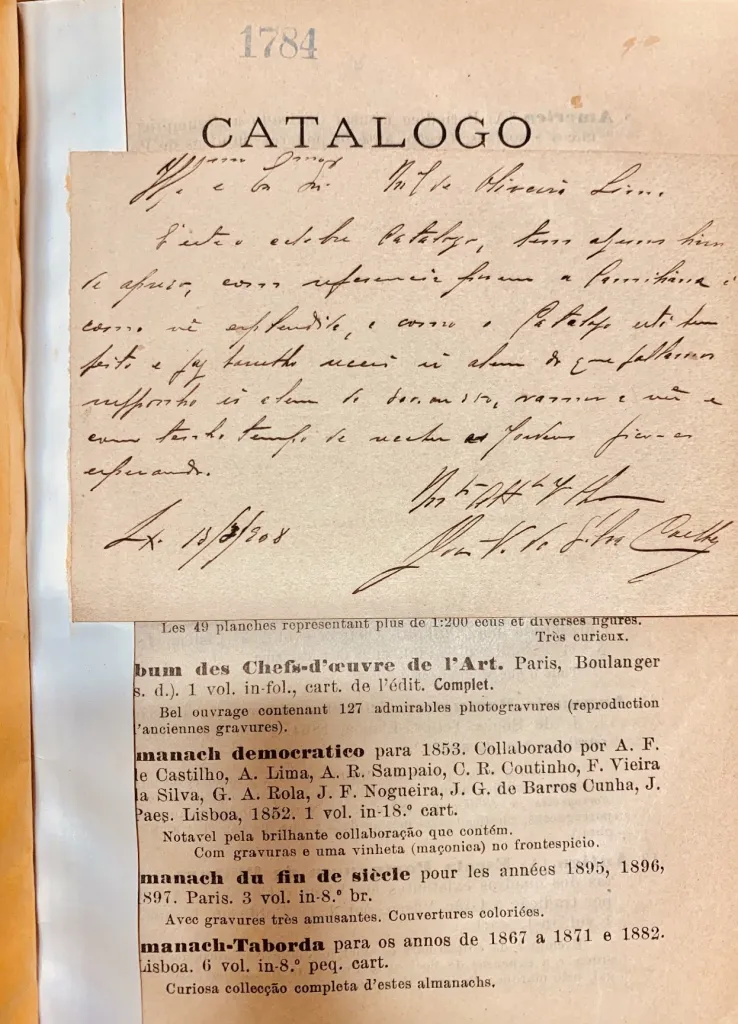
More recently, the Oliveira Lima Library at the Catholic University of America has joined the group. Under the coordination of Nathália Henrich, Henry Widener and I are partnering on a cataloguing project of the Camiliana collection that belonged to the library’s founder, Brazilian bibliophile Manoel de Oliveira Lima. The goal is not only to present a collection that has been largely unknown to the public, but also to highlight the provenance marks that make these books, and hence the collection, so unique.
At the university I work for (UNIRIO), as a result of a demand from the Library, I created a method to identify the provenances that work as documents that narrate, build and prove the history of the origin of a collection called “Memory of Library Science” (Memória da Biblioteconomia). The research had the collaboration of some of their own staff and one specifically, Marli Gaspar Bibas, under my supervision, did a research and wrote an award winning work on the history of a copy of the Histoire de l’Origine et des Premiers Progrès de l’Imprimerie (1740).
The librarian Maria Lucia Beffa, director of the Library of one of the oldest law schools in Brazil, (Faculty of Law of the University of São Paulo) is developing, with your team, protocols for the description and cataloging of provenances. They have been used for the reconstruction of the library’s own history, bookstore catalogs, record books, stamps and ex libris serve as valuable clues to this historiography.
On the left: One of the bookseller letters that negotiated the sale of a collection to Oliveira Lima. Photography by Nathalia Henrich.
An important aspect of our work is outreach. We feel strongly that the results of all the amazing research should be shared and publicized. Accordingly, we have supported actions such as seminars and courses on provenance. In 2020, the research project “The Eloquence of Books” had two events scheduled to bring people together and also discover new research. In April we would have had a One-day Conference in the City of São Paulo, with lectures, technical visits and a meeting with the researchers. And in July we had planned a three-day International Conference on Provenance, including lectures, conferences, workshops and panels. 25 papers were submitted from Brazil and other countries and there were 180 attendees registered. However, with the Pandemic we had to postpone it to 2021. As a way to compensate for the absence of these two events, we are organizing the Web Conference Provenance and Printing Culture that will take place throughout the month of October, with sections every Tuesday and Thursday. There will be about 22 lectures, 4 conferences, 1 workshop and 3 round tables with the participation of researchers from Brazil, Argentina, Mexico, United States, Portugal, Spain, Peru and England.
The event is organized by the Federal University of the State of Rio de Janeiro, The Oliveira Lima Library at The Catholic University of America (represented by Nathália Henrich) and Fundação Oswaldo Cruz.
We believe that one of the most relevant aspects that the project has raised is, more and more, to clarify that provenance is not a dilettante subject nor just an aficionado kind of preoccupation. Working with it is fundamental for the security of the library collections, knowing and valuing cultural heritage, and connecting libraries to establish a collaborative force.
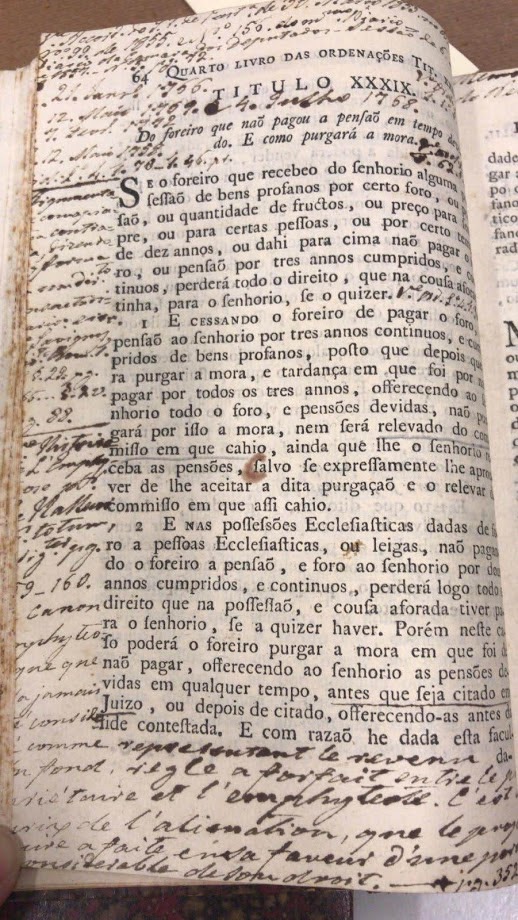
Annoted book from the Rare Book Collection of Faculdade de Direito da Universidade de São Paulo (Faculty of Law of the University of São Paulo). Photography by Maria Lucia Beffa.
Related articles
November 9, 2026
by Konrad K. Szymański (Ossolineum National Library, Wrocław)
November 9, 2026
by Caroline Duroselle-Melish, Angela Dressen and Attilio Bottegal, I Tatti, Harvard
November 9, 2026