Registration of incunabula provenance in Poland
by Agnieszka Franczyk-Cegła, Ossolineum Library, Wrocław
Share this article
Incunabula held in Polish institutional and private collections have long aroused the interest of early book scholars. Their first catalogues began to be published in Poland in the second half of the 19th century and are still an invaluable documentary source, especially in view of the destruction of the Second World War. The first catalogue recording books from before 1501 according to the modern standards of incunabulistics was published in 1912 in Lviv and described incunabula of the University Library there. It was then that broader voices began to emerge among Polish scholars calling for the creation of a modern register of Polish incunabula. In 1919 the Krakow Circle of the Polish Librarians’ Union decided to start a project to inventory private Polish libraries, covering the registration of all types of historical objects, including incunabula.
This task fell to a young, promising researcher of early books, Kazimierz Piekarski, today referred to as the father of Polish bibliology. The inventory was to consist not only of listing the titles of incunabula held in a given library, but also noting the individual features of the catalogued copies: rubrication, illumination, glosses, provenance notations and bindings. The result of Piekarski’s early research was an Inventory of incunabula of Polish libraries, published in 1925 – a small publication in the form of indexes, noting the existence of some 1,200 incunabula in 13 Polish libraries, without a description of the copies that remained in the working materials. Piekarski began more intensive work on the inventory of Polish incunabula in the 1930s, having obtained financial support from the Ministry of Religious Denominations and Public Enlightenment, which dealt with culture, education and religion. By 1939, he had gathered in working materials descriptions of 15,070 incunabula (4920 editions) from 86 Polish libraries.
The materials included a list of editions of Polish incunabula and notebooks with descriptions of the copies. During the Warsaw Uprising in 1944, the original materials were mostly burnt down. On the basis of partly preserved copies of the list of editions, work on a central catalogue of Polish incunabula began after the Second World War in the Ministry of Education, and later in the National Library. Their result was a two-volume publication Incunabula quae in bibliothecis Poloniae asservantur, published in 1970, edited by Maria Bohonos and Eliza Szandorowska and edited by Alodia Kawecka-Gryczowa. It registered 19,207 incunabula (5,768 editions) from 108 state and private libraries. In 1993, the third volume of this publication was published, recording Polish wartime losses of incunabula comprising some 4,600 books (2,329 editions). There is no information on provenance, bindings, manuscript notes, etc. Information on the individual characteristics of single incunabula volumes, including provenances, was recorded in catalogues and guides published by libraries themselves, but to date only 25% of institutions in Poland have such publications publicly available.
Why is the registration of incunabula provenance so important? The first Polish inventory work was guided by scientific objectives, but we should not forget the second, more practical aspect of registering collections, which is equally – if not more – important. Provenance research in Poland grew out of the practical need to search for objects looted from Poland during various wars. As early as the 17th century, envoys of the Polish kings Jan II Casimir Vasa and Jan III Sobieski searched for libraries and archives looted from the Republic of Poland in the Swedish collections. The first theoretical reflections in the analysis of the provenance of old books appeared in the second half of the 19th century, and the methodological basis for provenance research began to be formulated in the 1920s.
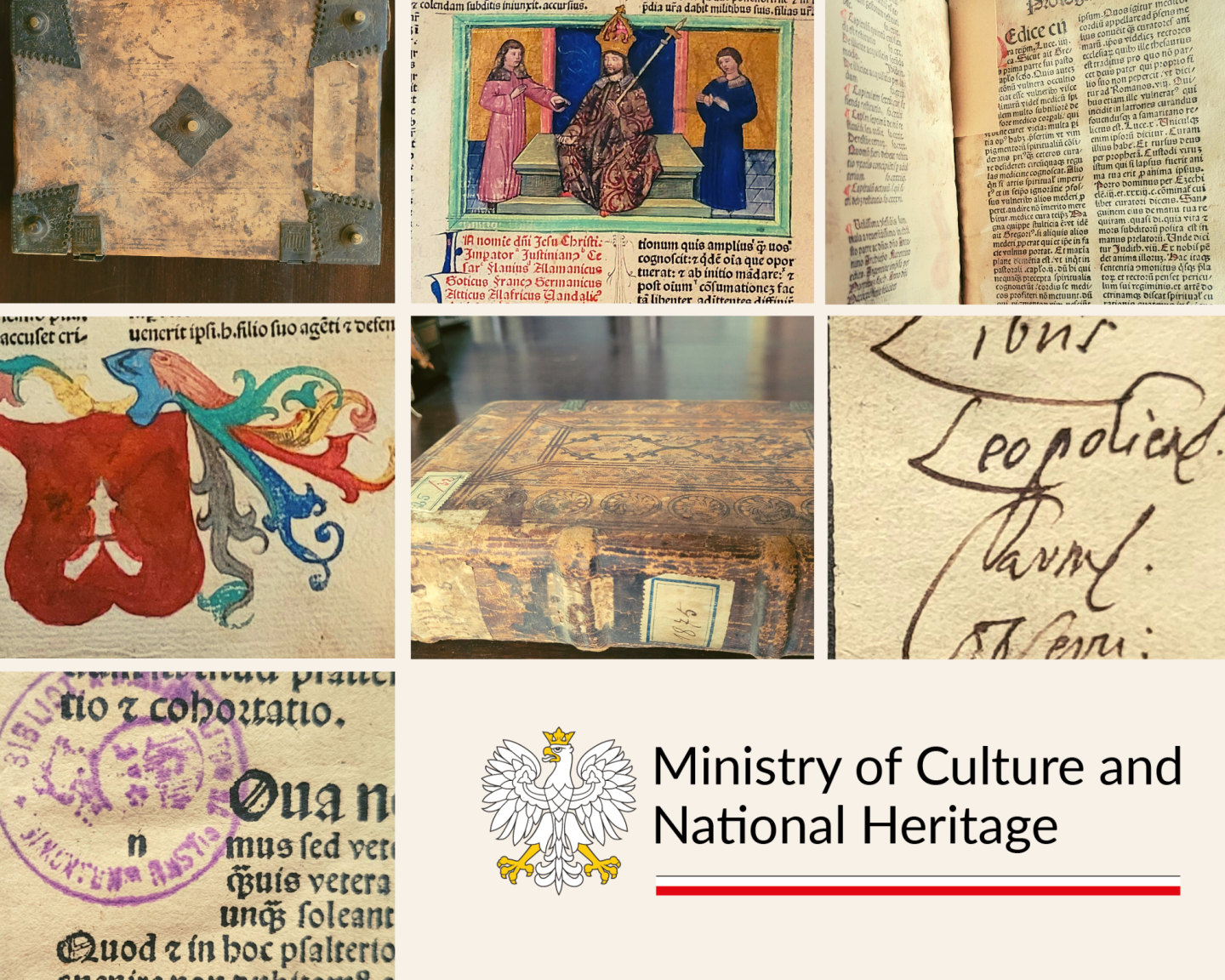
Incunabula, monuments of printed art created in the 15th century, often illuminated with gold and printed on parchment, form the most valuable part of Europe’s printed heritage and, because of their value, are extremely vulnerable to theft and falsification of provenance. Catalogues and publicly available databases with detailed descriptions of provenance and attribution can serve not only scholarly purposes, but are also a form of cultural heritage preservation. Buyers and sellers of works of art can use them as a source of legal attribution information, and uniformed services specialising in the theft of works of art can use them as a tool for detecting and prosecuting crimes. In Poland, such databases have usually covered paintings and prints, such as the ‘Safe Collections – Safe Collections’ programme created in 2010 under the Polish Ministry of Culture and National Heritage. As far as Polish old books are concerned, there are no public nationwide or international databases recording their provenance. A step towards changing this state of affairs was the project ‘Registering the provenance of Polish incunabula’, which I implemented in 2022 as part of a grant from the Ministry of Culture and National Heritage. The idea behind the project was to register the provenance of Polish incunabula in order to prevent theft of works of art. The registration, which involved collecting all ownership markings, reading them, identifying the owner and listing them chronologically, included a detailed description of almost 600 objects in the Material Evidence in Incunabula database.
Among the institutions whose collections were recorded, church and monastery libraries featured most prominently, as was the case with the work undertaken almost 100 years ago, since these collections are least well-known. The project succeeded in covering books from various regions in Poland. Not all of the institutions where the work had been planned gave their consent to do the query in their libraries, or responded at all. In others, it was not possible to find some of the books noted in the 1970 publication Incunabula quae in bibliothecis Poloniae asservantur. This demonstrates the necessity of this type of registration work not only to acquire new provenance data on these oldest monuments of the art of printing, but also to update the bibliographic information held. The registration of incunabula was carried out in accordance with the guidelines of contemporary incunabula studies and the Material Evidence in Incunabula database. From the point of view of the purpose of the project, the most valuable opportunity here was to record the ownership marks of the current owner, or the institution where the books are now held. Noting seals, ownership entries, bibliographic notes and their location in the book allows for easy attribution of the volume in the future.
The incunabula recorded as part of the project were very diverse in terms of provenance. In any given institution, the ownership marks of some incunabula could reflect the fascinating history of the wanderings of books closely connected with the turbulent history of Poland and Europe. An example of this is the Archives and Library of the Carmelite Fathers in Piasek, Kraków. It holds a collection that once belonged to the Carmelites of the former Observance in Lviv, which found its way there at the end of the Second World War when Lviv was incorporated into the Ukrainian Soviet Socialist Republic. The Soviet authorities proceeded to liquidate Polish and Ukrainian religious establishments, so the Lviv Carmelite convent was closed by the Soviet authorities in May 1946, and the clergy was given an order to leave. As the planned liquidation of the churches and monasteries had already been discussed, the Polish Archbishop of Lwow, Eugeniusz Baziak, had previously negotiated permission from the Soviet authorities to transport the church property in three transports. In one of these, the incunabula of the Krakow Carmelites were most likely transported. Other ownership marks in the same Kraków monastery, on the other hand, indicate its longevity, such as the provenance entries of Swietoslaw the Silent (-1487) in items he donated to the monks between 1482 and 1487.
The provenance material collected is used to study the history of collections and libraries, reading, history and culture in the area, the reception of authors’ works. The ownership marks themselves are also the subject of research, e.g. by art historians and tegumentologists. However, provenance analysis is first and foremost an essential tool in asserting rights to private or national property in revindication efforts. This was precisely the aim of the project carried out within the framework of a grant from the Polish Ministry of Culture and National Heritage, because provenance research – it should be remembered – originates from the need to prove ownership in order to recover it. And they should be carried out not only in order to learn about and preserve the memory of objects that no longer exist or have not yet been found, but – perhaps above all – for preventive purposes, in order to protect tangible cultural heritage items in current collections.
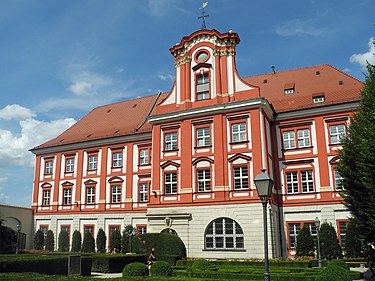
Ossolineum Library, Wrocław
https://en.wikipedia.org/wiki/Ossolineum
Related articles
November 9, 2026
by Konrad K. Szymański (Ossolineum National Library, Wrocław)
November 9, 2026