In de footsteps of Johan Picardt (1600-1670)
by Wijnand van der Sanden
Share this article
In 1660, the 300-page book Korte Beschryvinge Van eenige Vergetene en Verborgene Antiquiteten Der Provintien en Landen Gelegen tusschen de Noord-Zee, de Yssel, Emse en Lippe etc. appeared. It was published by the Amsterdam bookseller Gerrit van Goedesburgh. The author, clergyman Johan Picardt (1600-1670), had been pastor primus at the ecclesia Covordiensis, that is Coevorden in Drenthe, a province in the North of the Netherlands, from as early as 1648. His book, which from now I will refer to with the short-hand Antiquiteten, is the first history book about Drenthe and a milestone for those in the field of archaeology in Drenthe. Picardt’s book discusses topics like man-eating giants, hunebedden (megalithic graves), burial mounds, Celtic fields (walled field systems from the Iron Age), bogs and the origins of the Frisians, but also the destruction of the mythical city of Hunsow, the progression of the Eighty Years’ War and the development of the fortified town of Coevorden. Antiquiteten is appreciated for its fine illustrations of prehistoric situations, e.g. giants building a hunebed, or a so-called wit wief seen pontificating in a hollow burial mound while she is worshipped by the locals.

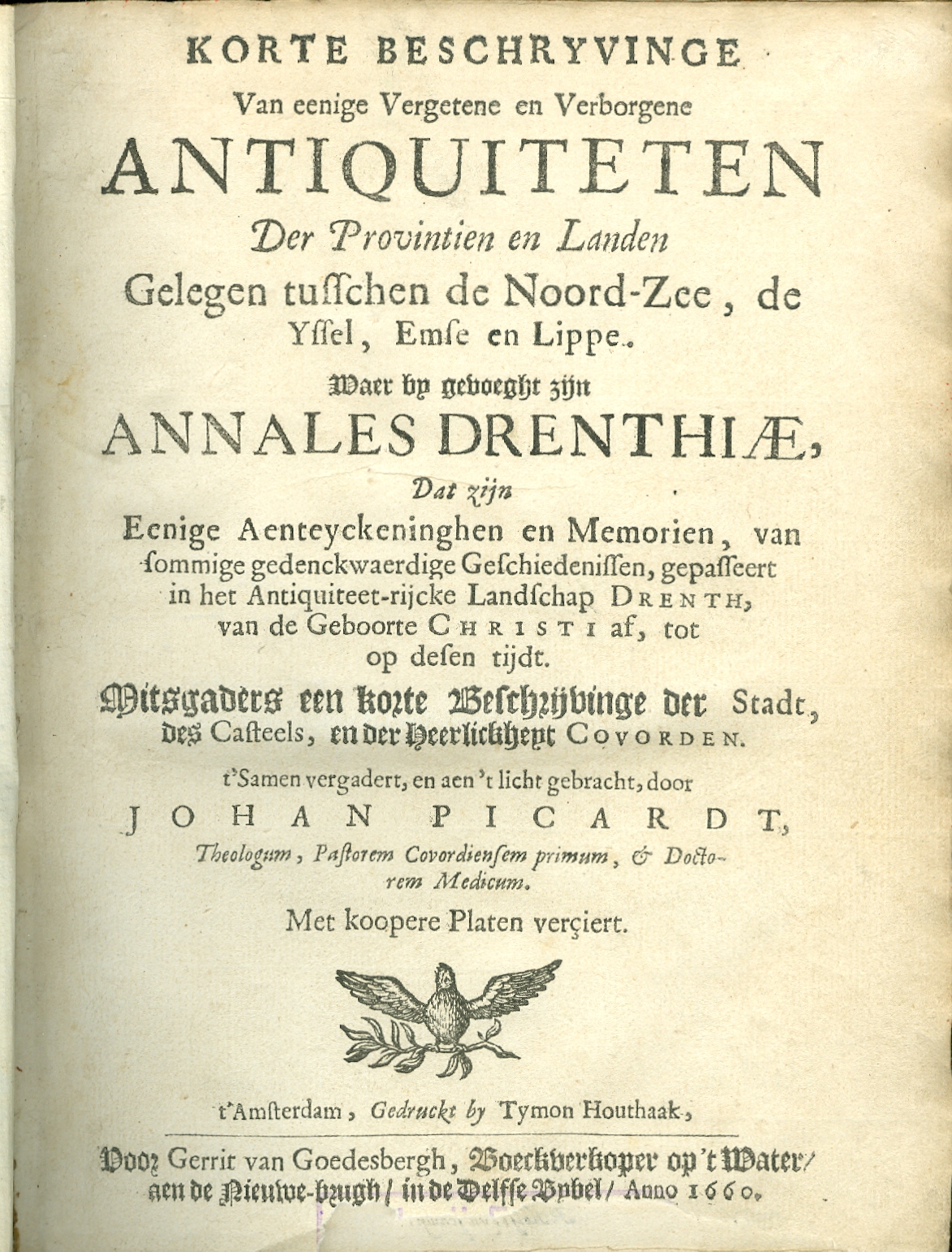
Left: Portrait of Johan Picardt in his book Antiquiteten. Picardt was born in Bentheim (Germany) in 1600. He died seventy years later in Coevorden. He started as a reverent in Egmond aan Zee, moved to Rolde (Drenthe, Netherlands) in 1642 and finally Coevorden in 1648.
Right: Johan Picardt, Korte Beschryvinge Van eenige Vergetene en Verborgene Antiquiteten Der Provintien en Landen Gelegen tusschen de Noord-Zee, de Yssel, Emse en Lippe etc. Amsterdam: Gerrit van Goedesburgh, 1660.
In 2020, I was able to buy a fine copy of this book for the Drents Museum (in Assen, the Netherlands). It bears provenance marks, namely the signatures of two of my predecessors, Prof. Dr A.E. van Giffen and Prof. Dr W. Glasbergen. This purchase made me view my own personal copy in a new light. I bought mine in 2014, from an antiquarian bookseller. It shows traces of two 19th century owners: one modest signature in the back of the book, the other a slightly larger ex libris in the front. The ex libris is that of the famous Amsterdam sugar merchant and book collector Isaac Meulman (1807-1868). This raised a range of questions: what other provenance marks might have been added to copies of Antiquiteten in the 360 years of the book’s existence? Might they tells us something about Picardt’s network, for example whether he donated copies to friends and colleagues? How many copies of this remarkable publication survive today and where are they now?
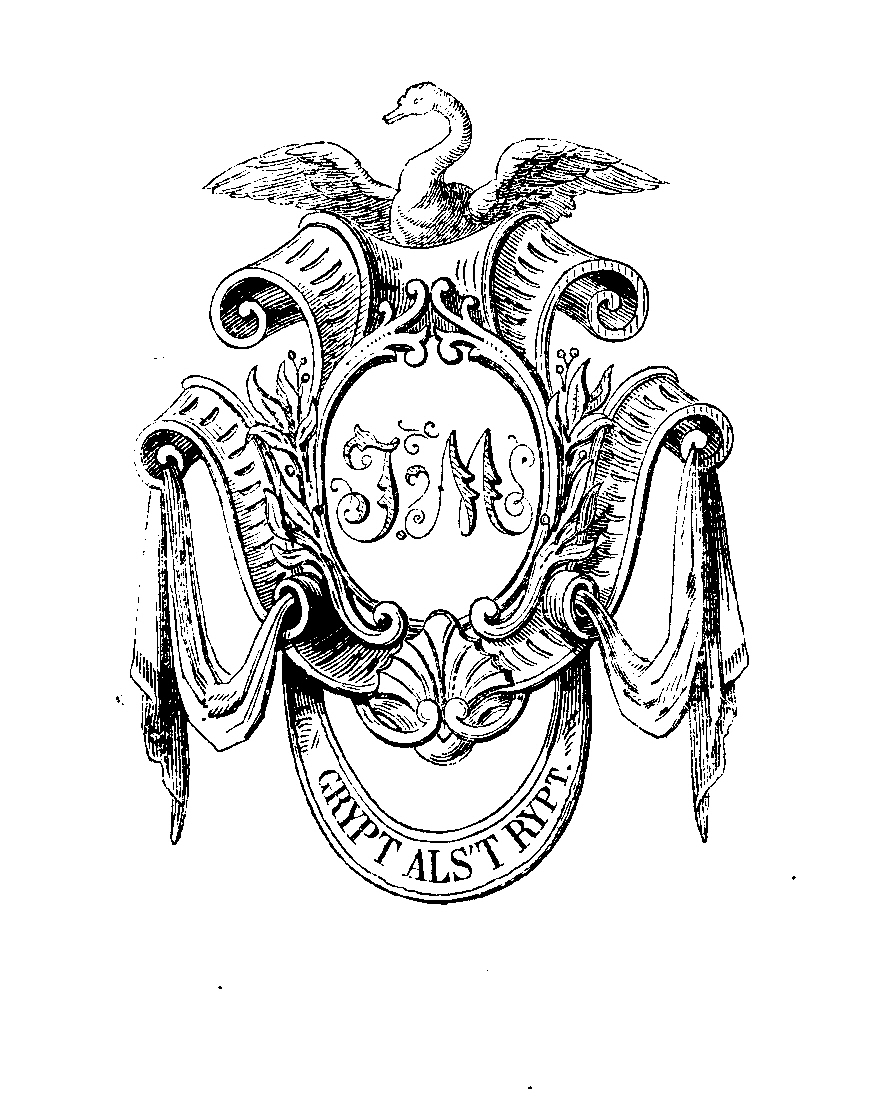
Ex libris of Isaac Meulman (1807-1868), sugar merchant and bibliophile,
with the text Grypt als ‘t rypt [harvest when ripe].
A new project was born: Hidden Antiquiteten, quite the undertaking for me as an archaeologist, who in his job as curator of archaeology normally works with pottery and artefacts made of flint, bronze and iron. In Wout Arentzen, the biographer of the nineteenth century Leiden archaeologist L.J.F. Janssen, the early-twentieth century hunebed researcher W.J. de Wilde and renowned Schliemann-expert, I found a valued research partner to work with on answering these questions. The outcomes of the project may well inform a new presentation of our permanent collections in the Drents Museum planned for 2022 or 2023. The ‘History of Drenthe’ is narrated not only with urns, stone axes and hunebedden, but also with books, and Johan Picardt’s Antiquiteten deserves a role in telling that tale.
The starting point for our work into preparing what we have since learned is called a census, was the note by Picardt’s biographer that 125 copies of the Antiquiteten were printed. We thought that that was a manageable number of copies to deal with for our research. We estimated (hoped?) that we might be able to trace some 75 copies. The work started mid-April 2020, with us approaching people and museums that we knew owned a copy of the book. We scoured the internet, sent some messages through our networks and ended up posting messages on Twitter and LinkedIn. A specialist in early print production noted that our harvest at the time (some hundred copies) suggested that the print run must have been considerably larger than 125 copies, and that perhaps as many as 1,000 or 2,000 copies were printed.
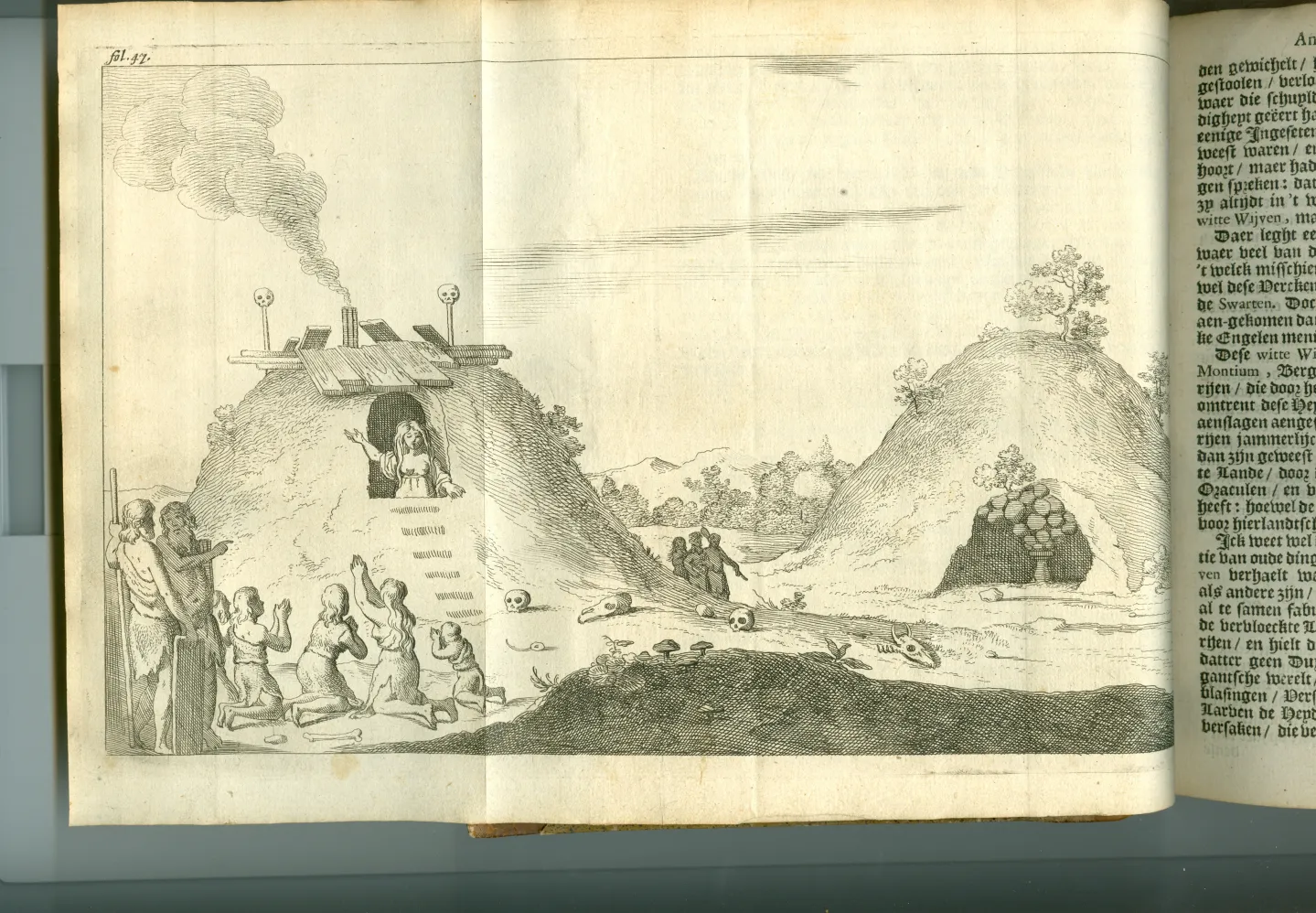
Copper plate engraving in Antiquiteten showing hollow barrows and a wit wief. Picardt claimed that witte wieven put a spell over the pagan locals and blind-sided them with their trickery. The ‘witten’ were the mouthpiece of the devil.
The Dutch society of bibliophiles (Nederlands Genootschap van Bibliofielen) introduced us to Dr Marieke van Delft, at the Koninklijke Bibiotheek, the National Library of the Netherlands. She organised for our call for information to be distributed through the CERL and SHARP (The Society for the History of Authorship, Reading and Publishing) networks. This opened the floodgates. Since then there has a been a steady stream of messages, tips, descriptions and photographs from around the world. The responses are heart-warming and frequently offer fascinating information. We have already seen some copies with remarkable former owners, including a few from the seventeenth century. One of those, a Swedish scholar, wrote in his copy that he bought it in Amsterdam in 1667 for one and a half florins.
As the research progresses, and inspired by Pettigree and Der Weduwen’s The Bookshop of the World: Making and Trading Books in the Dutch Golden Age, we formulated additional research questions. Our research has already led to valuable new insights about the book, the copper plate engravings, as well as the author himself. At the end of this journey – which due to the Covid-19 crisis will take a little longer, since not all librarians and researchers currently have access to the collections – we will have enough news for a book of our own. We realise that responses from the CERL and SHARP communities have given our undertaking a flying start and we would like to send our warmest thanks for that. And we would of course be happy to hear of further copies!
Dr Wijnand van der Sanden, conservator Archeologie, Drents Museum, Assen, NL (retired 15 May 2020 ), w.vandersanden@drentsmuseum.nl or wabsanden@live.nl
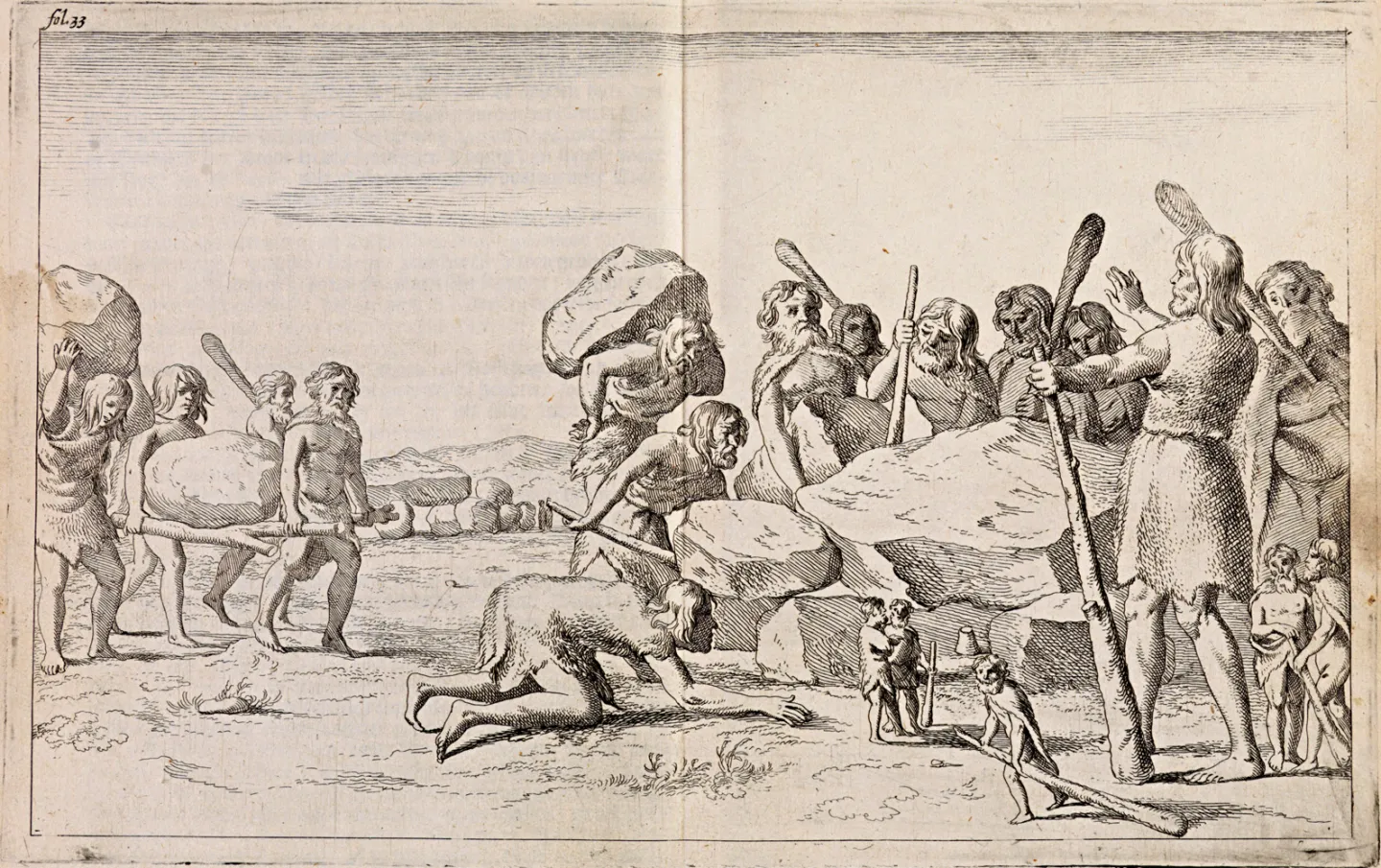
Copper plate engraving in Antiquiteten showing giants building a megalithic grave.
Related articles
November 9, 2026
by Konrad K. Szymański (Ossolineum National Library, Wrocław)
November 9, 2026