CERL internships 2025 – Royal Irish Academy in Dublin, Ireland
by Madeline Birnbaum, Assistant Archivist at the New England Historic Genealogical Society in Boston, Massachusetts.
Share this article
For four weeks in September of 2025, I was able to undertake an internship at the Royal Irish Academy in Dublin, Ireland, during which I researched the provenance of a pamphlet collection formerly owned by Charles Haliday. I’m very grateful for the funding by the Consortium of European Research Libraries that made this experience possible.
The Royal Irish Academy, founded in 1785, is a cultural and academic institution whose library holds a range of Old Irish Manuscripts and rare books on Irish history, archaeology, linguistics, and science. One of the cornerstones of the Royal Irish Academy’s extensive collections is the more than 25,000 pamphlets collected by Charles Haliday, a nineteenth-century Dublin merchant and antiquarian. One untapped area of inquiry in regards to the pamphlet collection is how Haliday acquired his immense library: Which booksellers and auction houses did Haliday frequent? Did friends or acquaintances contribute to his habit? How much did Haliday search for new items beyond the Dublin market? After several weeks delving into these questions, it was clear that it will take a great deal more time to uncover comprehensive answers, but interesting threads and details began to emerge.
Grafton Street Booksellers
One of the most straightforward pieces of evidence in Haliday’s collection are bookseller’s labels, indicating the shop from which books or pamphlets were purchased. Of the nineteen booksellers whose labels are present in Haliday’s collection, fifteen were located in Dublin, two in Cheltenham, one in Bath, and one in Edinburgh. The locations of the bookshops within Dublin give a sense of how booksellers were enmeshed with the intellectual community of the city. The majority were clustered around Trinity College: on Grafton Street alone, you could find Grant and Bolton at number 15, Fannin & Co. Medical Booksellers at number 41, R.M. Tims at number 85, Milliken (whose bookplate reads “Bookseller to His Majesty the Lord Lieutenant and to the University”) at number 104, and George Herbert at number 177.
Until the Royal Irish Academy (RIA) moved to its current home at 19 Dawson Street in 1852, it was located at 14 Grafton Street, next door to the bookshop of Grant and Bolton, as is visible in the photograph below – Grant and Bolton’s bookseller’s label appears with the highest frequency in Haliday’s collection. Haliday, elected as a member of the RIA in 1847, would have frequently spent time on this block and passing by its many bookshops, and the evidence of the labels as a whole suggests that Haliday visited the shops on and around Grafton Street to procure both new and antiquarian books and pamphlets.
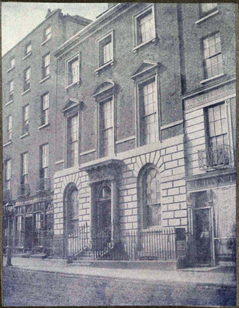
The Royal Irish Academy, center,
with Grant and Bolton’s bookshop visible on the right. 1
The British Museum and Sir Hans Sloane
In Haliday’s collection, there are twenty-two pamphlets bearing stamps indicating that they were purchased in duplicate sales at the British Museum, where redundant copies of books and pamphlets were sold at auction to the public. One of these pamphlets was purchased at the 1818 duplicate sale, and the remaining twenty-one from the 1788 sale (these books carry a 1787 stamp): Haliday, born in 1789, could not have purchased these himself, and it is unclear who the intermediary owner or owners were. Additionally, none of the titles appear to be listed in the 1788 auction catalogue, potentially because they were sold in lots of thematically-grouped pamphlets. 2 While there are still many questions about the British Museum duplicate sale items, the identity of one likely former owner has emerged.
Sir Hans Sloane (1660-1753) was an Irish physician and prolific collector who lived primarily in London. Upon his death, he bequeathed his more than 71,000 books and objects to the Kingdom of Great Britain, and this collection became the founding collection of the British Museum. Sloane’s legacy has recently been reevaluated in light of his ties to slavery: his wife was an heiress to a sugar plantation worked by enslaved people in Jamaica, and he himself worked as a physician on a Jamaican plantation. 3
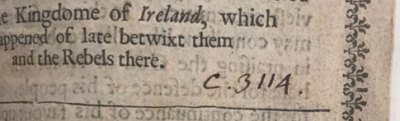
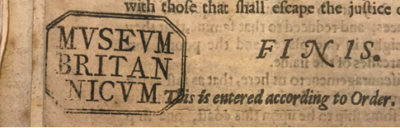
Two avenues through which Sloane’s books are identified are, first, the alphanumeric codes he used as both accession and shelfmarks and, second, the stamp used by the British Museum to mark his books and other early acquisitions.4 Based on these two pieces of evidence, at least two books in the Haliday collection are likely to have been part of Sloane’s library: A True Extract of Severall Letters Lately Received, Which Were Perused by the Committee for Irish-Affaires at Grocers Hall […] 5 (1643) and The Great Case of Transplantation in Ireland Discussed […] 6 (1655).
Examples of these marks from A True Extract of Severall Letters are shown in the images below.
The Haliday Brothers’ Bookplates
One touching detail that emerged during my research is that the bookplates of Charles Haliday’s brothers, William and Daniel, share a design. The brothers’ bookplates depict a shield with three knights, topped by a lion holding an anchor, with the Irish motto “is é dia mo sciat[h]” (“God is my shield”) underneath. During his short life, William Haliday (1788-1812) proved himself as a scholar of the Irish language, completing a book on Irish grammar at the age of nineteen in spite of being raised in a family that rejected Irish culture. 7 He died at the age of twenty-four, when the youngest Haliday brother, Daniel (1798–1836), was only fourteen. Given William’s interest in the Irish language and Daniel’s young age, it seems likely that William designed the bookplate – or at least the motto – for himself, and that he had a set made up for his younger brother; it is also possible that Daniel took up use of the bookplate in honor of his brother. There are at least eight books owned by Daniel and three owned by William in the Haliday collection, as evidenced by these distinctive bookplates.
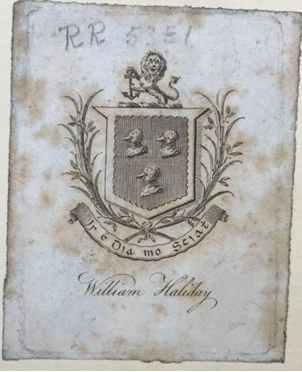
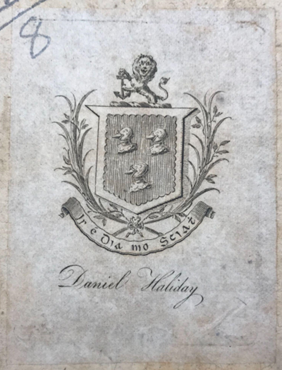
Further details of the provenance markings of the Dublin booksellers, Hans Sloane, and the Haliday brothers can be found on the Consortium of European Research Libraries’ Provenance Digital Archive, in addition to other markings found in the Haliday Collection. This database of provenance information allows librarians and academics to upload and describe bookplates, inscriptions, stamps, decorative binding elements, and more in order to create a resource for those seeking to learn more about the history of book ownership and to build connections across disparate collections.
While Charles Haliday’s books and pamphlets have certainly not given up all their secrets yet, patterns of his behavior as a collector and information about other former owners of his books are beginning to emerge, providing some texture and detail to the narrative of this core collection. As research into the provenance of the Haliday Collection continues, more stories will inevitably be unearthed using clues from the countless bookplates, stamps, scribblings, and other various evidence of ownership that mark the pages of its more than 25,000 volumes.
Many thanks to CERL for allowing me to undertake this internship and to Emma Rothwell and all of the staff at the Royal Irish Academy for their kindness and support.
- Bluesky: @rialibrary.bsky.social
- Instagram: @rialibrary
- LinkedIn: Royal Irish Academy Library
Bibliography
1 – Jones, Calvert Richard. Neoclassical facade and shopfronts, possibly Dublin [photograph]. Undated. In The Talbot Catalogue Raisonné. Oxford University, accessed 24 October 2025, https://talbot.bodleian.ox.ac.uk/search/catalog/schaaf-3033.
2 – A Catalogue of the Duplicate Books, Coins, and Medals … : Which Will Be Sold by Auction, (by Order of the Trustees) by Leigh and Sotheby […]. London: Becket, Robson and Clark, Walter, Owen, and Sewell, [1788]. Wellcome Collection, accessed 24 October 2025, https://wellcomecollection.org/works/ambgekn6/items.
3 – “Sir Hans Sloane.” The British Museum, accessed 24 October 2025, https://www.britishmuseum.org/about-us/british-museum-story/sir-hans-sloane.
4 – Walker, Alison. “Sir Hans Sloane’s Printed Books in the British Library: Their Identification and Associations.” In Libraries Within the Library, ed. by Giles Mandelbrote and Barry Taylor. The British Library, 2009, pp. 89-97.
5 – A True Extract of Severall Letters Lately Received, Which Were Perused by the Committee for Irish-Affaires at Grocers Hall […]. London: Printed by George Miller, 1643. Royal Irish Academy call number: HT (Bound) 38/34.
6 – Gookin, Vincent. The Great Case of Transplantation in Ireland Discussed […]. London: Printed for John Crooke, and are to be sold at his shop at the sign of the Ship in St. Paul’s Churchyard, 1655. Royal Irish Academy call number: HT (Bound) 67/11.
7 – Ó Raghallaigh, Eoghan. “Haliday, William.” Dictionary of Irish Biography, February 2019, https://doi.org/10.3318/dib.003714.v2.
8 – Campion, Edmund, Meredith Hanmer, Henry Marleburrough, and Edmund Spencer. Ancient Irish Histories: The Works of Spencer, Campion, Hanmer, and Marleburrough. Dublin: Hibernia Press, 1809. Royal Irish Academy call number: MR/17/L/23-24.
9 – Warner, Ferdinando. The History of the rebellion and civil wars in Ireland. Dublin: Printed for James Williams in Skinner-Row, 1768. Royal Irish Academy call number: MR/17/D/7-8.
Related articles
November 9, 2026
by Markéta Kučerová and Vojtěch Šícha, Library of the Czech Academy of Sciences
November 9, 2026