
A new Project in cooperation with CERL: MAT-MED in Transit
by Sabrina Minuzzi
Share this article
Sabrina Minuzzi, previously part of the team of the ERC-funded Oxford-based 15cBOOKTRADE Project led by Cristina Dondi, recently started a new research project: MAT-MED in Transit. The Transforming Knowledge of Healing Plants (Marie Skłodowska-Curie Fellowship, Oct. 2019-Sept. 2022). The acronym MAT-MED stands for materia medica, which is the body of knowledge concerning the medicinal properties principally of plants, but also of animals and minerals – the so called ‘simples’ – that formed the basis for making medical remedies. The research is being carried out on Italian manuscripts and printed books of the early 16th and 17th centuries pertaining to two genres – herbals and recipe books – with the aim of tracing the actual circulation of knowledge about local and exotic healing plants in Early Modern Italy.
Thanks to cooperation with the Data Conversion Group of the University of Göttingen (DCG), Sabrina will be able to rely on a customised digital tool for the description of the copy-specific features of the annotated printed books that she is going to study: MAT-MED-Readers. The application is based on the methodology that has been successfully pioneered on incunabula by MEI (Material Evidence in Incunabula) designed by Cristina Dondi and now containing evidence of the use of incunabula from 50,000 books kept in over 450 libraries.
Like PatrimonIT, the digital tool developed by Laura Carnelos based at CERL (funded by Marie Skłodowska-Curie Fellowship 2016-2018), MAT-MED-Readers envisages a link between the copy-specific descriptions and the respective editions already listed in HPB, the Heritage of the Printed Book Database.. A new field will be devoted to the specificity of MAT-MED in Transit, in order to gather information about the materia medica more widely discussed and annotated by the users and owners of herbals and books of secrets. MAT-MED-Readers will therefore allow a systematic analysis of the traces that readers left on this typology of scientific books across times and spaces, through: inscriptions, annotations, decoration, added recipes and supplementary texts/drawings, etc., all geographically and chronologically tagged. Evidence on former owners, in particular, will be shared in a common data repository of former book owners and users.
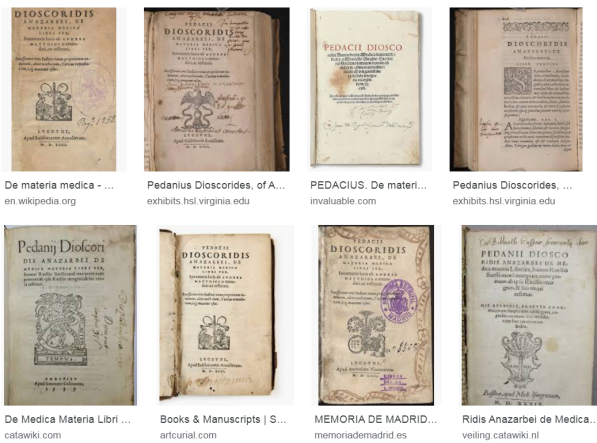
Many well-used copies of Dioscorides De Materia Medica libri sex
can be retrieved through Google image search.
A second digital tool devoted to the analysis of archival records, manuscript texts and images is being planned in collaboration with Brown University’s Center for Digital Scholarship, so that will presumably lead to a cooperation – or at least to the interoperability of digital tools – between CERL and this US institution.
Both digital tools are being conceived in a way that can be open to the future contribution in any Latinate language by scholars with a focus on different countries: indeed, MAT-MED in Transit is centred on the materia medica knowledge circulating in Italy with the awareness that it represents only a segment of the more global transit of medical matter among European countries and between Europe and the West and East Indies of the Early Modern period.
Report by Sabrina Minuzzi
Related articles
by R. Gasteiger, M. Belka, S. Rehberg, S. Schütz, Hanover University of Applied Sciences and Arts
November 9, 2026
by Michel Chevalier, Independent Researcher
November 9, 2026
by Antonia Delle Fratte, PhD student at the University of Padua/Venice Ca’ Foscari
November 9, 2026