A Knowledge Graph for CERL
by R. Gasteiger, M. Belka, S. Rehberg, S. Schütz, Hanover University of Applied Sciences and Arts
Share this article
In spring 2026, we, a group of sixth-semester students studying Information Management at Hanover University of Applied Sciences and Arts, had the opportunity to carry out a practical project as part of our studies in cooperation with CERL.
We began our work in March under the supervision of Prof. Andreas Walker. Together with our project contact, Helena Nebel from the Data Conversion Group at SUB Göttingen, he introduced us to the CERL databases. We learned about the history of the databases, their design, and the structures within which they evolved. We began by agreeing on what we wanted to achieve during the semester. Our previous knowledge in these subject areas consisted of Python, RDF, and SQL courses as part of our studies, as well as, for some of us, an interest in metadata, cataloguing, and historical collections.
We examined three databases: the Incunabula Short Title Catalogue (ISTC), the CERL Thesaurus, and the Holding Institutions. We wanted to understand how the data in these databases is structured and where potential connection points exist between them that could be implemented using Linked Open Data principles. The goal was to create a knowledge graph. Additional objectives were achieved during the course of the project, including SPARQL queries that make the links between the three databases visible for specific properties such as printers and places.
Understanding the data
The first challenge we faced was to understand the databases and the data contained within them. We were provided with JSON schema files for all three databases, which allowed us to understand the typical structure of the records. To create a working document and improve human readability, we organised this information in tables and noted any irregularities, such as inconsistent data types. Mind maps, as shown in the image below, were also very helpful in understanding the structure of the individual databases and gaining an overall overview.
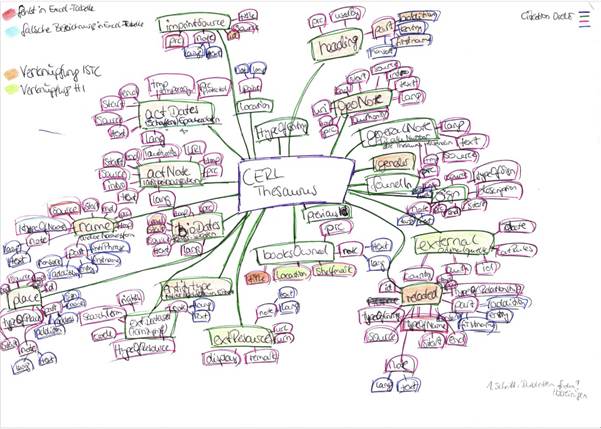
For understanding the databases, it was particularly helpful to examine the individual fields in such detail, especially in a database as large as the CERL Thesaurus. We also analyzed how frequently the individual data fields were populated across the three databases. For example, we observed that the field “language_of_item” is not populated in a total of 11 records in the ISTC. Based on our findings, we formulated suggestions for data cleaning and for changing data types in certain fields. We also documented additional issues that appeared to be errors and could be reviewed by CERL.
We then reviewed each data field to identify further potential links to the other databases and categorized new connections according to their application type as either meaningful or non-meaningful linking options. The insights gained through this process were incorporated into the JSON schema files.
We presented an interim project report at the 114th BiblioCon as part of the #Freiraum26 program on 22 May in Berlin to a specialist audience and interested colleagues from the library sector. We have received positive feedback on the work completed so far and, through discussions with participants, gained further ideas for the continuation of the project. The presentation slides are available on the OPUS publication server at the following link: https://nbn-resolving.org/urn:nbn:de:0290-opus4-205607
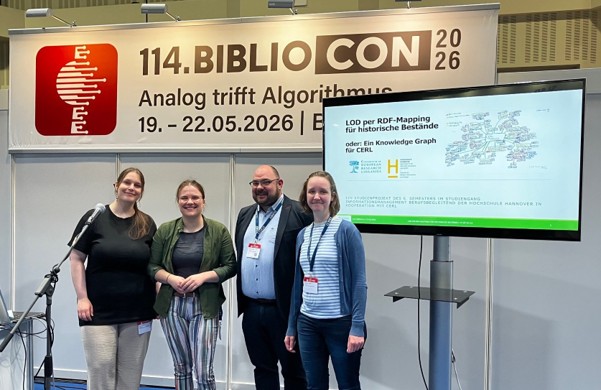
114th BiblioCon #Freiraum26 presentation team (from left to right):
Marina Belka, Sina Rehberg, Robert Gasteiger, Kathleen Quicker
RDF Modelling
One work package of the project was to model the ISTC and the database of holding institutions in RDF to represent information (e.g., about an incunabulum) in the form of triples consisting of a subject, a predicate, and an object. The aim was to create a knowledge graph that could potentially be made openly available and enriched with information from other sources such as Wikidata.
To begin with, we looked at other examples of RDF modelling for bibliographic data and orientated ourselves, among other things, towards the recommendations of the DINI AG KIM, including for the selection of namespaces and vocabularies (e.g. Dublin Core, GND Ontology, BIBFRAME). We then mapped the existing database fields to RDF properties and had to make decisions regarding the structure of the graph.
We were also able to refresh and further develop our Python skills from our studies by using RDFlib to convert all records from the Holding Institutions database and the ISTC into an RDF graph and output them in Turtle format.
SPARQL
As part of the RDF modelling work, the idea emerged to enable queries across all three databases using SPARQL. To achieve this, part of our team focused on learning SPARQL. We were also able to arrange a multi-hour introductory training session with Alexander Jahnke, Head of Publication and Data Services at SUB Göttingen, in order to further develop our skills in this area.
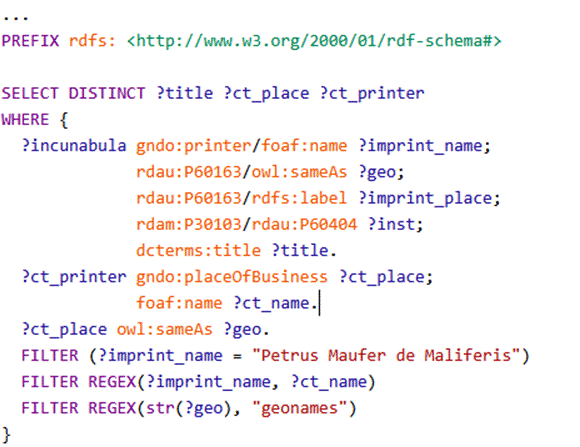
Subsequently, the triples serialised in Turtle format were processed using Apache Jena Fuseki, allowing us to successfully test initial SPARQL queries as a kind of proof of concept. The following screenshot shows part of a SPARQL query used to match ISTC records with a specific imprint name (printer) to the relevant CERL thesaurus entries for place and printer via geonames IDs.
Conclusion
In mid-June 2026, we presented the results of our project work to Helena Nebel and handed over our work to the CERL Data Conversion Group team for further use. Our findings are available via open access on Codeberg.org and Zenodo.
We found the project work in this context to be both a rewarding challenge and a fascinating insight into the realities of databases that not only have a history of their own but also preserve and make history accessible.
We can undoubtedly encourage future generations of students to engage with CERL and its databases, or with other similar data projects.
We would like to thank everyone who supported us throughout the project, in particular, Prof. Andreas Walker, Helena Nebel, Marian Lefferts, Elena Liventsova, and Alexander Jahnke.
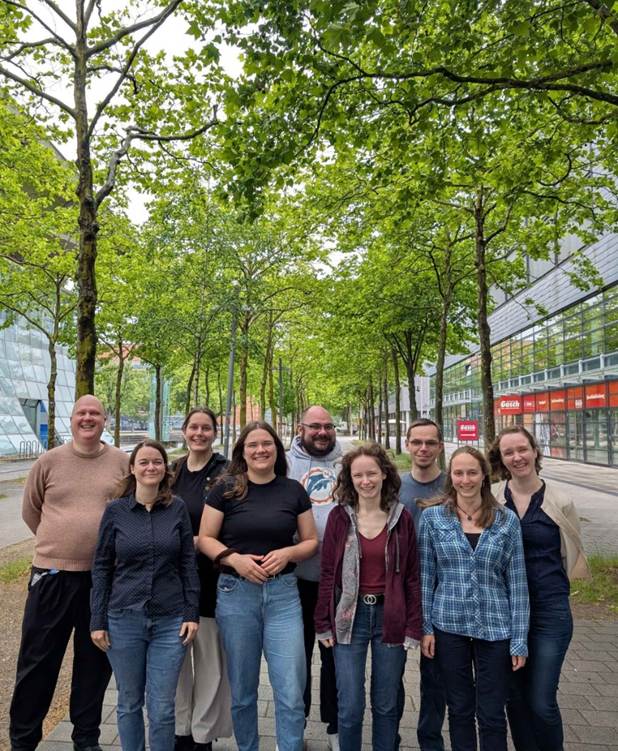
Prof. Andreas Walker with the project team (from left to right):
Sarah Schütz (Eversheds Sutherland), Marina Belka (ULB Darmstadt),
Sina Rehberg (TIB Hannover), Robert Gasteiger (ThULB Jena), Lisa Böging (Landesbibliothek Oldenburg), Tilo Schwarz (LBZ/PLB Speyer),
Esther Schröder (UB Duisburg-Essen), Kathleen Quicker (Städtische Bibliotheken Dresden)
Related articles
by Markéta Kučerová and Vojtěch Šícha, Library of the Czech Academy of Sciences
November 9, 2026
by Michel Chevalier, Independent Researcher
November 9, 2026