The Incunabula Short Title Catalogue at 45: ISTC Day on 15 January 2025
by Alyssa Steiner, British Library
Share this article
The Incunabula Short Title Catalogue (ISTC) is turning 45 in 2025. To mark the occasion, the Printed Heritage Collections team at the British Library is hosting an online ISTC day on 15 January 2025. This will be an opportunity to dive into the history of one of the key digital resources for incunabula research. We’ll hear from librarians, bibliographers, and book sellers about how they currently use ISTC and its significance for their daily work. We will also consider how bibliographical data can be used to enable digital humanities research by looking at recent examples of digital scholarship using bibliographical data, including the ‘Atlas of Early Printing’ and a project to digitize and extract data from the ‘Catalogue of books printed in the 15th century now at the British Library (BMC)’.
The Incunabula Short Title Catalogue was initiated in early 1980 by Lotte Hellinga and first became publicly available in 1984. Initially, it used as its basis Frederick R. Goff’s Incunabula in North American Libraries: A Third Census, which contains almost 13,000 short titles. Shortly thereafter, editions listed in the Indice Generale degli Incunaboli delle Biblioteche d’Italia (IGI) were added. Since then, thousands more records have been created either through libraries notifying ISTC directly or on the basis of published catalogues.
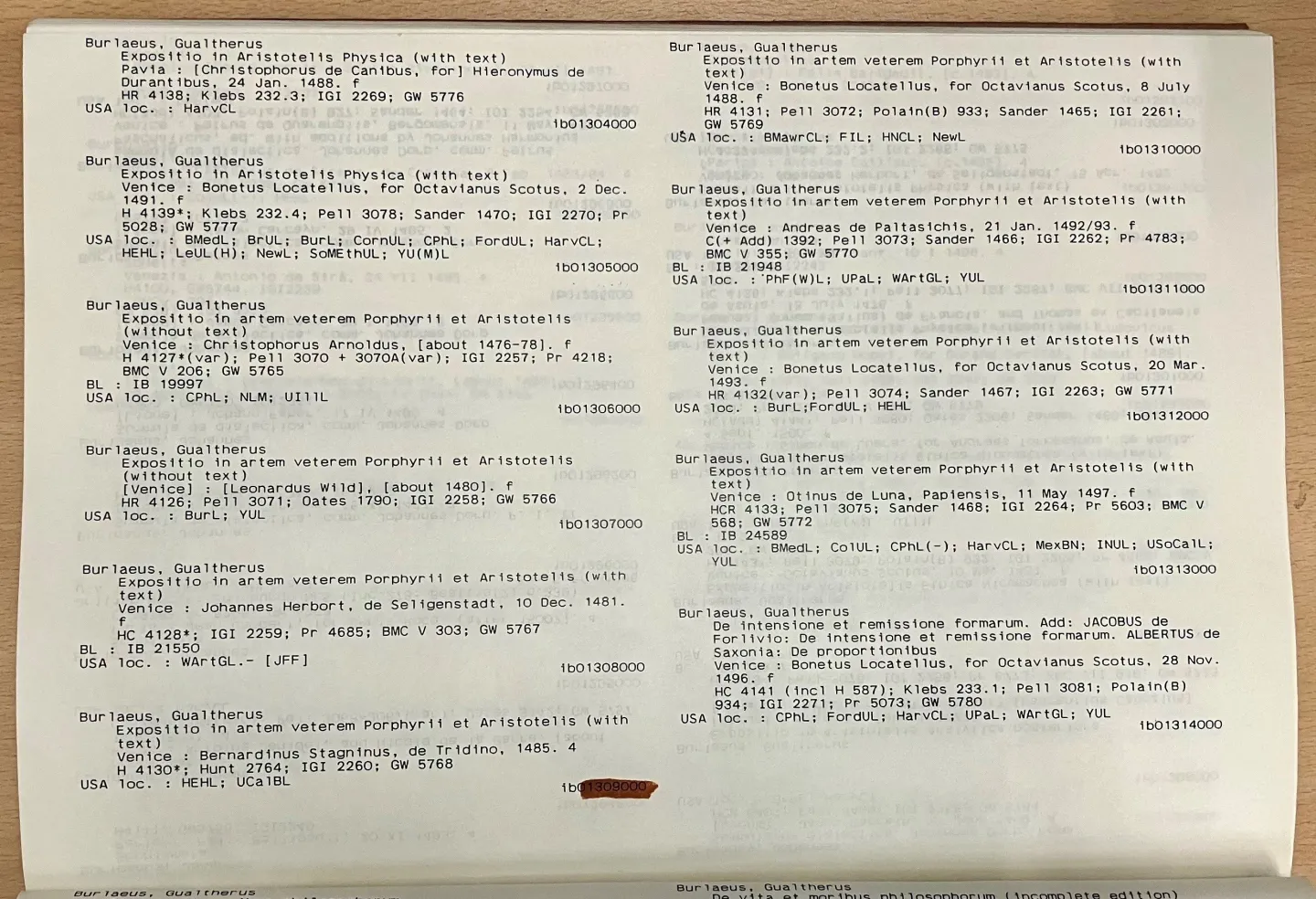
Printout of ISTC records from November 1982
Four years after its inception, the ISTC team convened a London colloquium with the results published in the edited volume Bibliography and the Study of the 15th-Century Civilisation (British Library 1987). The papers summarise the hopes and ambitions, but also some skepticism bibliographers held at the dawn of this machine-readable catalogue. Remarking “who has worked on the history of book collecting and not hopelessly struggled with the mysteries of prices and buyers’ names”, bookseller Felix B de Marez Oyens was hoping for “a separate field in ISTC’s program [that] could be created for listing incunabula in private and commercial hands”. Meanwhile, cataloguer Richard Rouse pointed to the significance of adding copy-specific notes including provenance, binding, painting or decorations, and handwritten additions. Considering ISTC’s use for analytical bibliography, Paul Needham outlined the difficulty of many incunabula catalogues to provide adequate information about the size and format of books, collation and type identification and typographical variants. Acknowledging the huge task of recording “every surviving fifteenth-century edition” he concluded that “continued experimentation will surely assist us all in arriving at a useful compromise between the practical and the ideal”.
Today, ISTC stands at 30,596 bibliographical records. While new editions are still added regularly (and others moved to the 16th Century based on new evidence), it is now an accurate representation of 15th-century books printed with movable type in Europe.
As the possibilities to use computational methods to query machine readable bibliographical data have expanded significantly since its inception, new ways of using and displaying ISTC data are now available. For instance, the Atlas of Early Printing mapped ISTC data alongside information about production and trade taken from print sources. An ISTC Hack & Yack session, which will be held at the BL in November 2024 ahead of the ISTC day in January 2025 will explore how digital humanities tools available online can be used for data visualisation. While digital research has expanded, new resources like Material Evidence in Incunabula (MEI), another database hosted by CERL, have established themselves, reflecting the growing interest in copy-specific information. Links to MEI records are now displayed alongside all ISTC records when available. This raises the question of how linking data can facilitate new insights into early printed books and their provenance.
As editors and users look at how ISTC has evolved over the last 45 years, the ISTC day will be an opportunity to take stock and consider what librarians, book historians, booksellers etc. need a database of 15th-century European printing to be able to do going forward.
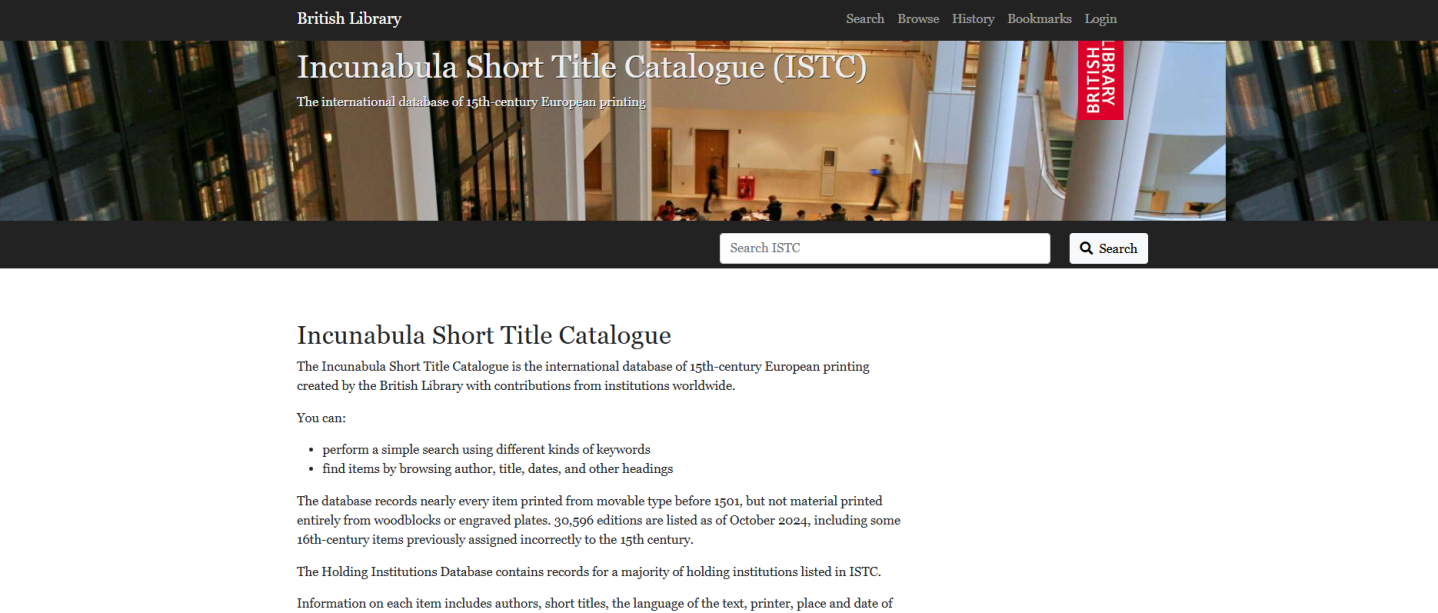
The ISTC day on 15 January 2025 will be convened online and is open to all. Please register at incunabula@bl.uk if you would like to participate. For further resources about ISTC and its history, see the newly updated ISTC homepage.
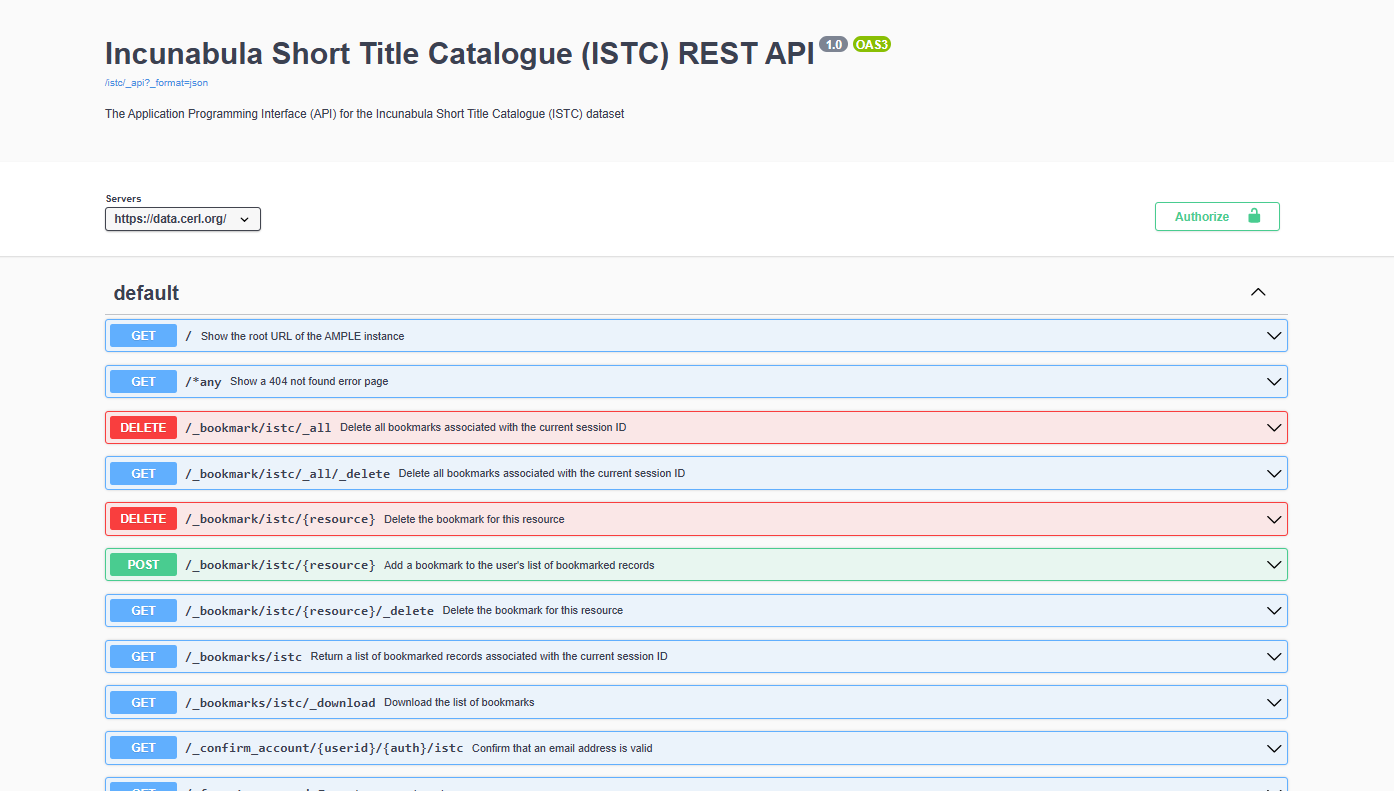
Incunabula Short Title Catalogue (ISTC) REST API 1.0
https://data.cerl.org/istc/_api
Related articles

November 9, 2026
by Konrad K. Szymański (Ossolineum National Library, Wrocław)
November 9, 2026