
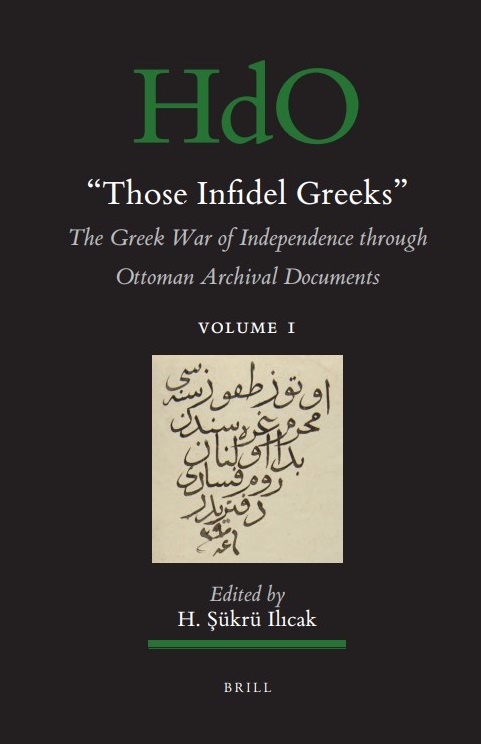
“Those Infidel Greeks; The Greek War of Independence through Ottoman Archival Documents.” (2 vols.) Brill, 2021.
by H. Şükrü Ilıcak (edited)
Share this article
The Greek War of Independence (1821-1830) is the founding event of the nation‐state building process in Greece and of the Greek master narrative, the generator of Greek historiography’s “others,” myths and stereotypes. Mainstream Greek historiography has essentially been a dramatic panegyric to the heroic deeds of the revolutionaries and, to this day, is haunted by nineteenth-century European romanticism: It constructs a linear civilizational history extending from antiquity to Modern Greece, ascribes historical agency to the “Greek nation” as a collective actor and apprehends the four‐hundred‐years‐long “alien occupation” as a lapse from its normal course of progress and a period of preparation for its freedom. It negates almost every aspect of the Ottoman heritage and views the Ottomans as the mere despotic “other” who paved the way for the martyred Greek nation to stage its revolution.
This ethnocentric teleological paradigm, invented mainly by Konstantinos Paparrigopoulos in the second half of the nineteenth century, has moved the Greek War of Independence to a universe of its own, whose spatial and temporal boundaries have been readjusted in time, based on the answers given to the larger questions of “what, where and when is the Greek nation.” In other words, mainstream ethnocentric Greek historiography has “de‐Ottomanized” the Greek War of Independence, making it very difficult for generations of historians to deviate from it.
The documents edited by H. Şükrü Ilıcak in “Those Infidel Greeks” is a historiographical intervention in an attempt to re-place the Greek War of Independence within the larger imperial context. The book comprises the transliterations and English translations of select documents from the Ayniyat Registers on the Greek War of Independence preserved in the Ottoman State Archives in Istanbul. Every order dispatched from the grand vizier’s office to various central state officials and provincial functionaries for the quelling of the Greek uprising was immediately copied into these bound volumes in chronological order to keep track of the rapidly accumulating correspondence. As a result, some thirty-three registers were compiled between June 1821 and April 1835, comprising 4,352 pages and, on average, 1.5 orders per page, providing us with a sea of information of great historical value regarding the Greek struggle for independence and the establishment of the Kingdom of Greece. The documents presented in this 1,700-page book are compiled from the first thirteen registers of this thirty-three-volume series and span from June 1821 to April 1826.
Coining the information collected in these registers as the “Ottoman view of the Greek Revolution” would only partly reflect the scope of the book. The primary importance of these documents is that they are a clear testimony of the larger imperial context in which the Greek Revolution evolved and proved successful. Through these documents, we acquire penetrating insights into the workings of Ottoman governance, imperial allegiances, the military, the navy, the commissariat, the economy, and human capital. We learn extensively about the political and military forces and allegiances the Sublime Porte strived to mobilize to fight its battles against the Greek revolutionaries and also about the ways in which it kept the Greek communities that did not rise up under control.
The mass of information in these documents clearly denotes a highly ineffective and failing state, which could hardly perform its core functions and exercised only nominal authority over much of its territory, and a desperate but eager Mahmud II, who was the Ottoman sultan throughout the Greek Revolution. At the time of the Greek Revolution, the Ottoman central state had essentially no army and limited means to raise one. The navy was totally inept and could hardly sail out of the Dardanelles.
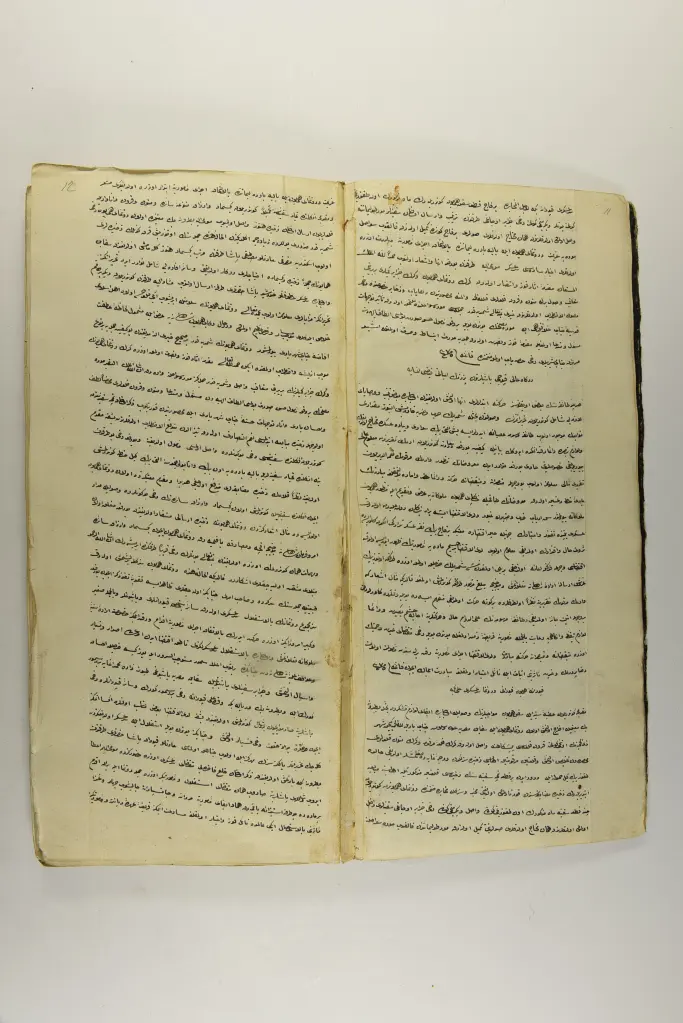
Two pages from the register Ayniyat # 574. The first one (on the right side) contains two orders. The second order continues to the left side.
The Sublime Porte severely lacked the military and naval manpower to put down a national uprising that broke out almost simultaneously throughout the empire wherever Greek populations constituted the majority. Hence, most documents in this book are unsurprisingly of a military nature, evincing the Sublime Porte’s frantic efforts to rally every possible military human resource for its war effort.
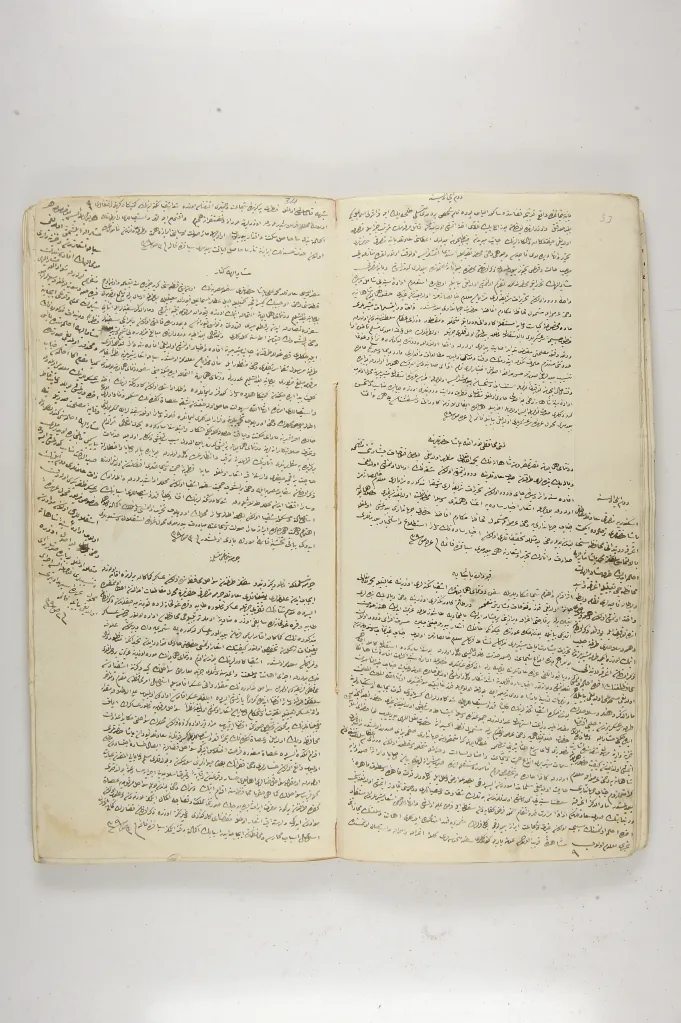
Two pages from the register Ayniyat # 1713. Additional orders are added in columns in the margins.
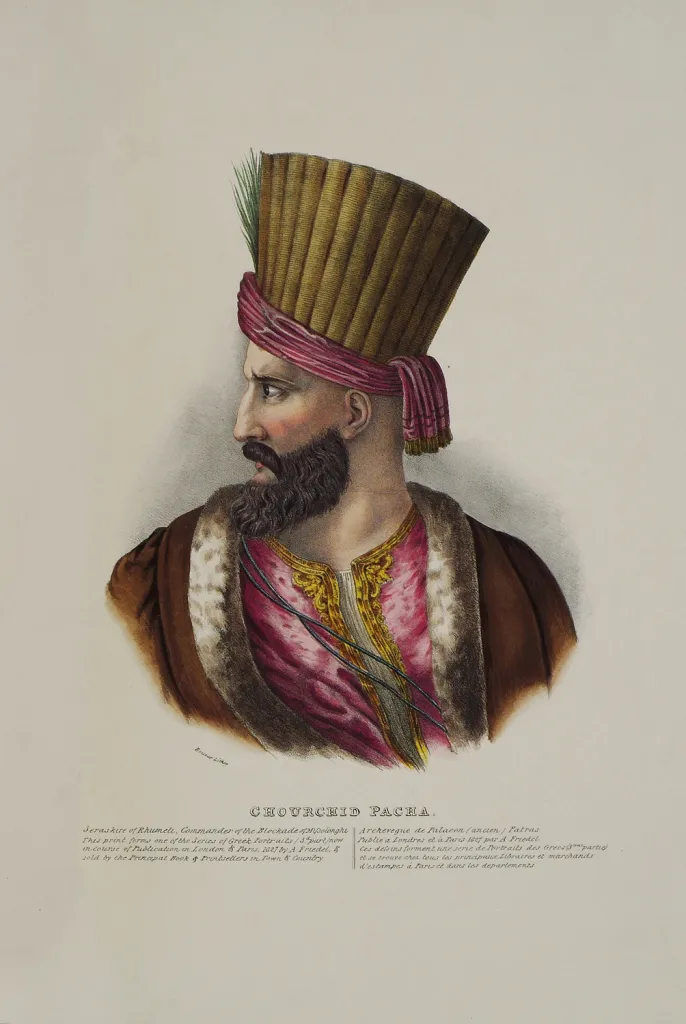
Portrait of Hurshid Pasha. Adam de Friedel, The Greeks, Twenty-four Portraits of the principal Leaders and Personages who have made themselves most conspicuous in the Greek Revolution, from the Commencement of the Struggle, London, 1832.
Throughout what they called “Rum Fesadı,” namely, the “Greek Sedition,” Ottoman functionaries denied historical agency to the Greeks, who set out to determine their collective future by themselves.
Although thrown into consternation by the events in which the Greeks “sacrificed their malignant souls in the name of their fallacious religion,” to them, the weakness of the state, lack of unity and zeal among the functionaries, and the decadent condition of the Muslim Ottomans in general were more significant causes for insurrection than the conscientious political action of the Greeks.
As a matter of fact, the line of thinking, the discourses, and the imperial hubris that would be spawned in each confrontation between the Ottoman state and separatist national movements in the following century—or even in the Republican era for that matter—were first manifested during the Greek War of Independence.
Fear of collapse and dissolution, heavy emphasis on foreign conspiracy and intervention, categorical denial of the insurgents’ historical agency, the pampered “other” turning into pawns in the hands of foreign powers, a discourse of isolation in the international arena, and a feeling of victimization are the main themes that run through the documents in this book, mainstream Ottoman/Turkish historiography, and, indeed, the speeches of contemporary Turkish politicians.
If one use of the study of history is to see patterns that rhyme, the publication of these documents two hundred years after they were penned will shed light not only on the conditions in which the Greek Revolution evolved, but also on our times.
The immense mass of information in the documents allows the readers to follow on an almost day-to-day basis how an empire tried to suppress a national uprising—the first of its kind in the early nineteenth century. Thanks to the generous donation of the Aikaterini Laskaridis Foundation, the sponsor of the project, the book is free access and can be downloaded for free in digital format here: https://brill.com/view/title/60933.
* H. Şükrü Ilıcak, PhD (Harvard University, 2011) is a fellow of the Institute for Mediterranean Studies in Rethymno, Crete. He has published broadly on the Greek War of Independence and the so-called Ottoman “Three Nations.”
Related articles
by Edina Zsupán, HUN-REN – HNMPCC NSZL Fragmenta et Codices Research Group, Head of the Corvina Programme of the National Széchényi Library, Budapest
November 9, 2026
by Claire Bolton
November 9, 2026