News from CERL Grantees
by Elena Fogolin
Share this article
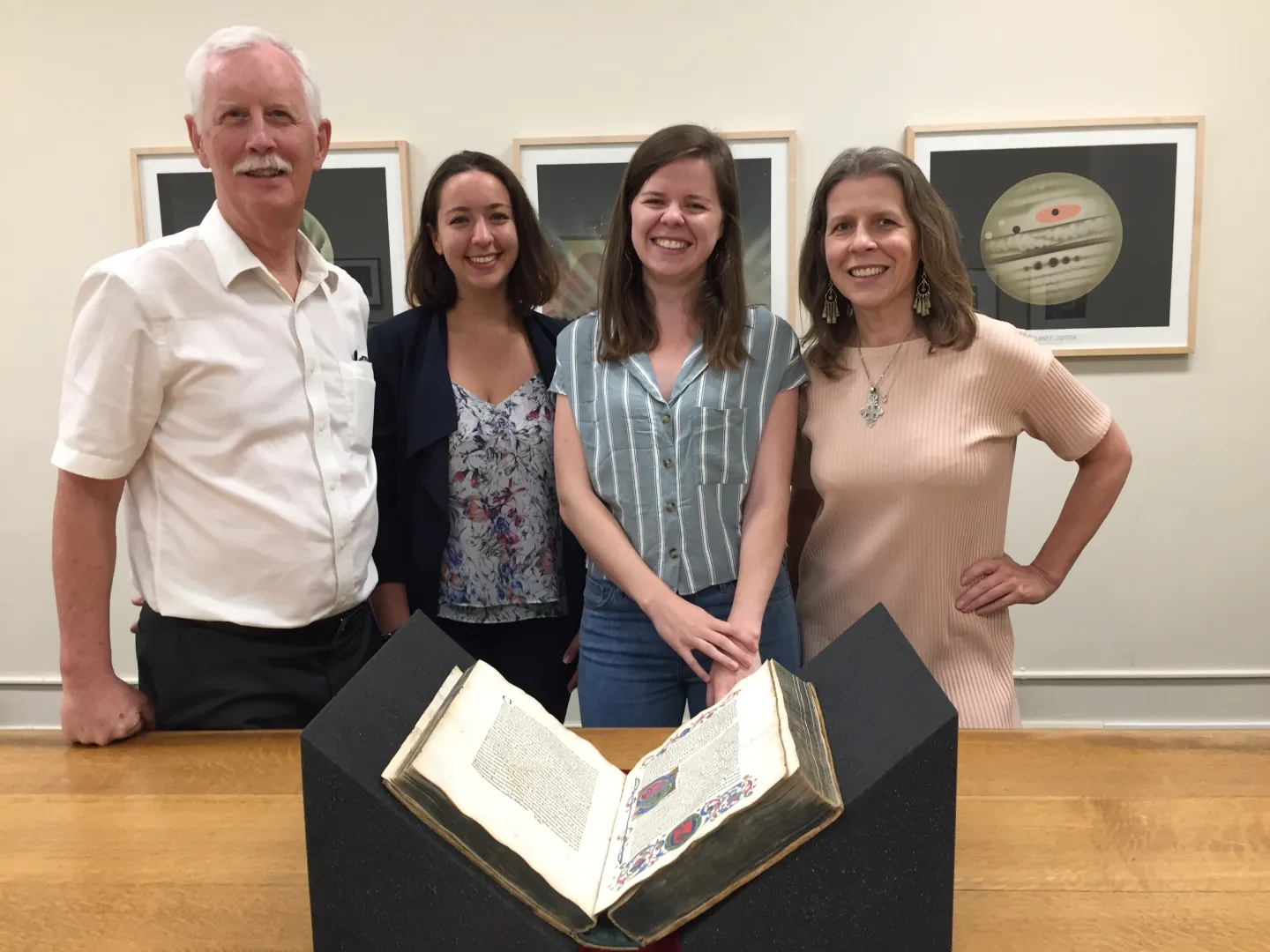
Former 2018/2019 CERL grantee Elena Fogolin (second from the left) is currently a PhD candidate at the Johannes Gutenberg University in Mainz, Germany, under the supervision of Prof. Dr. Stephan Füssel. Her research is a study on German incunabula printer Georg Herolt (15th century, Rome), and on the phenomena of the set-offs.
My M.A. thesis at the University of Udine in 2018, supervised by Neil Harris, involved two fifteenth-century editions by Ambrogio Massari or Ambrogius de Cora, printed in Rome by Georg Herolt in 1481/1482: the Vita precellentissimi ecclesie doctoris diui Aurelii Augustini Iponensis [ISTC ic00881000] and the Defensorium ordinis Heremitarum S. Augustini [ISTC ic00877000].
Set-offs in early printed books are caused by a freshly-printed sheet being pressed against another sheet: the result is a shadowy, back-to-front image on the other sheet. They are also relatively rare and it is very unusual to find a high number of set-offs concentrated in one copy of a particular edition, while at the same time being totally absent from other copies of the same book.
A copy now in the library of the Gutenberg Museum at Mainz, in which the Vita and the Defensorium are bound together in an original fifteenth-century German binding, presents a large number of set-offs, nearly 400.
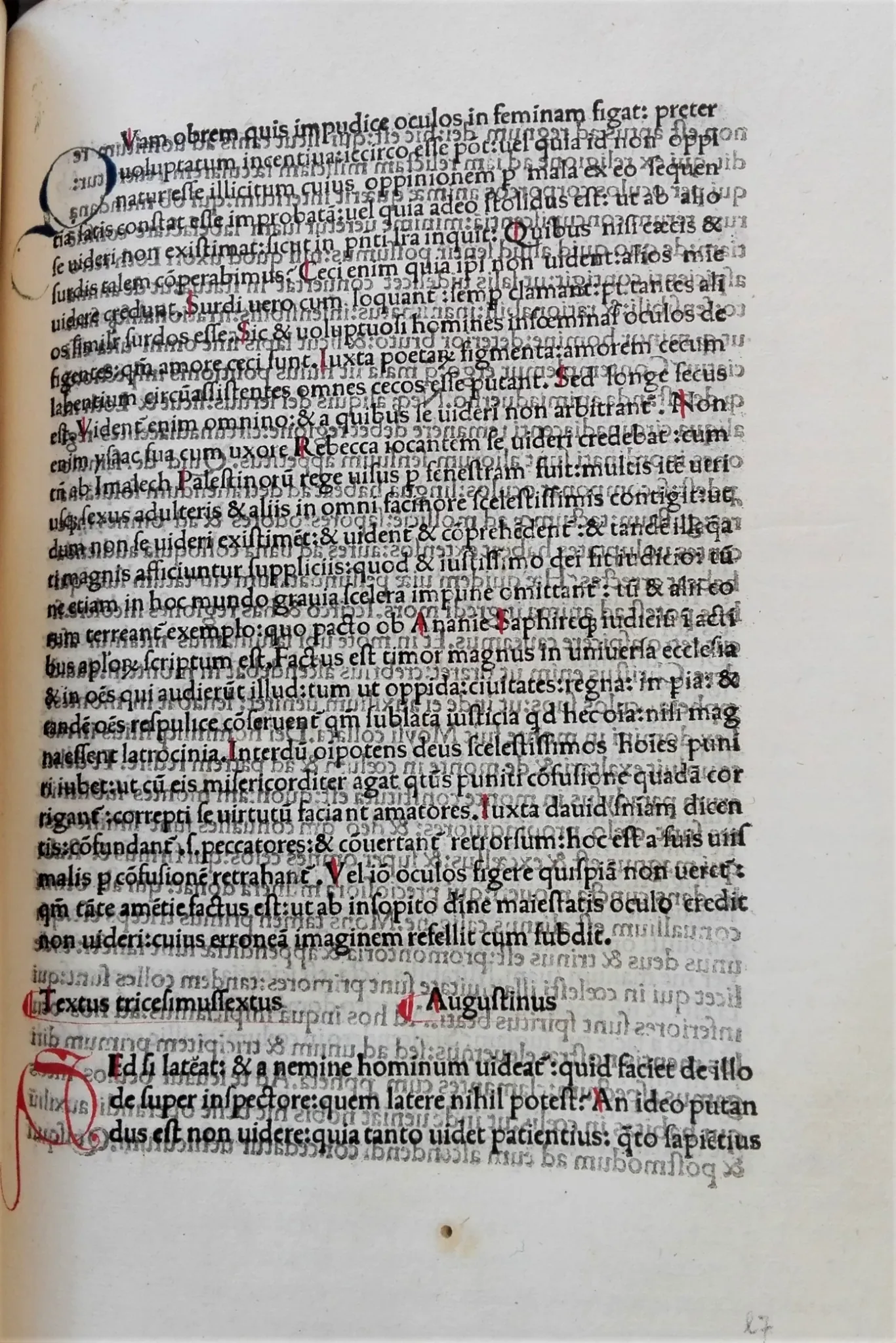
Cora, Ambrosius de, Vita S. Augustini, Roma, Georgius Herolt, 1481, Mainz, Gutenberg-Museum, leaf l7r.
The set-off overlaps the text of the regular impression.
The other striking feature is that, in general, set-offs are very weak and difficult to make out or identify; in the Mainz copy, however, though some are fragmentary and seem to be the consequence of only a fleeting contact, in many instances they are sharp, easy to read, and show that the sheets were pressed hard together just after impression. This strange phenomenon is therefore linked to some unknown and as yet mysterious aspect of the early printing process.
Furthermore, in the few known instances where a high number of set-offs are documented as being in a particular copy, they are not only from the same edition but from the very same copy, if in this particular instance the Vita and the Defensorium are considered as being a single item. In most cases the set-offs in the copy in Mainz are in fact reciprocal, i.e. both sheets have been freshly printed and set off on each other, including vice versa contacts between the Vita and the Defensorium.
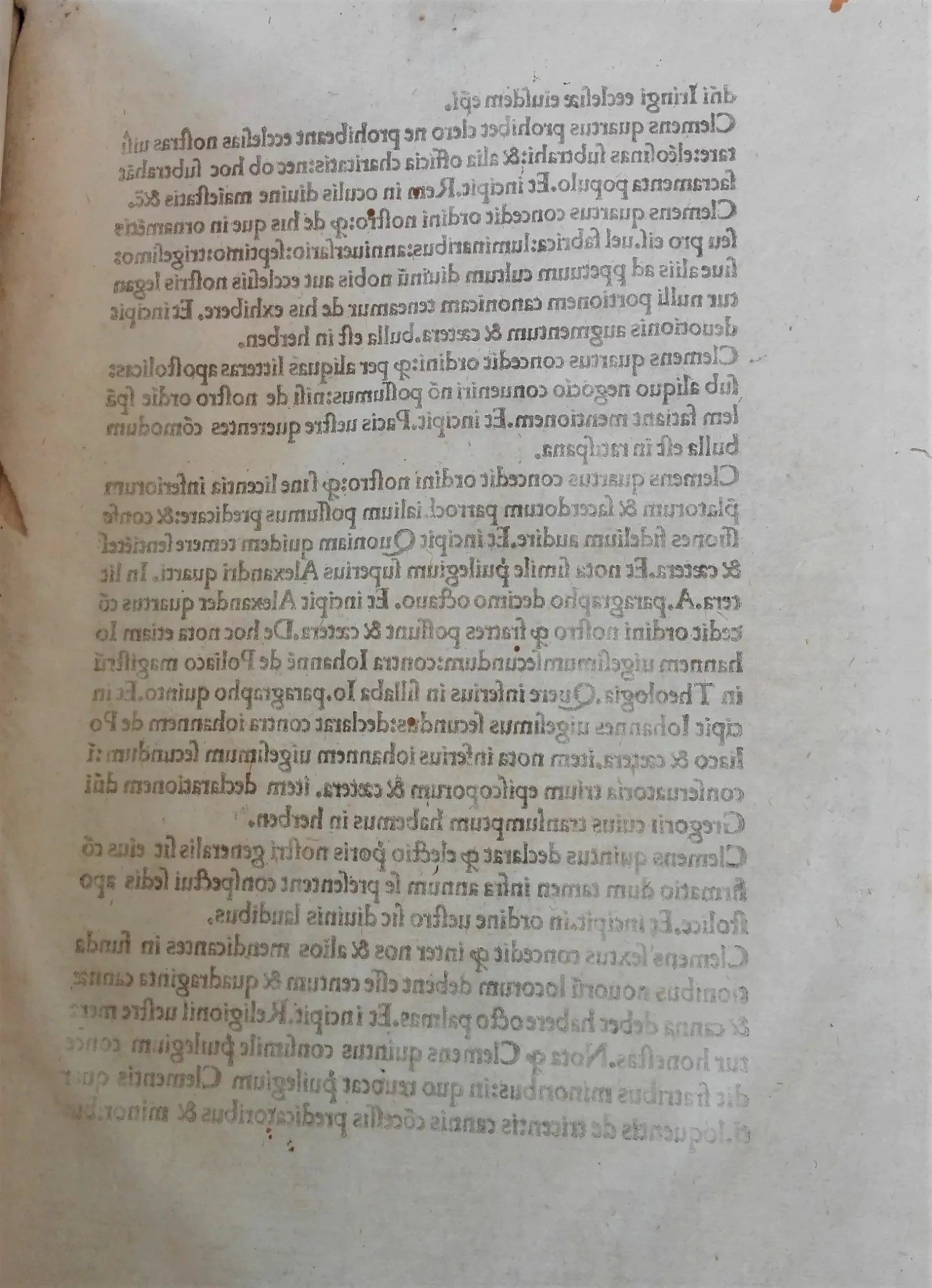
Cora, Ambrosius de, Defensorium ordinis Heremitarum S. Augustini, Roma, Georgius Herolt, 1481-82,
Mainz, Gutenberg-Museum, leaf q8r, i.e. the blank recto of the last leaf of the last quire, shows a set-off from leaf q1v.
Since completing my M.A., I have returned to the Mainz copy and have now identified the provenance of almost all the set-offs. So, something very unusual happened in Herolt’s printing shop. But is this a unique example in his production, or are there other traces of such phenomena in the editions printed by him or attributed to him?
To answer this question, for my Ph.D. I should like to extend my investigation to the other forty-odd editions assigned to Georg Herolt in the GW and ISTC. To do this, I first have to work on the numerous gaps found in the studies dedicated to this printer, who so far has been very little investigated.
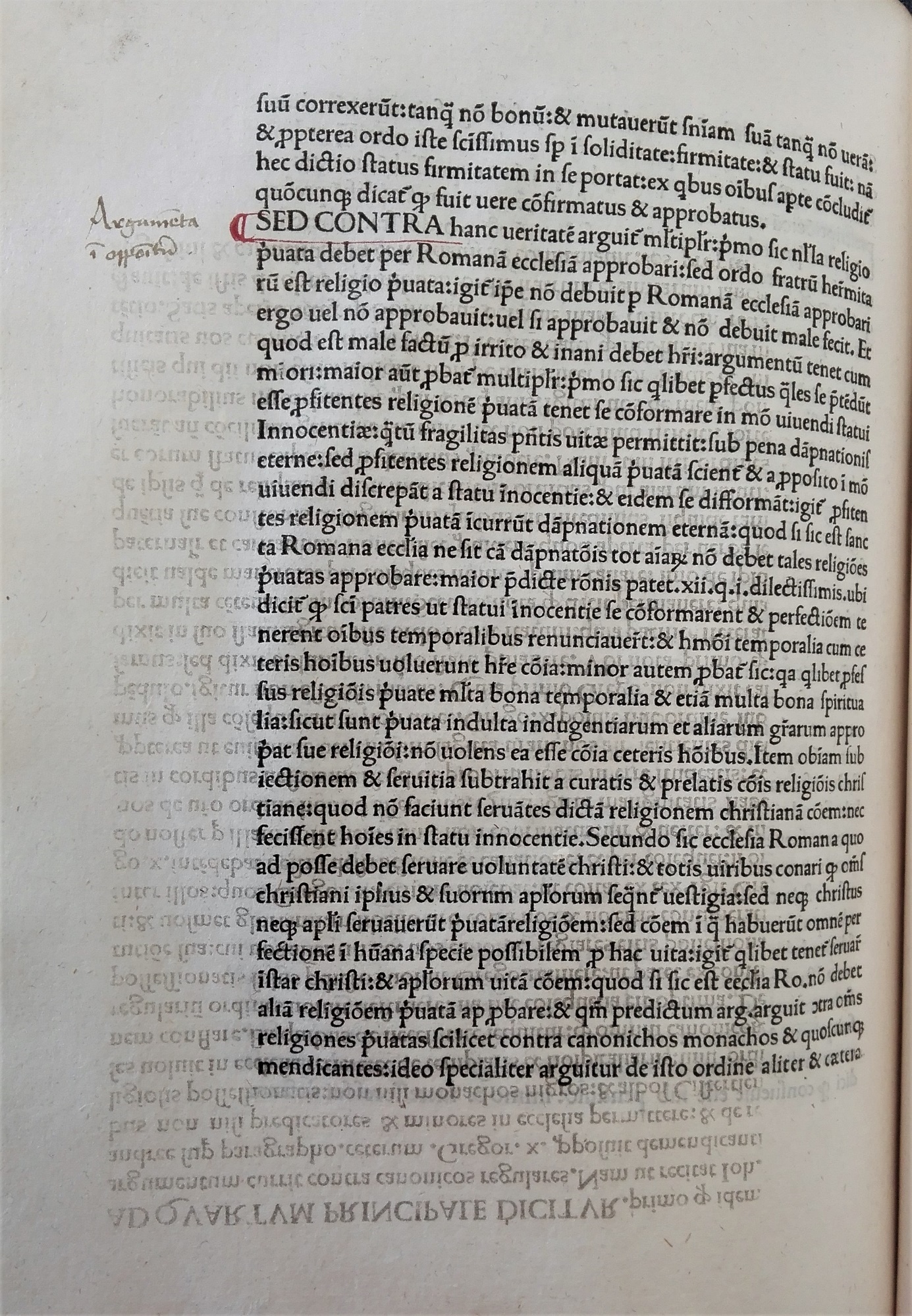
Cora, Ambrosius de, Defensorium ordinis Heremitarum S. Augustini, Roma, Georgius Herolt, 1481-82,
Mainz, Gutenberg-Museum, an upside-down set-off on leaf g5v.
It is known that he originally came from Bamberg and that his name appears in the colophons of two editions printed in Rome in 1481: the Contra Celsum et in fidei Christianae defensionem libri by Christophorus Persona [ISTC io00095000] and the already mentioned Vita Sancti Augustini. The research gets even more complicated given the fact that several Georgs, all Germans, were active as printers in Rome in the same period: Sachsel in 1474 and 1475, Herolt and Lauer in 1481, with inevitable confusion in the bibliography of their output. It is also possible that he was the “Georgius Teutonicus”, though it may well have been one of the others, or even a completely different German typographer called Georg, who appears from time to time in the colophons of editions signed by Sixtus Riessinger and other printers. Modern repertories in fact do not take a position on this question, but only list the prevailing opinions: Georgius Teutonicus (Herolt or Lauer).
Therefore, as a continuation of the in-depth bibliographical research begun for my M.A., I intend to look more fully at the figure of Georg Herolt, his production and, more generally, his role in the early printing of the fifteenth century in Rome, while at the same time clarifying, as far as possible, the ambiguity associated with his identity.
Since I am based in Germany and have access primarily to German collections of Italian incunabula, I also hope to find unusual and so far unnoticed copy-specific details involving fifteenth-century books printed in Rome.
Cristina Dondi: It was a pleasure to meet Elena and discuss her research plans in Göttingen last October 2019, where she joined us for CERL AGM and seminar. We look forward to adding ‘set-offs’ to Copy Features in MEI!
Thanks to the CERL Internship and Placement Grant 2018/19, I was able to work for six weeks as an intern at the Huntington Library, under the supervision of Stephen Tabor, Curator of Rare Books, and I became acquainted with MEI and the different sources of evidence useful to track the movement of books across the world and through the centuries. For this reason, my plan is also to create MEI records for each incunable that I examine in the course of my prospective research.
Elena Fogolin, PhD candidate at the Johannes Gutenberg University in Mainz, Germany.
For the period 2018/2019 CERL Grant Committee has been able to offer five grants. Click here for more information on CERL internship and placement grants.
Related articles
by Konrad K. Szymański (Ossolineum National Library, Wrocław)
November 9, 2026
by Caroline Duroselle-Melish, Angela Dressen and Attilio Bottegal, I Tatti, Harvard
November 9, 2026