CERL Internships 2025 – Aikaterini Laskaridis Foundation
by Jemima Bennett, PhD candidate – University of Kent/Bodleian Libraries
Share this article
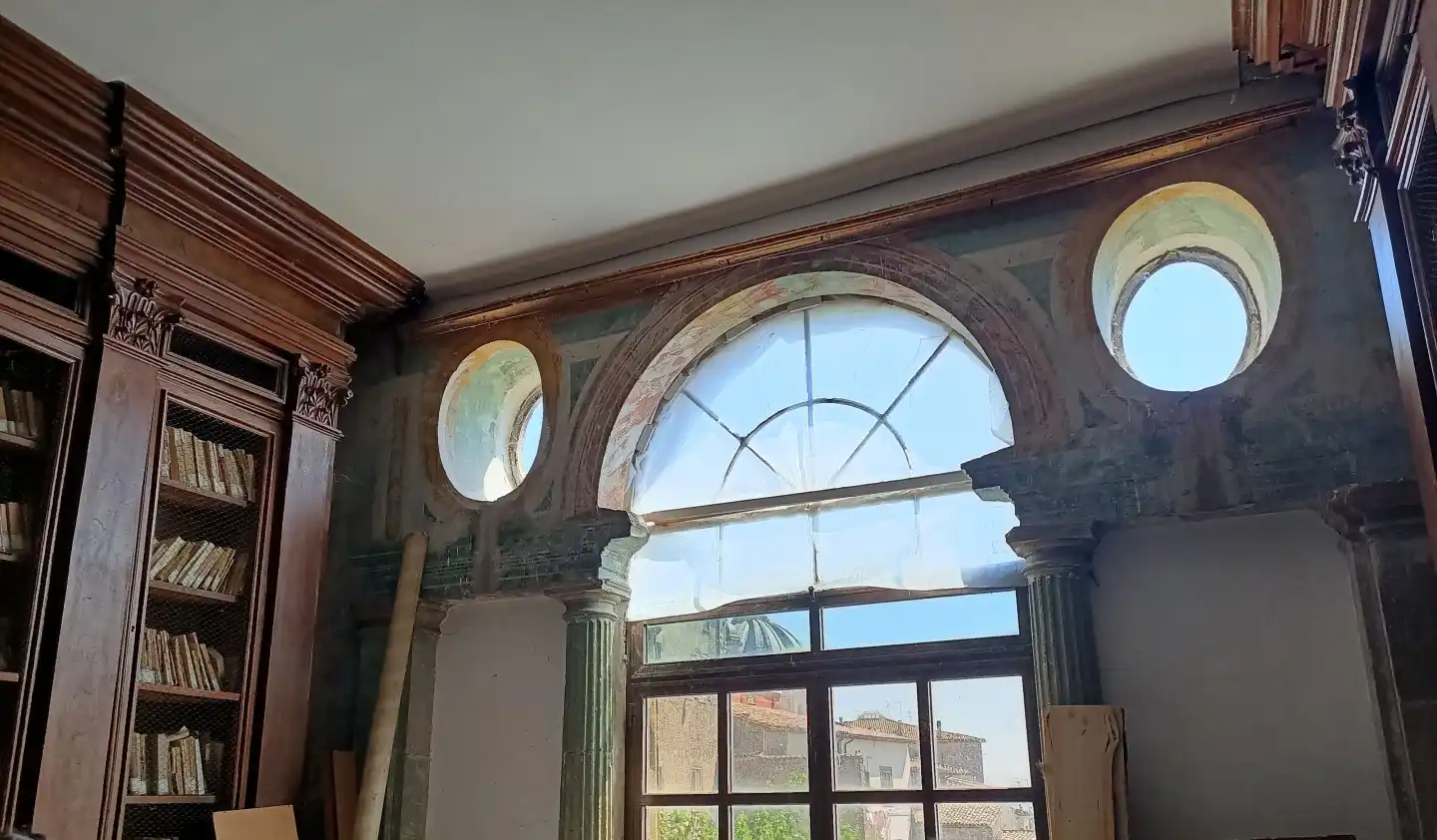
For four weeks in September and October 2025, I had the amazing opportunity, as a CERL grantee, to work with the incunables at the Aikaterini Laskaridis Foundation in Piraeus, Greece. My placement consisted of creating records for the books for CERL’s database, Material Evidence in Incunabula (MEI), and linking these with images I had uploaded to CERL’s Provenance Digital Archive (PDA).
In my regular work with medieval books, it is rare to encounter a former owner who can be confidently associated with a real person in history, let alone a whole chain of ownership. It was exciting and satisfying, therefore, to be able to record the marks in incunables which were left behind by people who have names and identities. For this reason, the following piece will showcase some of the books with which I worked, with a particular focus on the activities of former owners to mark their books as belonging to them.
We can begin with INC122, whose front pastedown (the leaf stuck to the inside of the front board) reveals evidence of two of its former owners. The book is an edition of the Biblia pauperum, printed in Venice by Georgius Walch in about 1480. One of the bookplates is an oval stamp which tells us that the book once belonged to F. Fasting, of Rio de Janeiro, although unfortunately not much more information about this collector is publicly available, except that they were active around the first half of the twentieth century.
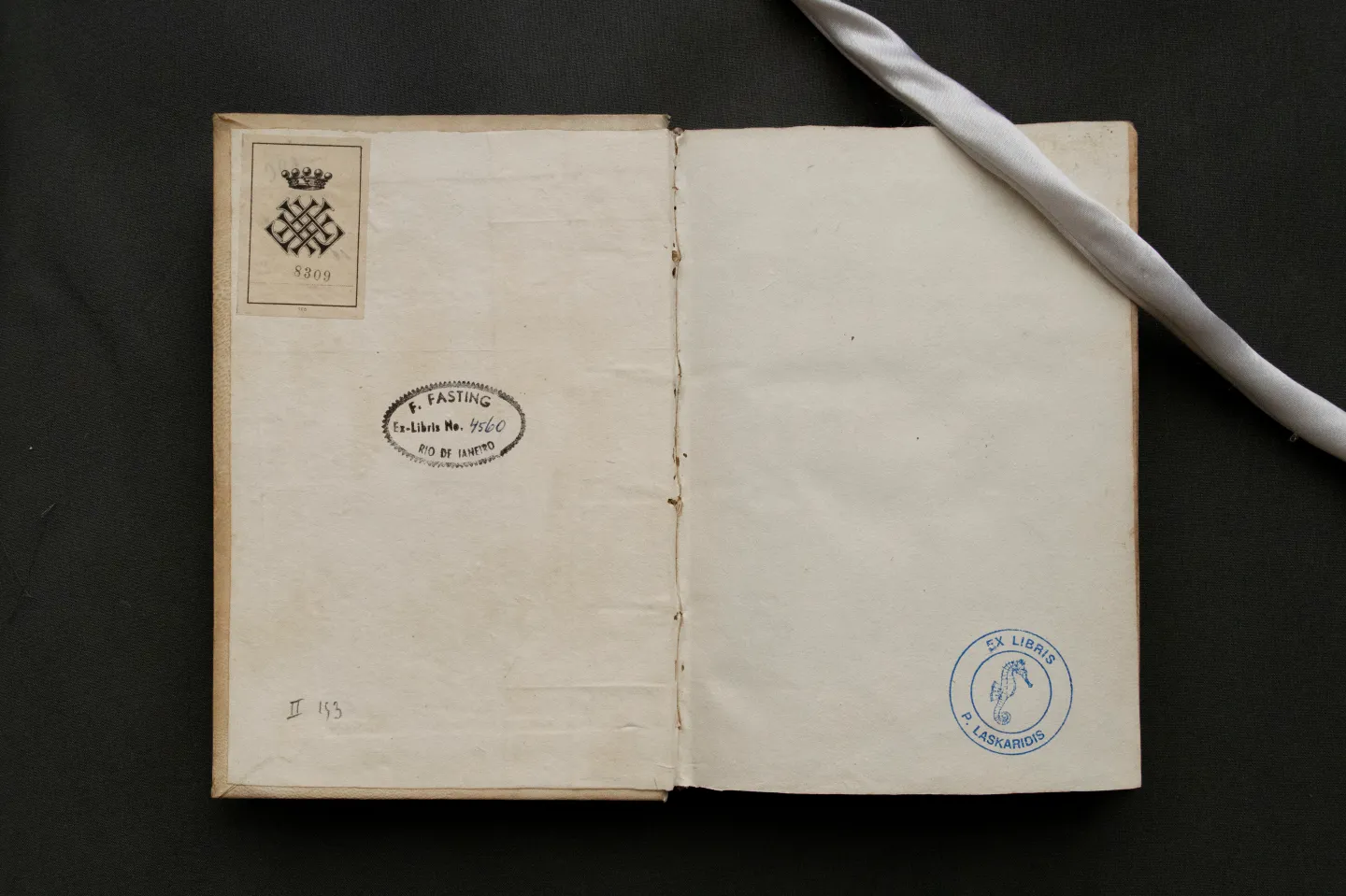
The other bookplate on this pastedown is enigmatic in another way, in that it is not immediately obvious to whom it refers. On initial inspection it appeared to consist of a crown above a pattern of cross-hatched lines, above the stamped number ‘8309’. After a reverse Google search, I was able to find images of other bookplates that were almost identical (except for the stamped number) that seemed to be connected to Baron Horace de Landau. Another search, this time for Horace de Landau on the PDA, confirmed this to be the case. What first looked like a cross-hatch of lines is, in fact, the initials HL, doubled and interlaced. Horace de Landau was acquiring books in the eighteenth-century, so he must have owned the book before F Fasting acquired it.
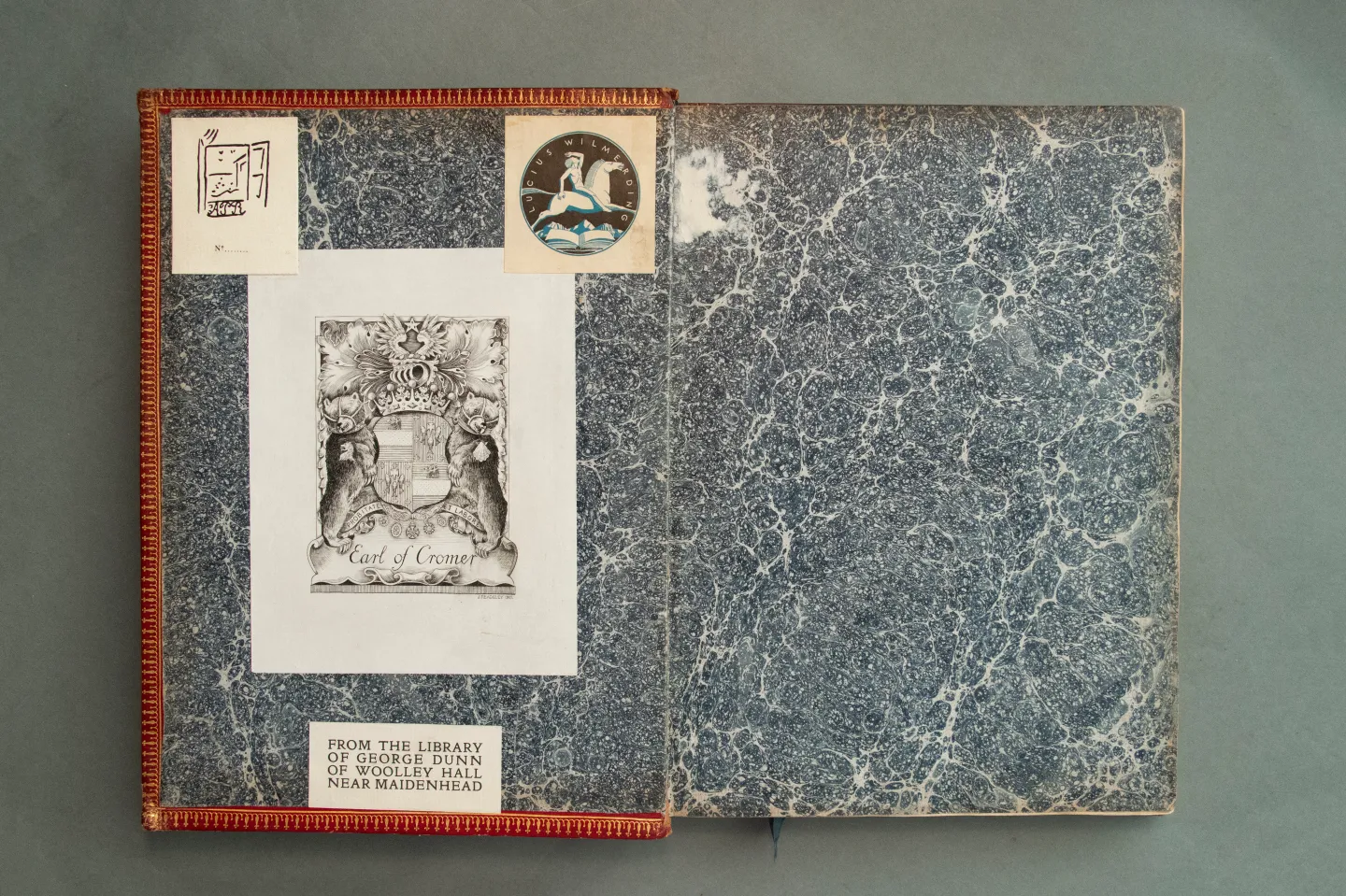
There are no fewer than four bookplates on the front pastedown of a copy of John Chrysostom’s Sermones Morales, printed in Rome by Georgius Lauer in about 1470 (INC126). But before addressing the bookplates, we can work out provenance from the binding of this book itself, a product of the late eighteenth century, a red Morocco binding with gilt titling on the spine, pastedowns of marbled paper, and gold tooling on the inside of the boards. The whole binding is beautiful, but the important detail for provenance is the tiny label in the top foredge corner (the opposite end from the spine) of the inside of the front board.


This small label tells us that the book was bound (relié) by la Veuve Gueffier, or the Widow Gueffier, at rue Gallande n. 61. It was not uncommon for widows to take over the professions of their deceased husbands, but what is unusual about Mme Gueffier is that she also made playing cards. Bookbinders were often more than just that, they could also be involved in the selling and sometimes printing of books, but this binding is testament to a truly broad range of work that Widow Gueffier was undertaking.
It is not clear what happened to the book immediately after it was bound sometime around the year 1800, but within the first decade or so of the twentieth century, it was in the possession of bibliophile George Dunn, whose bookplate is on the inside of the front board.
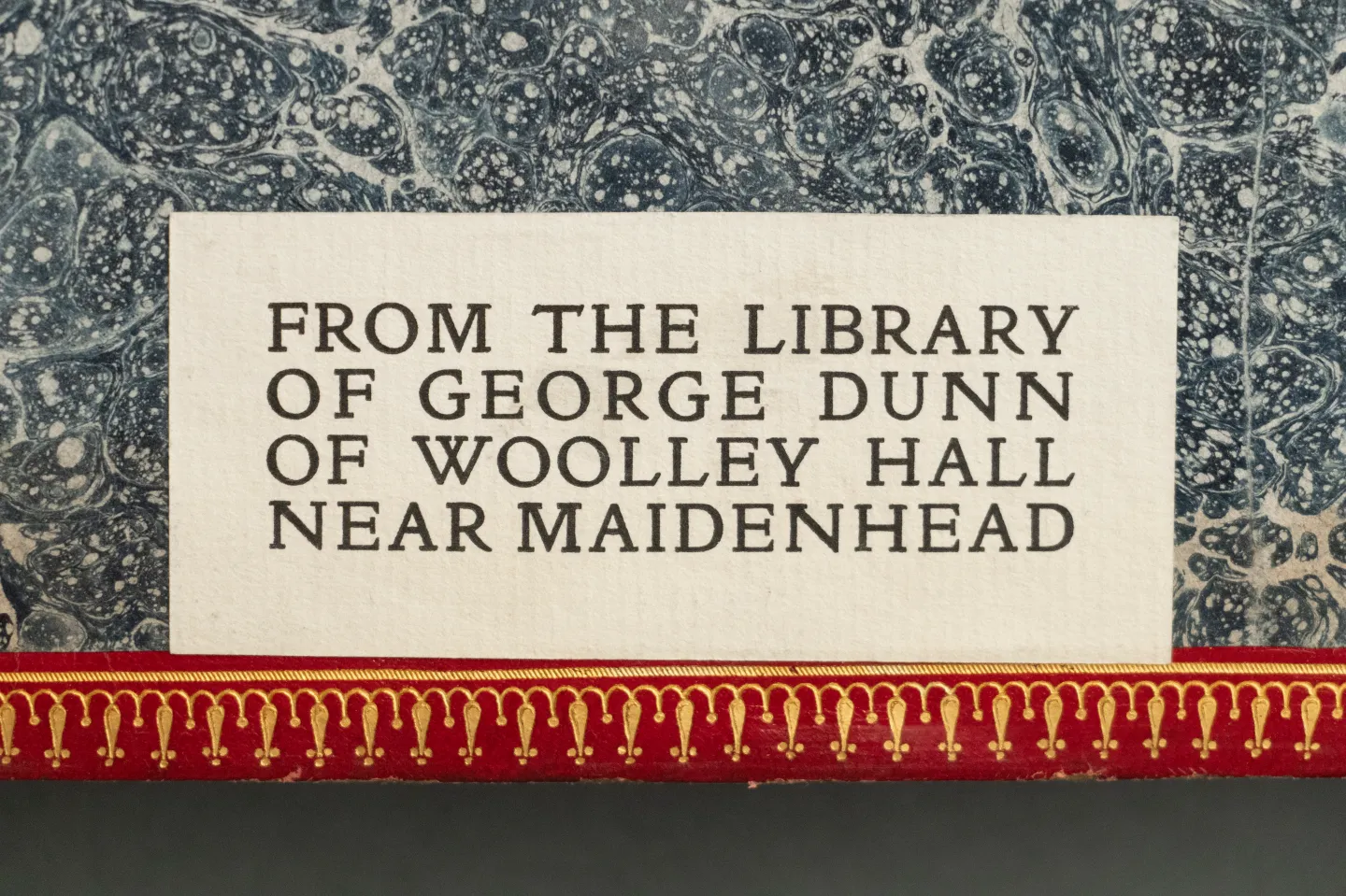
Dunn amassed a significant collection of incunabula and medieval manuscripts at his home near Maidenhead in the UK and, when he died in 1912, this was sold in a series of sales between 1913 and 1917. It is probable that it was at one of these sales that this book was acquired by its next owner, the Earl of Cromer. Furthermore, a note on Cromer’s bookplate itself tells us that it was designed by J. F. Badeley in 1912, so very likely the book was with Cromer sometime after 1912, and before his death in 1917.
Between 1917 and 1955, there is another gap in the known provenance of the book, but the next bookplate confirms where it ended up by the close of the 1940s: in the collection of Lucius Wilmerding, a New York book collector, whose bookplate is in the top right-hand corner of the inside of the board.
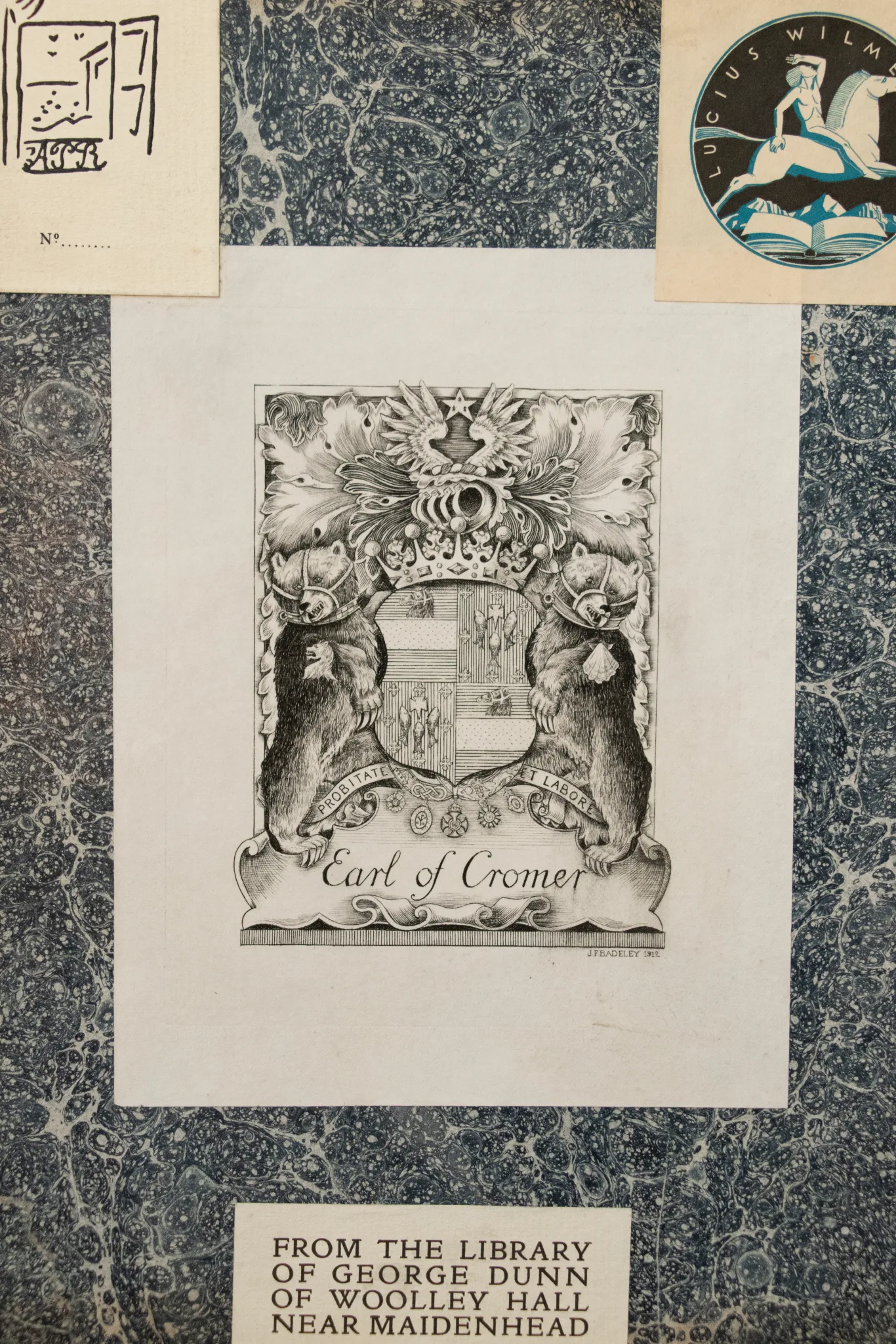
Over the course of the next thirty years, the book passed through the hands of other New York collectors, Saul Cohn, and Lucien Goldschmidt, before it was acquired by the dealer Alexandre P. Rosenberg, before the end of the 1980s. His bookplate is the last on this board, and it is especially interesting because it was designed for fourteen-year-old Rosenberg by the artist Pablo Picasso, a friend of the family. Rosenberg continued to use the plate throughout his life.

Alexandre and Elaine Rosenberg were great New York collectors and, by Alexandre’s death in 1987, had built up a world-class collection of illuminated manuscripts and early printed books.
Elaine Rosenberg continued to care for these until her death in 2020, after which the collection was sold by Christie’s, and this book, among others, was bought by the Laskaridis Foundation.
It is possible then, just by looking at the endleaves of this book to trace the history of its ownership in an almost complete line from the start of the twentieth century – but what about the beginning of an incunable’s life? How can a book’s endleaves reveal details of its fifteenth-century history?
Unfortunately, with the eighteenth-century binding provided by Mme Gueffier, and the book’s original endleaves removed, it is not yet possible to know the earlier, fifteenth-century provenance of INC126. INC127, however, a copy of Eusebius’ De evangelica praeparatione, translated into Latin by Trapezuntius and printed in Venice by Leonhardus Aurl in 1473 is in its original fifteenth-century binding and thus preserves fascinating details of its earlier history.
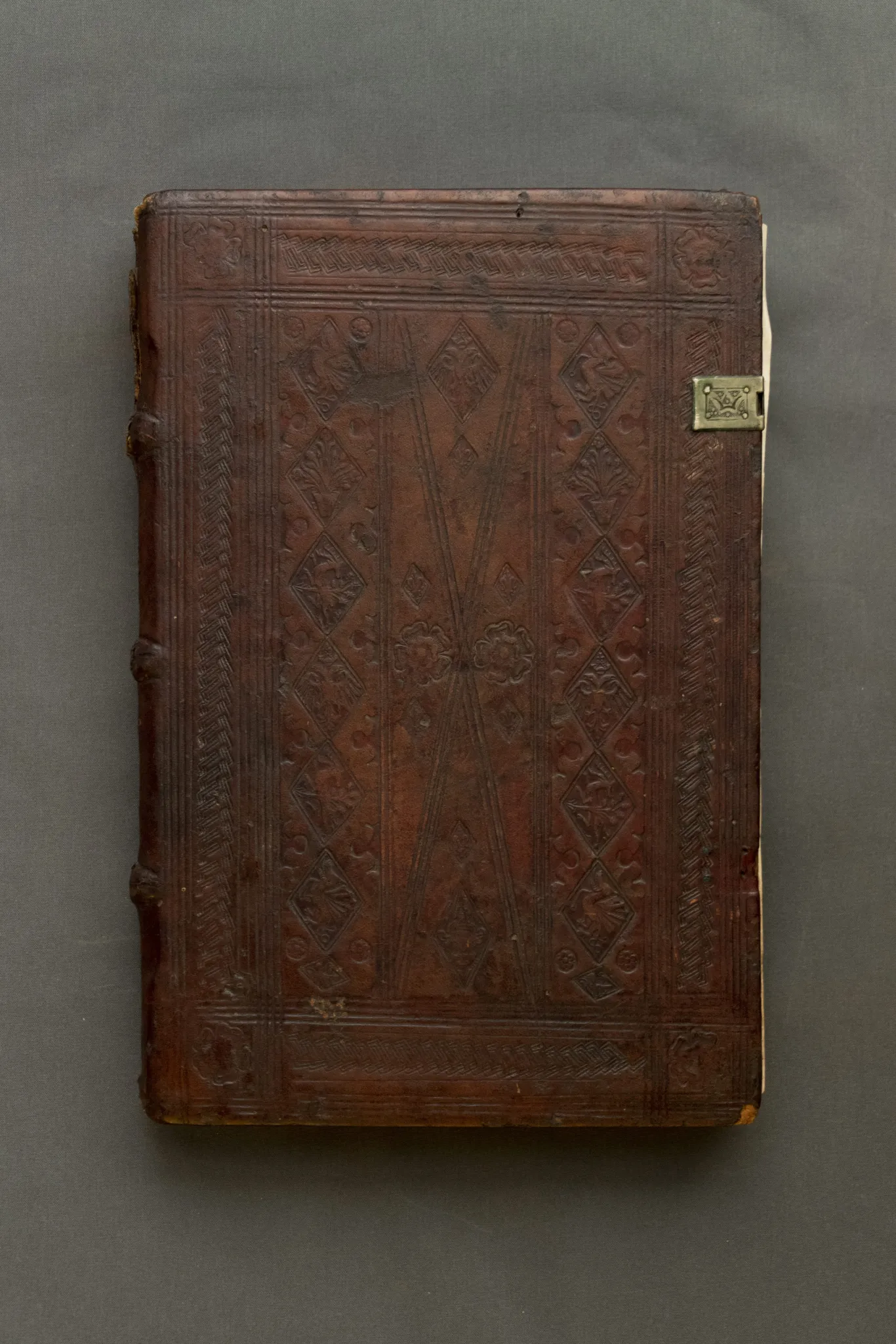
For me at least, the most interesting part of the provenance of this book can be found, again, on the inside of its front cover, where you can see the binder has pasted a paper manuscript fragment.
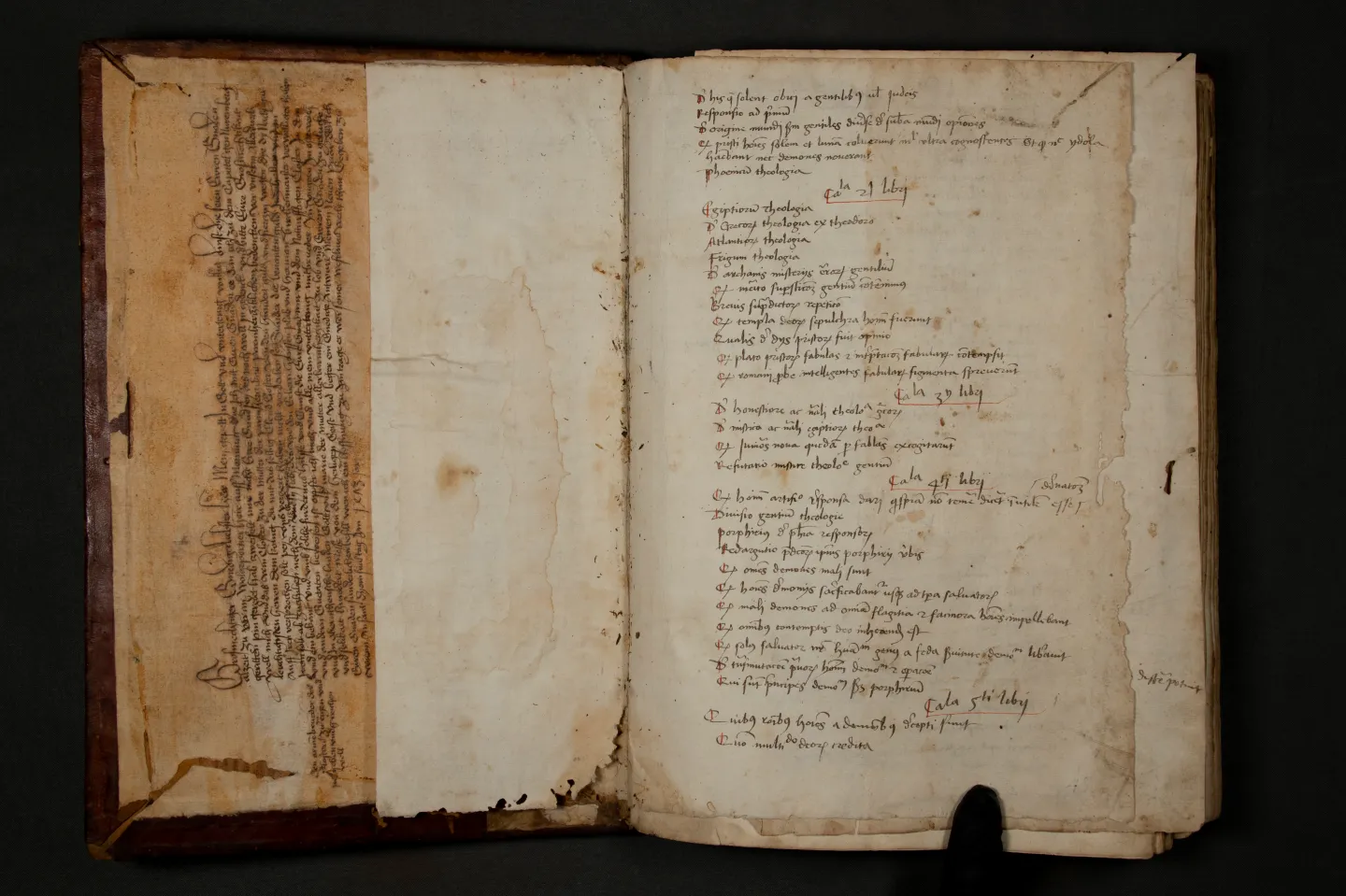
It was a common practice for binders of this period to strengthen their bindings with whatever waste parchment or paper was available to them, whether it contained manuscript text or not. This fragment is a part of a document, written in German, and dated to 1473 in Vienna in Austria. This has a few implications for what we can know about the book’s binding. One is that it has to have been made after 1473 (although some readers may have spotted that we know this anyway, since it is the date of the book’s imprint), but we also can be fairly sure that it was made in the area around Vienna, because that is where the fragment was discarded. It is interesting then that in the time between its printing and binding, the book travelled from Venice to Vienna, receiving annotations from a reader on the way. We might expect this kind of international, cross-continental book trade to be feature of the modern era, but this medieval book shows that this is not the case.
After receiving its binding in Vienna, the book travelled again, this time to the town of Ingolstadt in southern Germany. We can see this from the ownership inscription at the bottom of the first leaf.
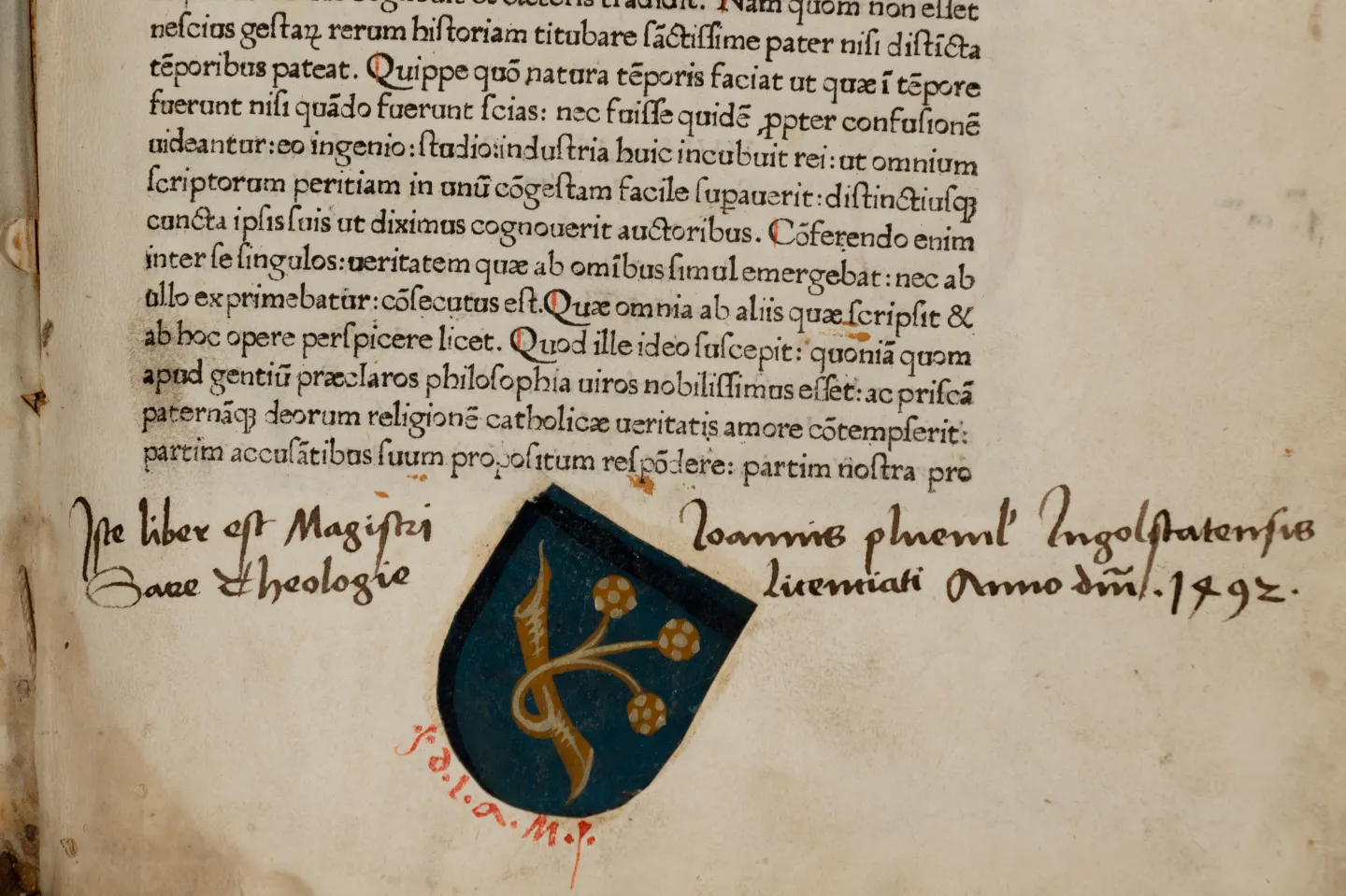
This inscription, in a fifteenth-century hand, reads ‘Iste liber est Magistri Joannis plueml’ Ingoldstatensis… Anno domini 1492’, showing that this book belonged to Johannes Pluemel of Ingolstadt in the year 1492. Pluemel matriculated at the University of Ingolstadt in 1472 and served both the Faculty of Arts and the Faculty of Theology in the final decades of the fifteenth century. It is clear that Pluemel cared about his book, adding not only this inscription to mark his ownership, but also his coat of arms, a similar inscription at the end of the book, and some red titles to structure the text. His library has been well documented, although INC127 is a new addition to the listing, and across his books, Pluemel can be seen showing the same care, with the inclusion of his coat of arms in most of them.1
It is not clear what happened to this book after it left Pluemel’s collection. There is evidence that he gave away some of his books while he was still working at Ingolstadt, and the relatively high number of different annotating hands in this book could be explained by its use by several students in a university context. But it is also possible that Pluemel took this book with him when he left Ingolstadt in 1508 to preach at Bruchsal, about 240km to the west, and that it was from there that the book was passed on to its next owner.
INC122, INC126, and INC127 are just three of the books that I was working on at the Laskaridis Foundation, and it was so exciting to uncover more of their history, and that of other books. Ownership marks and other marks of use from over the last five hundred years were crucial in enabling me to do this, and the internship has been invaluable in broadening my experience of incunables beyond simply my PhD thesis.
I am very grateful to Dr Vera Andriopoulou, Kleopatra Kyrtata, and Aggeliki Papadopoulou for making me feel so welcome at the Foundation, and for the time and support they gave in supervising and training me.
Thanks are due too to librarians at the Gennadius Library and the National Library of Greece for kindly showing me their collections, and to Dr Cristina Dondi and the CERL board for awarding me this grant.
Bibliography
- Dennis E. Rhodes, ‘The Library of Johann Plümel’ in Incunabula : studies in fifteenth-century printed books presented to Lotte Hellinga, ed. by Martin Davies (London: British Library, 1999), pp. 231-41.
Related articles
November 9, 2026
by Markéta Kučerová and Vojtěch Šícha, Library of the Czech Academy of Sciences
November 9, 2026