Old meets new: Chapbooks as digital scholarship resources
by Dr Anette Hagan and Dr Sarah Ames, National Library of Scotland
Share this article
Following our first blog post about special collections as data at the National Library of Scotland, this piece highlights the uses of a specific collection in the National Library of Scotland: chapbooks printed in Scotland.
National Library of Scotland Chapbooks collection
Our collection of Scottish chapbooks is available in a IIIF viewer on our Digital Gallery. Sorted by subject from accidents to wit and humour, there are over 3,000 chapbooks to whet your appetite. They belong to the Lauriston Castle Collection.
But what are chapbooks? They are cheap little publications made from one folio sheet, or even only half a sheet, which was printed on both sides and folded into 8, 12, 16 or 24 pages. The paper was coarse, the type and the woodblocks that were often used on the title page were second- and sometimes third-hand, and the ink was cheap too. Known also as story-books, little pamphlets or stall tracts, chapbooks were produced in millions of copies across the British Isles from the 17th to the 19th centuries. Chapbooks formed the staple reading diet of the common people, but they were also popular with the educated orders of society. The majority of Scottish chapbooks contain songs, and the others have entertaining, didactic or devotional texts: histories, humorous stories, last words on the scaffold, catechisms and prophecies galore.
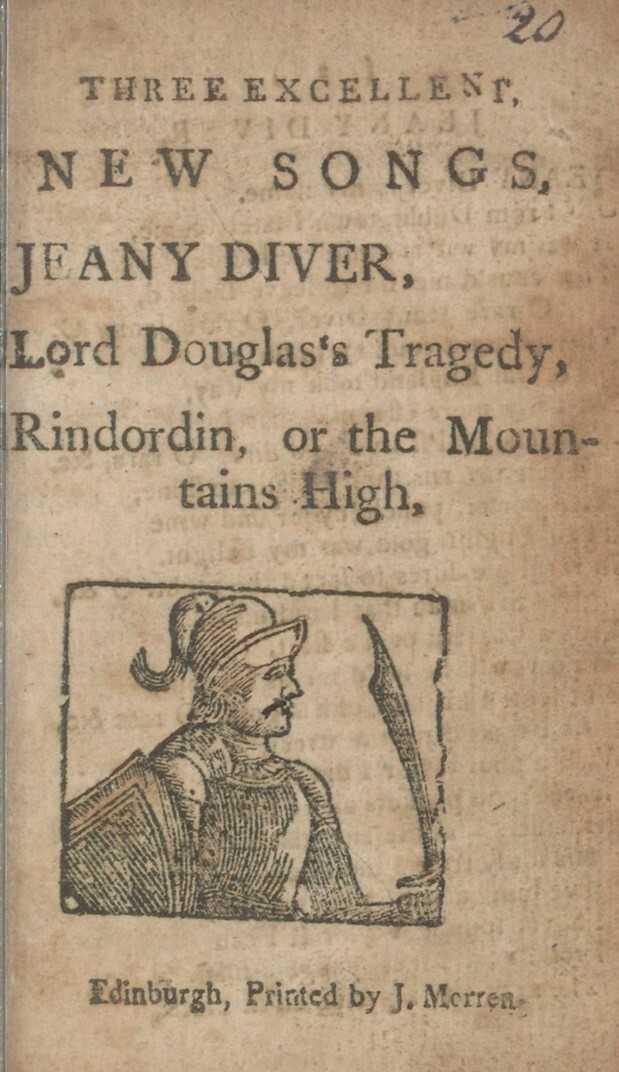
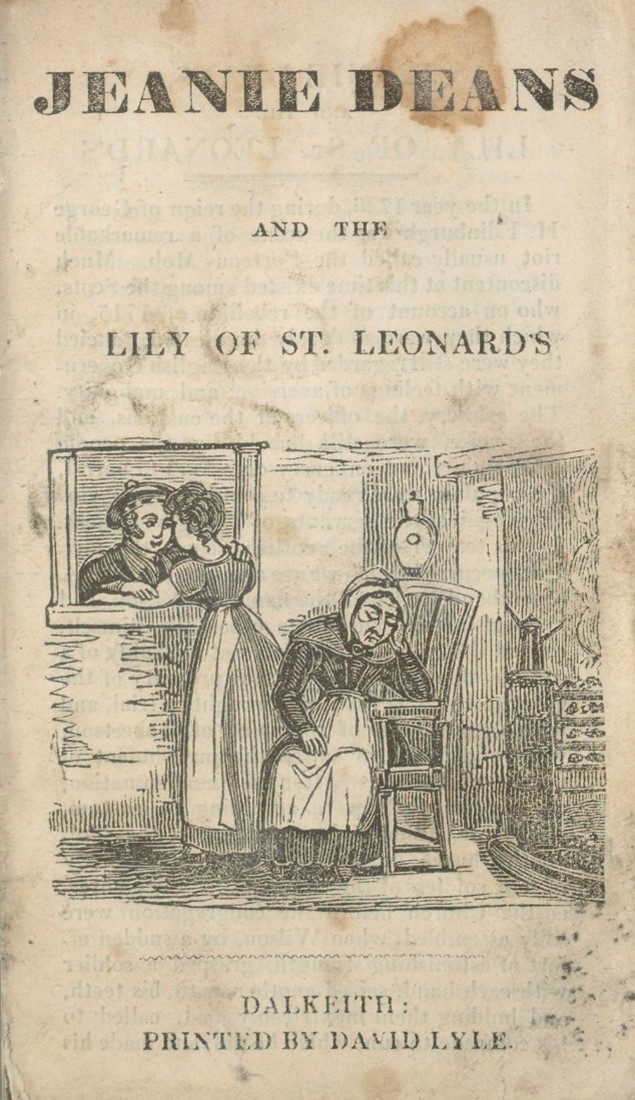
Left: Three excellent new songs, Jeany Diver, Lord Douglas’s tragedy, Rindordin, or the mountains high.
Edinburgh, J. Morren, c. 1800. NLS shelfmark L.C.2805(06)
Right: Jeanie Deans and the lily of St. Leonards. Dalkeith, printed by David Lyle, c. 1860.
NLS shelfmark L.C.2793(2)
Chapbooks were sold for a penny a piece on the street and at fairs and markets, from the printer’s workshops and in coffee houses. Itinerant pedlars known as chapmen bought them wholesale from the printers and sold them on their routes through the country. Through this web of distribution, chapbooks were available in provincial towns and villages as well as farmsteads no matter where they had been produced. They were printed in English, Scots and Gaelic, though only a handful of Gaelic chapbooks survive today.
Because they were so fragile and often went through many hands, their survival rate is very low: a lot are only extant in one or two copies, and we know of hundreds if not thousands of titles only from printers’ testaments and inventories.
Using chapbooks in digital humanities projects: from music to computer vision
We released the Scottish chapbooks collection as a ‘dataset’ in late 2019 on the Data Foundry website. Given the broad timeframe the collection spans, and its extent , this collection holds exciting potential for computational use, enabling changing patterns in language over time to be explored, or providing enough data to begin training a machine learning model.
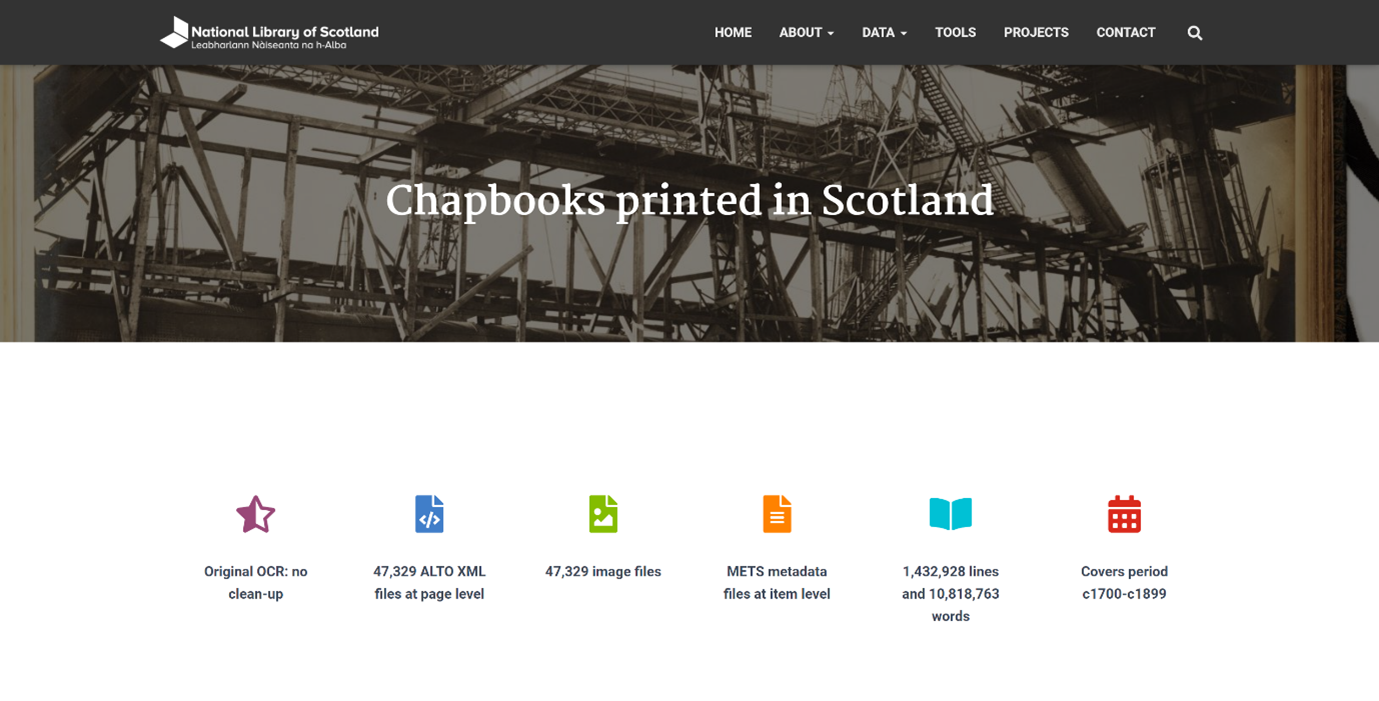
Chapbooks on the Data Foundry
Turning chapbooks into music
One of the first to explore this collection was Dr Shawn Graham (Carleton University, Canada), who spotted the release of the dataset on Twitter. He began experimenting with the collection by creating topic models of the data – a form of statistical modelling which identifies broad themes or ‘topics’ within text – and he detailed the challenges of working with digitised collections, such as the size of the datasets and the quality of OCR
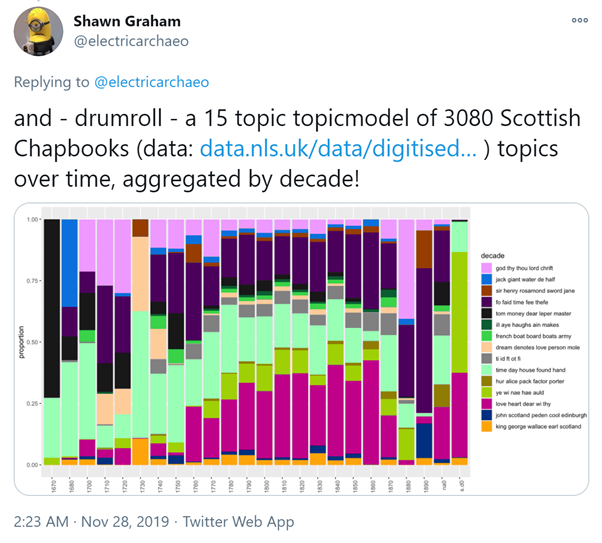
Tweet with initial topic mode of 3000 chapbooks
This topic model identified broad themes, which can be interpreted as ‘love’, ‘war’ and so on… and also ‘messy OCR’. From this, Graham turned the data into music: a sonification (musical data visualisation) of the chapbooks collection, assigning different topics to different musical instruments – far beyond the realms of what the Library had imagined the chapbooks would ever be used for!
More information about this project can be found on the Data Foundry projects page, which links through to Graham’s blog.
Chapbooks meet computer vision
In 2020, Dr Giles Bergel (University of Oxford) was appointed as The National Librarian’s Research Fellow in Digital Scholarship 2020-21. For his project, Bergel is exploring the illustration within the Chapbooks dataset. Following on from the work of the Bodleian Ballads project, this project is using computer vision to ‘match’ images and explore their reuse across collections.
By using these methods, the project asks what can be learnt about chapbooks from their illustrations, and explores the relationship between printers, publishers, distributors and audiences.
More information about this project can be found on the Data Foundry Projects page.
Digital humanities and chapbooks
While there remain endless ‘analogue’ research possibilities from materials such as chapbooks, releasing the Library’s Scottish chapbooks as a dataset has given them a renewed lease of life for new audiences, approaches and methodologies. This is enabling computational research into provenance, subject matter and more – all of which would be beyond the possibilities of the human eye, or take more time than a human could manage.
We’re excited to see what approaches and research questions are asked next!
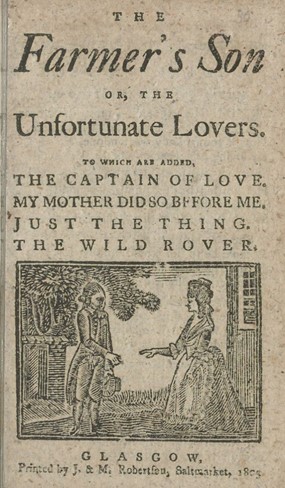
Farmer’s Son or, the Unfortunate Lovers. Glasgow: Printed by J. & M. Robertson 1803
NLS shelfmark L.C.2837(30)
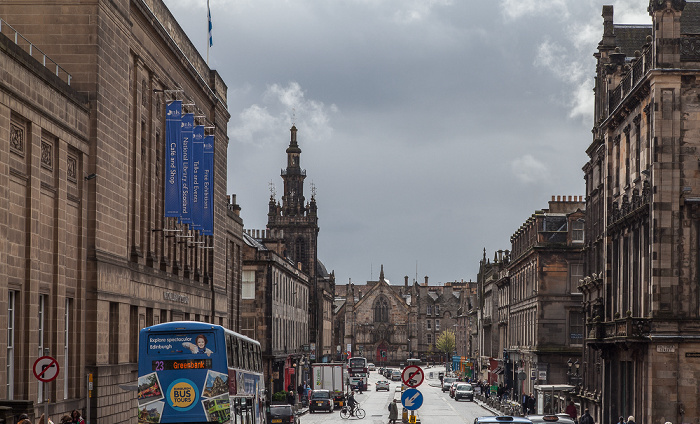
On the left:National Library of Scotland, Edinburgh
Related articles
by Caroline Duroselle-Melish, Angela Dressen and Attilio Bottegal, I Tatti, Harvard
November 9, 2026
by R. Gasteiger, M. Belka, S. Rehberg, S. Schütz, Hanover University of Applied Sciences and Arts
November 9, 2026